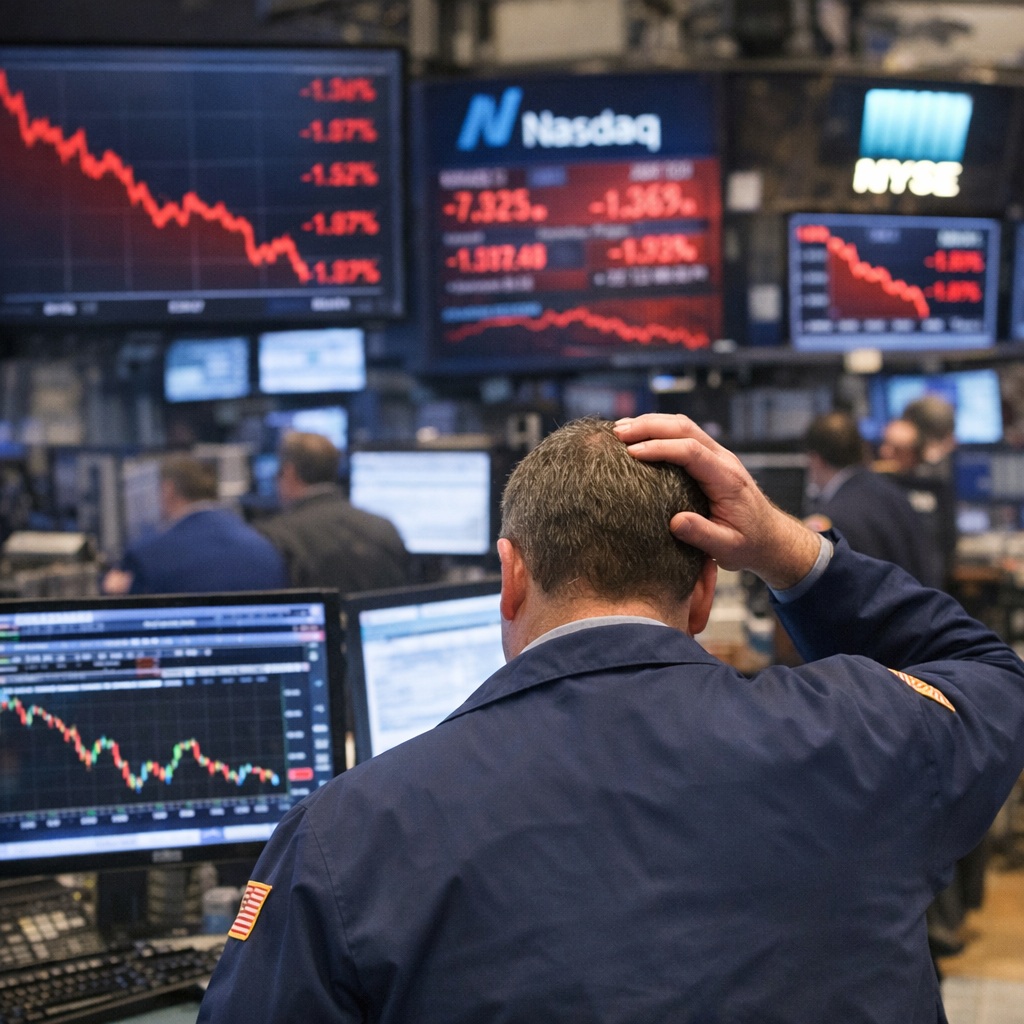
Wall Street’s main indexes soften as investors reassess technology stocks and year-end positioning, with cautious sentiment spreading worldwide.
US stock futures edged lower as the final trading stretch of the year unfolded, signaling a tentative start to the week and a reflective mood among investors recalibrating portfolios. A pullback in technology shares weighed on sentiment, nudging Wall Street’s main indexes off recent highs and echoing across markets in Europe and Asia.
The retreat follows a year marked by sharp gains in artificial intelligence leaders and mega-cap technology firms, whose dominance has defined equity performance. As the calendar turns, traders appear increasingly selective, trimming exposure to crowded trades while locking in profits after a prolonged rally. The result has been a pause that feels less like panic and more like a collective exhale.
Futures tied to the S&P 500 and Nasdaq pointed modestly lower in early dealing, reflecting softness in the same tech names that powered much of the year’s advance. Semiconductor stocks, cloud computing leaders, and high-growth software companies showed signs of fatigue, prompting a rotation into more defensive corners of the market.
Market participants describe the move as a classic year-end adjustment rather than a reversal of conviction. With liquidity thinner and risk appetite subdued, even small shifts in positioning have had outsized effects. “This is a moment for balance,” said one portfolio manager. “Investors are asking what they want to carry forward and what they’re comfortable leaving behind.”
The recalibration in US markets quickly rippled outward. European equities opened lower, mirroring Wall Street’s cautious tone, while Asian markets closed mixed as investors weighed local fundamentals against the signal coming from the US. Technology-heavy benchmarks were particularly sensitive, underscoring the sector’s global interconnectedness.
Beyond equities, the mood of caution extended to other asset classes. Government bond yields steadied as demand for perceived safety ticked up, while the dollar held firm against major currencies. Commodity markets were largely range-bound, reflecting uncertainty rather than a decisive shift in outlook.
At the heart of the reassessment lies a broader question about valuation and sustainability. Technology stocks have delivered exceptional returns, fueled by optimism around productivity gains, automation, and the transformative potential of AI. Yet those expectations now face a higher bar, especially as investors consider whether earnings growth can keep pace with lofty prices.
Policy considerations also remain in focus. Signals from the entity[“organization”,”Federal Reserve”,”us central bank”] have reinforced the idea that monetary conditions will remain restrictive enough to discourage excess risk-taking, even as inflation pressures ease. That balance—between supporting growth and maintaining discipline—continues to shape investor psychology.
As the year draws to a close, many fund managers are more focused on preservation than pursuit. The final sessions often serve as a bridge between what has been and what might come next, a time when strategy overtakes speculation. The current softness, they argue, reflects prudence rather than pessimism.
Looking ahead, investors are preparing for a new year that promises both opportunity and complexity. Earnings season will test the resilience of corporate profits, while geopolitical developments and policy decisions could introduce fresh volatility. For now, markets appear content to slow their pace, digest gains, and reset expectations.
In that sense, the slip in US stock futures is less a warning sign than a reminder of markets’ cyclical nature. After months of momentum, a period of consolidation may offer a healthier foundation. As trading winds down and attention turns forward, the prevailing sentiment is one of cautious optimism—tempered, thoughtful, and keenly aware of the global ties that bind modern markets.




 The Tower Post