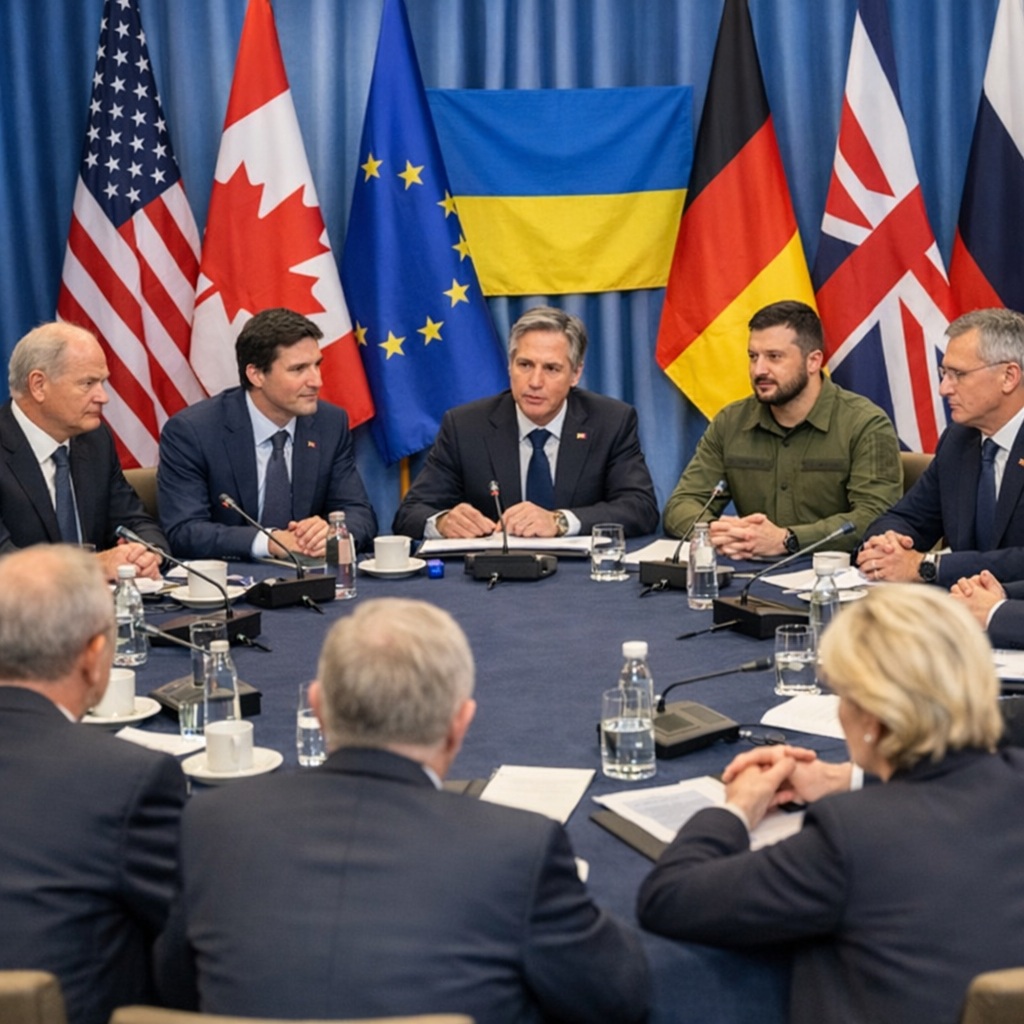
Allied leaders align behind Washington’s diplomatic push, signaling renewed emphasis on negotiated conflict resolution.
Europe and Canada entered the new year with a renewed diplomatic focus on ending the war in Ukraine, joining U.S.-led efforts to explore pathways toward a negotiated peace. Senior officials and heads of government from across the Atlantic convened in a series of coordinated meetings aimed at aligning positions, managing expectations, and reinforcing a shared commitment to ending the conflict that has reshaped European security and strained global stability.
The talks, described by participants as “serious, pragmatic, and outcome-oriented,” reflect a growing recognition among Western allies that diplomacy must complement military support. While there is no indication of a near-term breakthrough, the expanded format — now including key European governments and Canada alongside Washington — underscores a strategic shift toward broader allied ownership of peace initiatives.
At the center of the effort is the United States, which has intensified its role as a diplomatic broker while continuing to coordinate security assistance to Kyiv. European leaders, many of whom have borne the economic and political consequences of the war most directly, have increasingly pressed for a structured diplomatic track that keeps pressure on Moscow while safeguarding Ukrainian sovereignty.
“This is not about freezing the conflict or trading principles for expediency,” said one senior European diplomat involved in the discussions. “It is about testing whether conditions exist — or can be created — for a just and durable peace.”
The inclusion of Canada adds further weight to the initiative. Ottawa has been one of Ukraine’s most consistent supporters since the outset of the war, combining military aid with humanitarian assistance and sanctions enforcement. Canadian officials see participation in peace talks as a logical extension of that role, reinforcing transatlantic unity while amplifying voices committed to international law.
Diplomatic coordination has taken place against a backdrop of continued fighting on the ground. Despite shifting front lines and periodic escalations, the conflict has settled into a grinding war of attrition. For European governments facing war fatigue at home and economic headwinds abroad, the urgency of exploring diplomatic off-ramps has grown.
Yet officials involved in the talks are careful to temper expectations. There is broad agreement that any peace process must be Ukrainian-led and that Kyiv retains full agency over decisions affecting its territory and future. Western leaders insist that negotiations cannot come at the expense of Ukraine’s independence or its right to choose its own security arrangements.
Ukrainian representatives, while welcoming allied diplomatic engagement, have reiterated longstanding red lines. These include full respect for Ukraine’s territorial integrity and credible security guarantees to prevent renewed aggression. Kyiv has made clear that diplomacy, in its view, must be grounded in strength — both on the battlefield and at the negotiating table.
European participants, particularly from countries bordering the conflict zone, have emphasized the regional stakes. The war has prompted the largest military buildup in Europe in decades and reshaped defense planning across the continent. For them, a poorly constructed peace could be as destabilizing as prolonged war.
Still, the very act of coordinated talks marks an evolution. Earlier diplomatic efforts were often fragmented, with parallel initiatives and limited coordination. The current approach seeks to unify messaging, reduce mixed signals, and present a coherent allied framework should negotiations gain traction.
Canada’s role has been especially visible in bridging perspectives between Europe and the United States. Canadian officials have stressed the importance of maintaining pressure through sanctions while leaving open channels for dialogue. They have also highlighted the humanitarian toll of the conflict, advocating for prisoner exchanges, civilian protection measures, and reconstruction planning as confidence-building steps.
Washington, for its part, has framed the talks as exploratory rather than transactional. U.S. officials emphasize that there is no predetermined outcome and no imposed timetable. The objective, they say, is to assess diplomatic space, coordinate allies, and be prepared should an opening emerge.
Russia’s response has been cautious and, at times, dismissive. Kremlin statements have questioned Western sincerity while reiterating demands that allies consider unacceptable. Nonetheless, diplomats note that the existence of a unified allied process could alter calculations over time, particularly if paired with sustained economic and military pressure.
Analysts see the talks as part of a broader recalibration rather than a dramatic pivot. “This is diplomacy catching up with reality,” said a senior fellow at a European think tank. “The war is not ending tomorrow, but allies are laying groundwork so that when conditions change, they are not starting from zero.”
For Europe, the stakes extend beyond Ukraine. The conflict has challenged assumptions about security, energy dependence, and the durability of the rules-based international order. A credible peace process, even a protracted one, could help stabilize markets, reassure publics, and reassert the role of diplomacy in crisis management.
As the year opens, allied leaders appear united in one conclusion: military support and diplomacy are not mutually exclusive, but interdependent. Whether the current talks will yield tangible results remains uncertain. What is clear is that Europe and Canada, alongside the United States, are signaling a shared determination to pursue every responsible avenue toward ending the war — without compromising the principles that define their alliance.
 The Tower Post