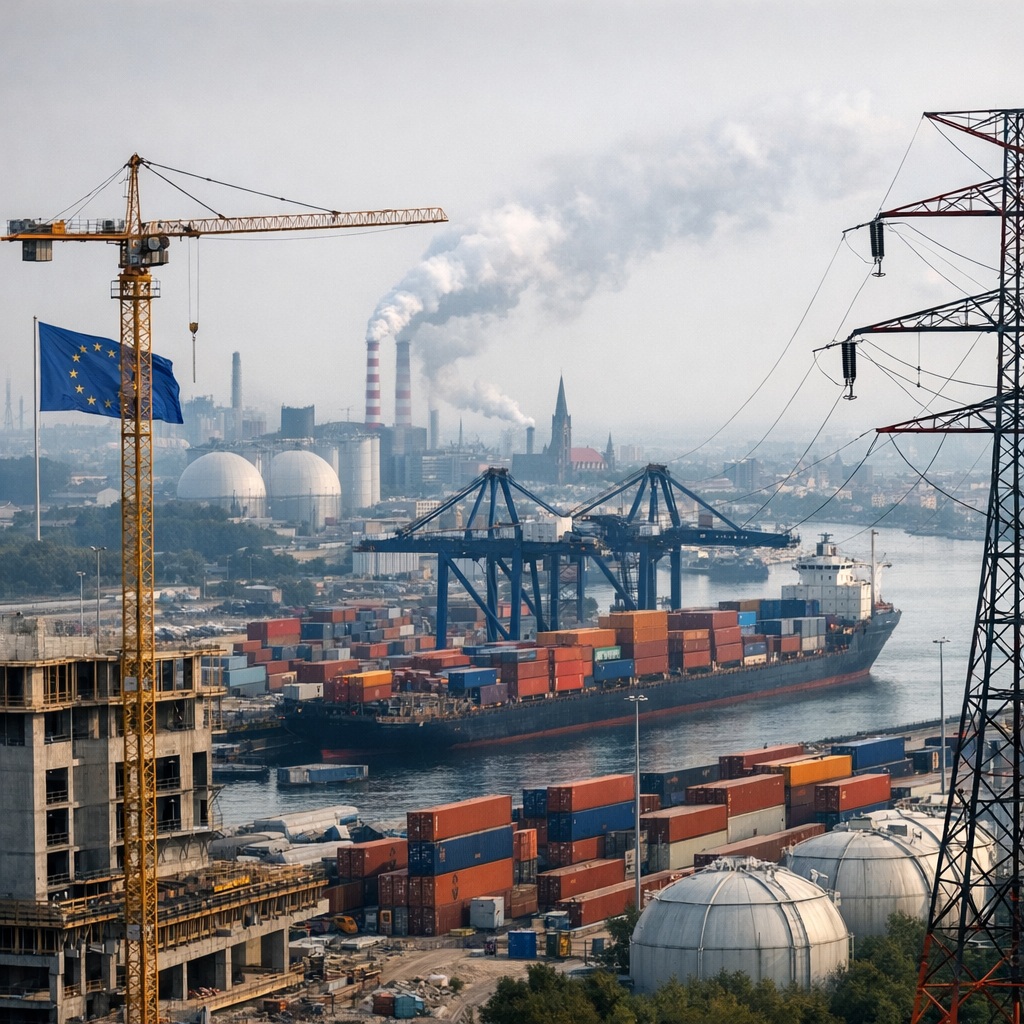
Beyond affordability, tight rules are constricting access to housing, energy, labour and capital goods—posing a quiet but potent threat to Europe’s recovery.
As the new year opens, Europe’s economic debate is shifting. Inflation has eased from its peaks, wage growth has begun to stabilise, and borrowing costs are no longer rising at the pace that unsettled households and businesses alike. Yet across the continent, economists are warning that affordability is no longer the central constraint. Instead, Europe is confronting a deeper and more structural challenge: availability.
From housing to energy, from skilled labour to industrial inputs, shortages are increasingly shaping economic outcomes. The issue is not simply price, but whether goods and services can be obtained at all. In sector after sector, tight regulation, slow permitting and fragmented national rules are constraining supply—undermining investment and threatening to cap growth prospects as Europe moves through the year.
Housing offers the clearest example. Across major cities, demand remains strong, driven by urbanisation, migration and changing household structures. Yet new construction is failing to keep pace. Developers cite complex zoning rules, lengthy environmental assessments and legal uncertainty that can delay projects for years. Even where financing is available, regulatory bottlenecks often make building economically unviable.
The result is a paradox: easing inflation but persistent housing scarcity. Rent controls and tenant protections, while politically popular, have in some markets discouraged new supply and pushed investors elsewhere. Economists argue that without faster permitting and clearer rules, Europe risks locking itself into a chronic housing shortage that weighs on labour mobility and productivity.
Energy is another sector where availability is emerging as the binding constraint. The push to decarbonise has accelerated investment in renewables, but grid expansion and storage capacity have lagged behind. Wind farms and solar parks are approved on paper, yet delayed in practice by local opposition, overlapping authorities and under-resourced regulators.
At the same time, the phase-out of legacy energy sources has reduced system flexibility. Industrial users report difficulties securing long-term, reliable power contracts, complicating investment decisions. While prices have moderated, uncertainty over access is becoming the bigger concern—particularly for energy-intensive manufacturing that underpins Europe’s export base.
Labour markets tell a similar story. Unemployment remains low by historical standards, but firms across healthcare, construction, engineering and digital services report acute shortages of qualified workers. Demographic ageing is shrinking the domestic workforce, while immigration systems remain slow and fragmented.
Professional qualifications are often not recognised across borders, even within the EU. This limits the ability of workers to move where they are most needed. Economists warn that without reforms to training, migration and skills recognition, labour scarcity could become a structural drag on growth rather than a cyclical mismatch.
Industry, too, is feeling the squeeze. Europe’s ambition to re-shore strategic manufacturing—from semiconductors to clean technologies—has collided with reality on the ground. Permitting for new factories can take years, and state aid rules remain complex despite recent relaxations. Companies compare Europe’s regulatory environment unfavourably with faster-moving jurisdictions elsewhere.
Financial conditions, meanwhile, are no longer the primary obstacle they were. With monetary policy stabilising and the ECB signalling a more predictable stance, access to capital has improved. Yet money alone cannot overcome regulatory inertia. Projects stall not for lack of funding, but for lack of approvals.
National governments acknowledge the problem, but progress is uneven. Some countries have announced permitting “fast lanes” for strategic projects, while others remain cautious, constrained by legal traditions and local resistance. In larger economies such as Germany and France, debates over planning reform have become politically charged, pitting environmental protection against economic urgency.
Economists caution that an availability crisis can be more damaging than an affordability one. High prices can, in theory, attract new supply. Scarcity created by rigid rules cannot. When firms and households doubt that housing, energy or labour will be available when needed, they delay decisions, dampening investment and consumption alike.
As Europe looks ahead, the risk is not a sudden downturn, but a slow erosion of potential growth. Without tackling the regulatory roots of scarcity, recovery efforts may fall short, leaving the continent stable but stuck. The challenge for policymakers is clear: safeguarding standards while allowing supply to respond. In the year ahead, Europe’s economic fate may hinge less on how much things cost, and more on whether they can be found at all.


 The Tower Post