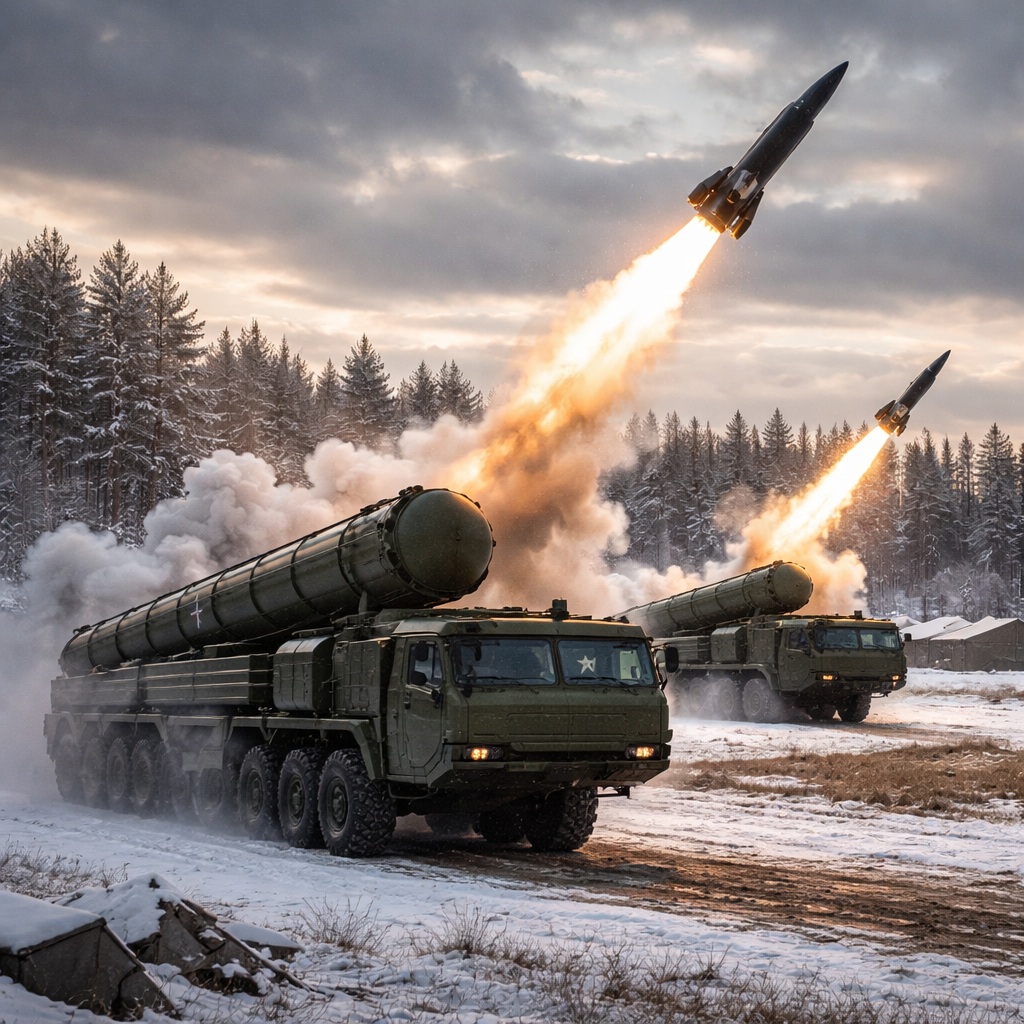
Moscow’s decision to station nuclear-capable Oreshnik systems in Belarus sharpens Western scrutiny and raises fears of escalation linked to the war in Ukraine.

As winter settles across Eastern Europe, a new development has injected fresh urgency into an already volatile security environment. Russia has confirmed the deployment of hypersonic missile systems on Belarusian territory, a move that Western governments and military analysts say underscores a hardening posture toward NATO and a willingness by Moscow to broaden the strategic geography of the conflict surrounding Ukraine.
According to Russian officials, the missiles involved are part of the Oreshnik program, a new generation of nuclear-capable hypersonic weapons designed to evade modern air defenses through extreme speed and maneuverability. While Moscow has offered few technical details, the placement of such systems in Belarus represents a significant shift in regional force posture, effectively pushing high-end strike capabilities closer to NATO’s eastern borders.
Belarusian authorities have publicly framed the deployment as a defensive measure, citing what they describe as sustained pressure and military activity by Western alliances near their borders. President Alexander Lukashenko, a close ally of the Kremlin, has repeatedly emphasized Belarus’s reliance on Russia for security guarantees. Hosting advanced missile systems, he argues, strengthens deterrence and ensures that Belarus is not left exposed in an increasingly polarized Europe.
Western officials see the move differently. In Brussels, NATO representatives have characterized the deployment as destabilizing, warning that hypersonic weapons compress decision-making timelines and increase the risk of miscalculation. Unlike traditional ballistic missiles, hypersonic systems fly at lower altitudes and can change course mid-flight, making them harder to detect and intercept. This technological edge, analysts say, magnifies their psychological and strategic impact.
The decision also reinforces Belarus’s role as a forward operating space for Russian forces. Since the early stages of the Ukraine war, Belarus has provided logistical support, training grounds, and airspace access for Russian military operations. Stationing hypersonic missiles there deepens that integration and blurs the line between national and allied assets, complicating efforts by Western intelligence services to assess intent and capability.
For Ukraine, the development adds another layer of uncertainty. Although there has been no indication that the missiles are intended for immediate use, their presence expands the range of potential strike vectors. Ukrainian defense officials have cautioned that any increase in Russian strategic capabilities near their borders must be treated seriously, particularly as the conflict shows few signs of resolution and periodic escalations continue along the front lines.
Military experts note that the deployment is as much about signaling as it is about battlefield utility. By placing cutting-edge weapons in Belarus, Moscow sends a message to NATO capitals that it retains escalation options beyond Ukraine itself. The move also serves domestic audiences, reinforcing the narrative of Russia as a besieged power responding to Western encroachment with technological prowess and strategic resolve.
At the same time, questions remain about the operational readiness and scale of the deployment. Hypersonic weapons are expensive, complex, and difficult to produce in large numbers. Some analysts caution against assuming that a limited number of deployed systems fundamentally alters the balance of power. Instead, they argue, the psychological effect and political symbolism may outweigh immediate military advantages.
European governments are responding with a mix of caution and restraint. While NATO has reiterated its commitment to collective defense and ongoing support for Ukraine, officials have been careful to avoid steps that could be interpreted as provocative. Diplomatic channels remain open, even as military planners quietly reassess contingency scenarios along the alliance’s eastern flank.
The deployment also raises broader questions about arms control and strategic stability. Existing treaties do not comprehensively address hypersonic weapons, leaving a regulatory gap at a time when major powers are racing to develop and field them. Calls for renewed dialogue on strategic weapons have grown louder among experts, though prospects for meaningful negotiations remain uncertain amid deep mistrust between Russia and the West.
In Minsk, public reaction has been muted, shaped by a tightly controlled media environment and longstanding alignment with Moscow. Nonetheless, the presence of nuclear-capable systems on Belarusian soil marks a profound step, one that could have long-term implications for the country’s sovereignty and security calculus.
As the new year begins, the deployment of Oreshnik missiles in Belarus stands as a stark reminder that the conflict linked to Ukraine continues to reverberate far beyond the battlefield. With hypersonic weapons now part of the regional equation, the stakes have risen, and the margin for error has narrowed. Whether this latest move serves primarily as deterrence or becomes a precursor to further escalation will depend on decisions made in the months ahead, in capitals where patience is thin and trust is scarce.