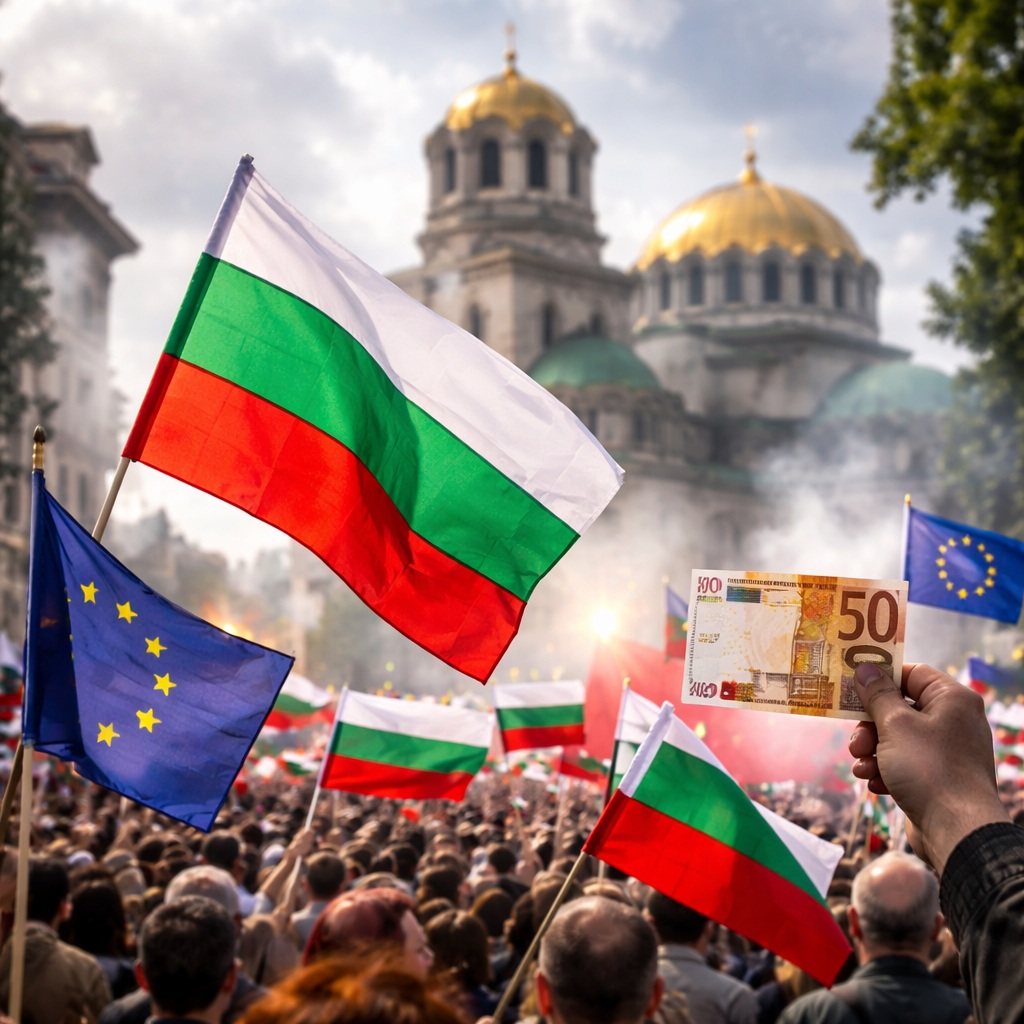
A historic monetary shift collides with governance paralysis, testing public trust and the European Union’s promise of cohesion
SOFIA — Streets that should have echoed with unambiguous celebration carried a more complicated sound this week: applause mixed with whistles, flags waving alongside protest banners. Bulgaria has joined the euro area, sealing a long-sought milestone in its European integration. Yet the adoption of the common currency arrives against a backdrop of political instability, institutional fatigue, and public skepticism that threatens to overshadow the moment.
For years, euro entry was framed by successive governments as proof that Bulgaria belonged firmly in the European mainstream — fiscally disciplined, economically convergent, and politically reliable. On paper, the transition fulfills technical commitments made when the country joined the European Union. In practice, it comes at a time when Bulgaria lacks a stable government, operates without a fully approved state budget, and remains trapped in a cycle of frequent elections that have failed to produce lasting parliamentary majorities.
The contrast has been stark. Official ceremonies emphasized continuity and confidence, with leaders describing the euro as a shield against economic shocks and a catalyst for investment. Outside, demonstrators voiced frustration not only with rising prices they fear may follow the changeover, but with what they see as a political class incapable of governing regardless of the currency in citizens’ wallets.
“I don’t feel richer because my money looks European,” said a pensioner attending a small protest near the city center. “What matters is whether anyone is responsible for how the country is run.”
This sentiment captures a broader unease. While economists point out that Bulgaria’s currency had long been pegged to the euro, limiting immediate macroeconomic disruption, many households worry about price rounding, stagnant wages, and the erosion of purchasing power. These fears are amplified by a lack of trust in institutions meant to regulate markets and protect consumers — a trust weakened by years of corruption scandals and short-lived governments.
Political paralysis has become almost routine. Elections have come and gone with little resolution, producing fragmented parliaments and fragile coalitions. Without a durable majority, key reforms have stalled, including those linked to judicial independence and public sector accountability. The absence of a clear budget framework has further strained confidence, leaving municipalities, businesses, and social services navigating uncertainty.
The euro, in this context, risks becoming a symbol of dissonance: a marker of European success layered onto domestic dysfunction. Supporters argue that the discipline of the common currency will impose stability from the outside, forcing better governance and anchoring Bulgaria more firmly to European decision-making. Critics counter that monetary integration cannot substitute for political legitimacy or administrative capacity.
At the European level, Bulgaria’s moment resonates beyond its borders. The country’s entry revives long-running debates within the European Union about enlargement, cohesion, and the balance between technical readiness and political maturity. As Brussels weighs future accessions and deeper integration, Bulgaria’s experience underscores the tension between meeting formal criteria and sustaining democratic trust at home.
Some EU officials view the euro adoption as a strategic affirmation that integration remains open and credible, even for member states facing internal challenges. Others quietly worry that celebrating monetary milestones without parallel political stability risks fueling euroskeptic narratives, both in Bulgaria and elsewhere.
On Sofia’s streets, these abstract debates translate into everyday questions: Will salaries keep pace with costs? Will elections finally produce accountable leadership? Will the euro bring opportunity, or simply make existing inequalities more visible?
For now, Bulgaria stands at a crossroads. The new currency in circulation represents decades of aspiration and alignment with Europe’s core. The protests, however, reflect a population increasingly impatient with promises that seem disconnected from lived reality. Whether the euro becomes a foundation for renewed confidence or another chapter in political disillusionment will depend less on exchange rates than on the country’s ability to break its cycle of instability.
As celebrations fade and daily routines resume, Bulgaria’s challenge is clear: to ensure that European integration is not just a matter of currency, but of governance that delivers stability, transparency, and tangible improvement in citizens’ lives.


 The Tower Post