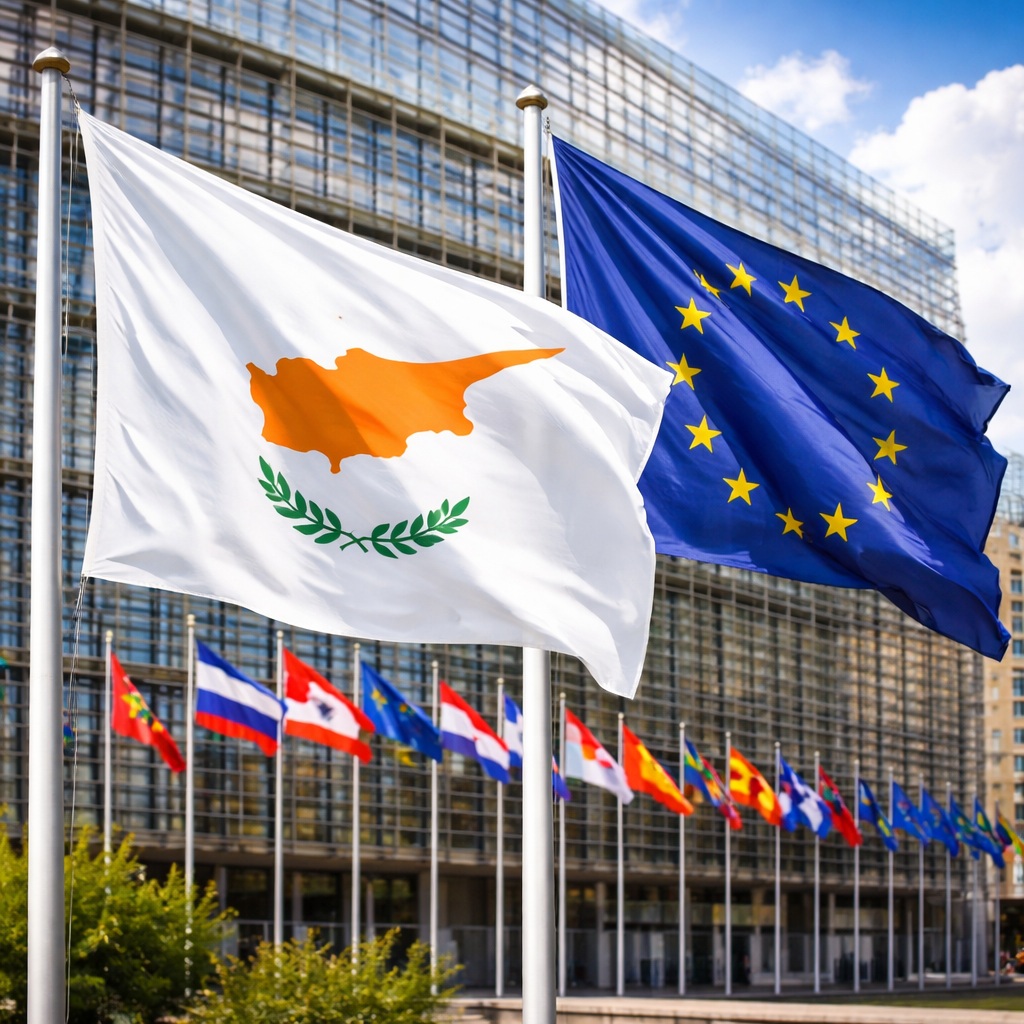
As it assumes the EU Council presidency, Nicosia signals a more outward-looking Union focused on strategic autonomy, security, and diplomacy beyond its borders.

Cyprus entered the new year with a rare opportunity and a clear message. Taking over the rotating presidency of the Council of the European Union, the island nation has pledged to bring what officials describe as a “different mindset” to Brussels—one that looks beyond internal management and toward Europe’s role in an increasingly fragmented global order.
For Cyprus, the presidency is not only a procedural responsibility but also a statement of intent. Government leaders have framed their term as a chance to reinforce European unity while expanding the Union’s diplomatic reach in regions that are gaining strategic importance. At a time of shifting alliances, protracted conflicts, and economic uncertainty, the Cypriot agenda reflects a belief that the European project must become more assertive abroad to remain resilient at home.
A presidency shaped by geography and experience
Cyprus’s approach is deeply influenced by its geographic position at the crossroads of Europe, the Middle East, and North Africa. Long accustomed to navigating complex regional dynamics, Nicosia argues that the EU must develop a sharper understanding of its southern and eastern neighbourhoods. This perspective is expected to shape discussions on foreign policy coordination, energy security, and migration management throughout the presidency.
Central to Cyprus’s priorities is the concept of European strategic autonomy. While firmly committed to transatlantic cooperation, Cypriot officials stress that Europe must strengthen its capacity to act independently in critical areas such as defence, supply chains, and technology. The presidency plans to push for closer coordination between EU institutions and member states to ensure that strategic autonomy complements, rather than undermines, existing alliances.
Security remains a unifying theme
Security considerations run through nearly every aspect of the Cypriot programme. Continued support for the EU’s collective security objectives, including assistance to partners facing external threats, is positioned as a non-negotiable priority. Cyprus has underlined the need for sustained political and economic backing for European security commitments, arguing that credibility abroad depends on consistency at home.
At the same time, the presidency aims to broaden the EU’s diplomatic engagement beyond its traditional focus areas. Greater involvement in the wider Middle East is seen as essential, not only to address ongoing instability but also to manage its spillover effects on Europe. Cyprus has also identified deeper engagement with India as a strategic objective, reflecting Europe’s interest in diversifying partnerships and strengthening ties with emerging global powers.
Relations with Turkey test the unity message
Cyprus’s assumption of the presidency inevitably draws attention to its long-standing tensions with Turkey. Despite unresolved disputes, Cypriot leaders have been careful to strike a conciliatory tone, emphasising that their role requires impartiality and a commitment to European unity. The presidency, they say, will not be used to advance bilateral grievances but to promote dialogue grounded in international law and EU principles.
This balancing act will be closely watched in Brussels and beyond. Cyprus’s ability to separate national sensitivities from its institutional responsibilities is seen as a test of its credibility as an honest broker during its term.
An outward-looking Europe
More broadly, the Cypriot presidency seeks to reinforce the idea of the European Union as a global actor with a coherent voice. From trade and energy to climate diplomacy and crisis management, officials argue that Europe must engage more decisively with partners across regions. Outreach to Africa, the Gulf, and the Indo-Pacific is framed as part of a long-term effort to align European values with pragmatic cooperation.
As Cyprus settles into its role, expectations remain measured. Smaller member states traditionally face constraints in driving sweeping change. Yet Cyprus appears determined to use its moment at the helm to shape conversations about where Europe is heading and how it engages with the world.
In an era defined by uncertainty, Cyprus’s presidency is less about grand gestures and more about direction. By advocating unity, strategic autonomy, and broader global engagement, Nicosia is signalling that the European Union cannot afford to look inward. The months ahead will show whether this outward-looking vision can translate into lasting momentum for Europe’s global role.