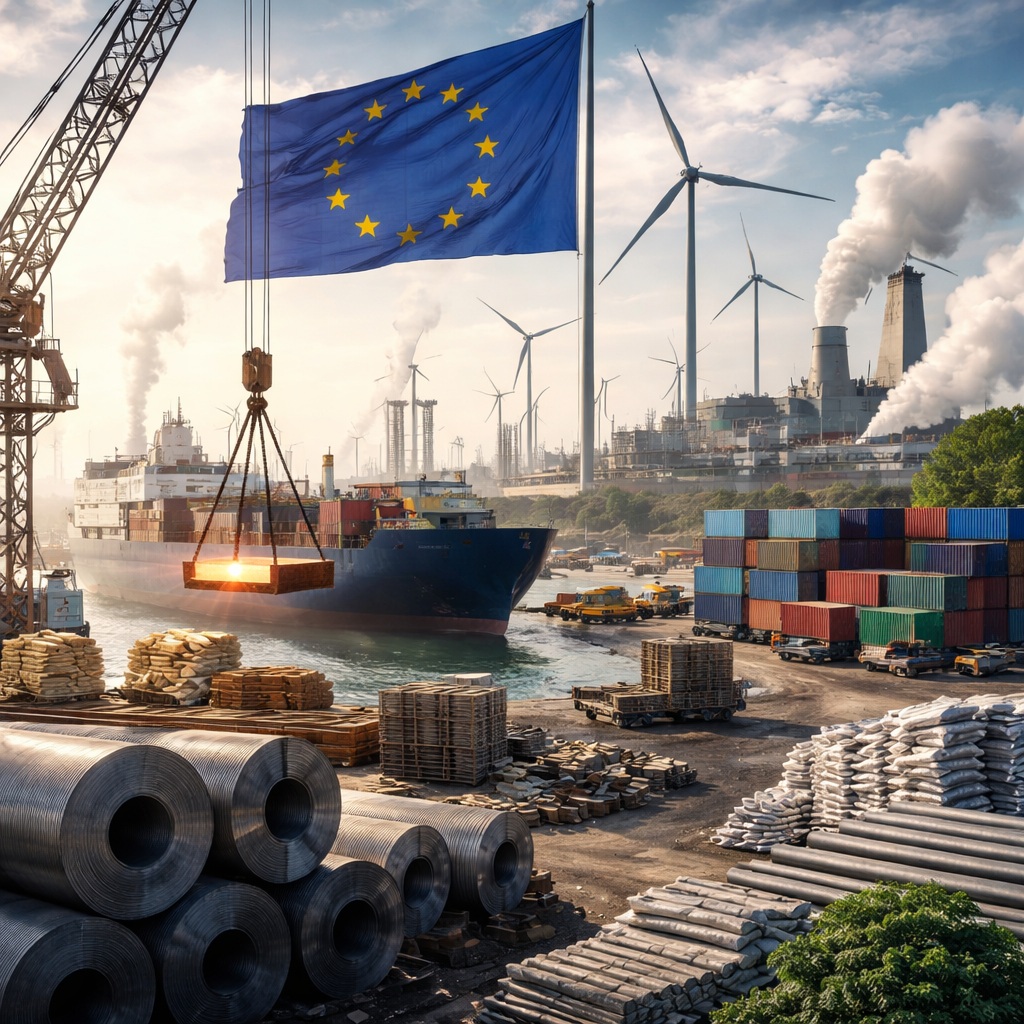
Green tariffs enter force as Brussels rewrites the rules of global trade

By early January, Europe has crossed a symbolic threshold in its climate policy. The European Union has begun applying carbon charges at its borders, turning years of regulatory debate into a concrete trade instrument. The Carbon Border Adjustment Mechanism, or CBAM, now places a price on the carbon embedded in some of the most emissions‑intensive goods entering the EU market, from steel and cement to aluminium and fertilisers.
The move is designed to mirror the costs already borne by European manufacturers under the bloc’s climate rules. For policymakers in Brussels, the logic is straightforward: if European industry must pay for its pollution, foreign competitors should not gain an advantage by producing under looser environmental standards.
A CLIMATE TOOL WITH TRADE CONSEQUENCES
At its core, CBAM seeks to address what economists call “carbon leakage” — the risk that companies relocate production to countries with weaker climate policies, exporting emissions rather than reducing them. European officials argue that leakage undermines both climate ambition and industrial competitiveness.
Under the new system, importers must declare the greenhouse gas emissions associated with their products and purchase certificates reflecting the equivalent carbon price faced by EU producers. The intention is not only defensive but also diplomatic: to encourage trading partners to adopt cleaner production methods and, eventually, comparable carbon pricing systems.
“This is about fairness,” European Commission officials have repeatedly said. “The climate effort cannot stop at the EU’s borders.”
INDUSTRY ON EDGE
European heavy industry has largely welcomed the principle, seeing CBAM as a long‑awaited shield against cheaper, high‑carbon imports. Steelmakers and cement producers, long exposed to global competition, argue that without border measures, Europe’s climate ambition risks hollowing out its own industrial base.
Yet the enthusiasm is cautious. The administrative burden of calculating emissions across complex supply chains remains heavy, and companies worry about uneven enforcement. Smaller importers, in particular, fear being caught between climate compliance and rising costs.
Outside Europe, reactions are more defensive. The United Kingdom, closely tied to EU supply chains, is weighing how CBAM interacts with its own emissions trading system. China, a major exporter of steel and aluminium, has warned against what it sees as disguised protectionism. In Washington, officials acknowledge the climate rationale but remain wary of trade friction, especially in the absence of a federal carbon price.
A TEST FOR GLOBAL RULES
CBAM sits at the intersection of climate policy and international trade law, a notoriously sensitive fault line. Critics argue that carbon border tariffs risk violating the principles of non‑discrimination enshrined in the World Trade Organization. Brussels counters that the mechanism is carefully designed to treat domestic and foreign producers equally, basing charges solely on carbon content.
Legal challenges are possible, but so far, most governments are choosing to watch rather than confront. The complexity of the system — and the political cost of opposing climate action outright — has tempered early resistance.
What is clear is that CBAM is already reshaping conversations far beyond Europe. Several countries are accelerating discussions on carbon pricing, motivated less by environmental idealism than by the desire to avoid paying at the EU border.
FROM POLICY TO PRACTICE
The first days of implementation are as much about learning as enforcement. Customs authorities, importers and regulators are navigating new reporting requirements, while data gaps and methodological disputes remain common. Brussels insists the system will be refined over time, with technical guidance evolving as experience accumulates.
Environmental groups, meanwhile, caution against complacency. They argue that CBAM must complement, not replace, domestic climate action and industrial decarbonisation. Without continued investment in clean technologies, border measures alone will not deliver Europe’s climate goals.
A SIGNAL BEYOND EUROPE
More than a tariff, CBAM is a signal — that climate policy is no longer confined to environmental ministries but embedded in the mechanics of global trade. For supporters, it marks a turning point, proving that ambitious climate rules can coexist with industrial strategy. For critics, it is a risky experiment that could fragment trade relations in an already tense geopolitical landscape.
As the year opens, one thing is certain: Europe has put carbon at the border, and the world is paying attention.



 The Tower Post