After Bulgaria’s euro adoption, neighbouring EU states weigh stability, sovereignty, and timing as Europe’s currency future grows more fragmented.

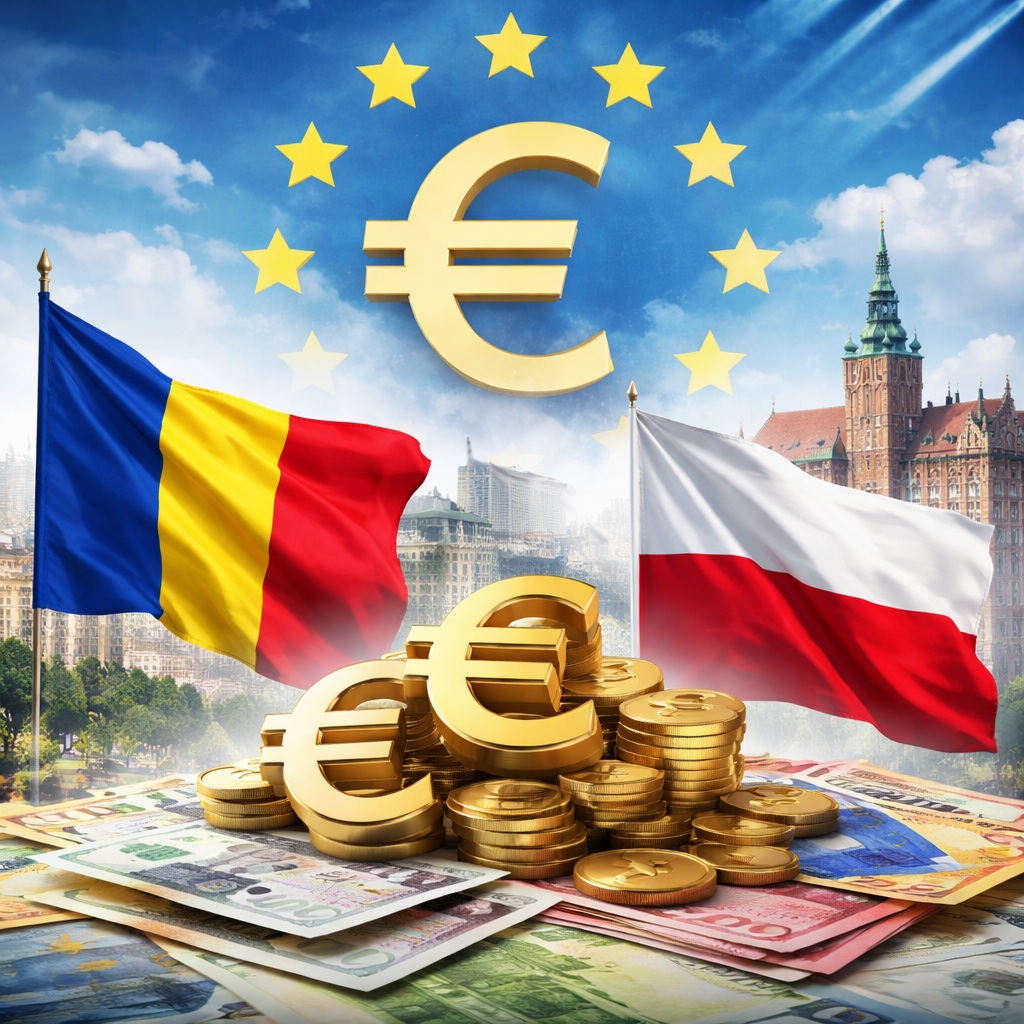
As Europe enters the new year with cautious optimism and lingering uncertainty, the eurozone’s outer edges tell a story of uneven convergence. The recent adoption of the single currency by Bulgaria has refocused attention on the European Union’s remaining non-euro members, particularly Romania and Poland. While both countries are deeply integrated into the EU’s economic fabric, their paths toward the euro are shaped by starkly different domestic realities—and by a broader reassessment of what monetary union now represents.
For Romania, the challenge is primarily fiscal. Despite years of robust growth and expanding trade links within the EU, the country continues to wrestle with structural weaknesses in public finances. Persistent budget imbalances, driven by rising social spending, wage pressures, and limited tax collection efficiency, have kept Romania outside the convergence criteria required for euro adoption. Policymakers in Bucharest formally maintain the objective of joining the eurozone, but in practice the timeline remains elusive. The emphasis, increasingly, is on stabilising public finances and preserving economic credibility rather than setting ambitious entry targets.
The contrast with Bulgaria is instructive. Sofia’s successful transition to the euro followed years of policy discipline and participation in the exchange-rate mechanism, reinforcing the perception that euro adoption is less about geography and more about sustained institutional commitment. For Romania, the lesson is clear but politically difficult: fiscal consolidation demands trade-offs that are hard to sell domestically, particularly in a climate of social expectations and electoral sensitivity.
Poland’s position is different—and, in many ways, more deliberate. As the largest economy in the EU outside the eurozone, Poland has the scale and policy autonomy to chart its own course. Successive governments have cooled earlier enthusiasm for adopting the single currency, framing the zloty as a tool of economic resilience rather than a temporary arrangement. The experience of recent shocks has strengthened arguments that monetary sovereignty allows greater flexibility in responding to crises, even at the cost of exchange-rate volatility.
Public opinion and political rhetoric in Warsaw reflect this recalibration. The euro is no longer presented as an inevitable milestone of European integration but as a strategic choice that must clearly serve national interests. With no active preparations underway, Poland’s eurozone accession has effectively been placed on an indefinite horizon, pending a shift in both political consensus and perceptions of risk.
Together, Romania and Poland illustrate the evolving nature of Europe’s monetary project. The eurozone remains a powerful anchor for integration, yet its appeal is no longer uniform. For some countries, the obstacle lies in meeting demanding economic standards; for others, it is a question of whether the benefits still outweigh the constraints.
This divergence points to a more fragmented outlook for Europe’s currency union. Rather than a single, linear path toward euro adoption, the continent now exhibits a mosaic of priorities shaped by domestic politics, fiscal capacity, and lessons drawn from recent crises. As the EU reflects on its future architecture, the experiences of Romania and Poland suggest that the next phase of eurozone enlargement—if it comes at all—will be slower, more selective, and deeply conditioned by national choice.