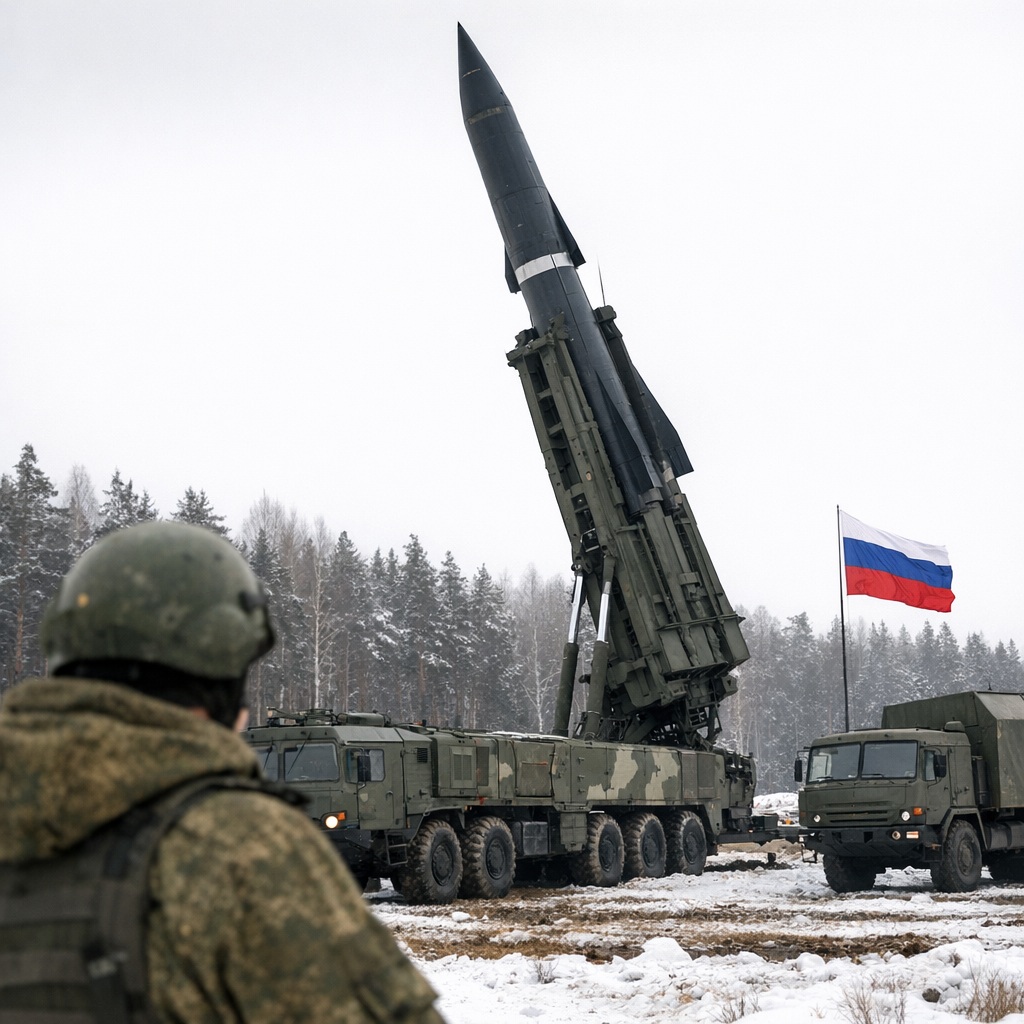
Moscow’s decision to station nuclear-capable hypersonic systems on NATO’s doorstep signals a sharper phase of confrontation as the Ukraine war continues to reshape Europe’s security landscape.
As the new year unfolds under the shadow of war in Eastern Europe, Russia has taken a step that is reverberating through Western capitals. Moscow has confirmed the deployment of its hypersonic Oreshnik missile systems on Belarusian territory, a move that significantly expands its strategic reach and intensifies concerns over regional stability.
The deployment, carried out with the consent of Belarusian authorities, places nuclear-capable missiles closer to the eastern flank of NATO than at any point since the end of the Cold War. While Russian officials describe the move as defensive and “purely deterrent,” European governments and military planners see it as a deliberate escalation designed to alter the balance of power on the continent.
Hypersonic weapons such as the Oreshnik are designed to travel at extreme speeds while maneuvering unpredictably, making them difficult to track and intercept with existing missile defense systems. Their presence in Belarus effectively compresses warning times for neighboring countries, raising the stakes in any future crisis.
Western intelligence assessments suggest the systems are likely integrated into Russia’s broader strategic forces, even if no nuclear warheads are believed to be permanently stationed alongside them. The ambiguity surrounding their operational status is itself a source of anxiety, forcing NATO to assume worst-case scenarios in its planning.
Belarus, long a close ally of Moscow, has become an increasingly central player in Russia’s military posture since the outbreak of the war in Ukraine. Russian troops, aircraft, and now advanced missile systems have all used Belarusian territory, blurring the line between the two countries’ defense infrastructures. Minsk insists it remains committed to avoiding direct involvement in the conflict, but its hosting of strategic weapons tells a more complex story.
For NATO members bordering Belarus, the development is deeply unsettling. Officials in the Baltic states and Poland have warned that the deployment represents a qualitative shift rather than a routine military adjustment. Hypersonic missiles, they argue, are not just another piece of hardware but a tool that can undermine deterrence by reducing decision-making time during crises.
The European Union has echoed these concerns, framing the deployment as part of a broader pattern of Russian pressure on Europe’s security order. Diplomatic channels remain open, but officials privately acknowledge that trust between Moscow and the West is at its lowest point in decades.
Russia’s leadership, for its part, has framed the move as a response to NATO’s own military posture. The Kremlin frequently cites the expansion of alliance infrastructure and the supply of advanced weapons to Ukraine as justification for strengthening its forward defenses. In this narrative, Belarus is portrayed as a vulnerable ally that requires additional protection.
Military analysts say the reality is more complex. By placing hypersonic missiles in Belarus, Russia gains both strategic depth and political leverage. The deployment sends a clear message that Moscow is willing to push advanced capabilities closer to NATO borders, raising the costs of any further Western involvement in the region.
The timing is also significant. As the war in Ukraine drags on with no clear resolution in sight, both sides are increasingly focused on long-term positioning rather than short-term battlefield gains. The Oreshnik deployment appears aimed at shaping the strategic environment for the years ahead, signaling that Russia intends to remain a dominant military actor in Eastern Europe.
Within NATO, discussions are already underway about how to respond. While alliance officials have been careful to avoid inflammatory rhetoric, there is little doubt that the deployment will influence future defense planning, including air and missile defense investments and troop deployments along the eastern flank.
Some analysts caution against overreaction, noting that Russia has long possessed the ability to strike European targets from its own territory. From this perspective, the Belarus deployment is more about signaling than fundamentally changing military realities. Others disagree, arguing that proximity matters, especially when dealing with weapons that drastically shorten response times.
Public opinion across Europe reflects this tension. In countries closest to Belarus, fears of becoming front-line states once again are palpable. Elsewhere, the deployment reinforces a growing sense that the continent is entering a prolonged period of instability, where the norms and assumptions of the post–Cold War era no longer apply.
As winter grips Eastern Europe, the presence of hypersonic missiles in Belarus stands as a stark reminder of how quickly the security landscape has shifted. What was once unthinkable has become reality, and the challenge for European leaders now is to navigate this new environment without allowing deterrence to slide into dangerous escalation.
The Oreshnik missiles may never be fired in anger, but their deployment has already achieved one objective: forcing Europe and its allies to confront a harsher strategic reality at the dawn of the new year.




 The Tower Post