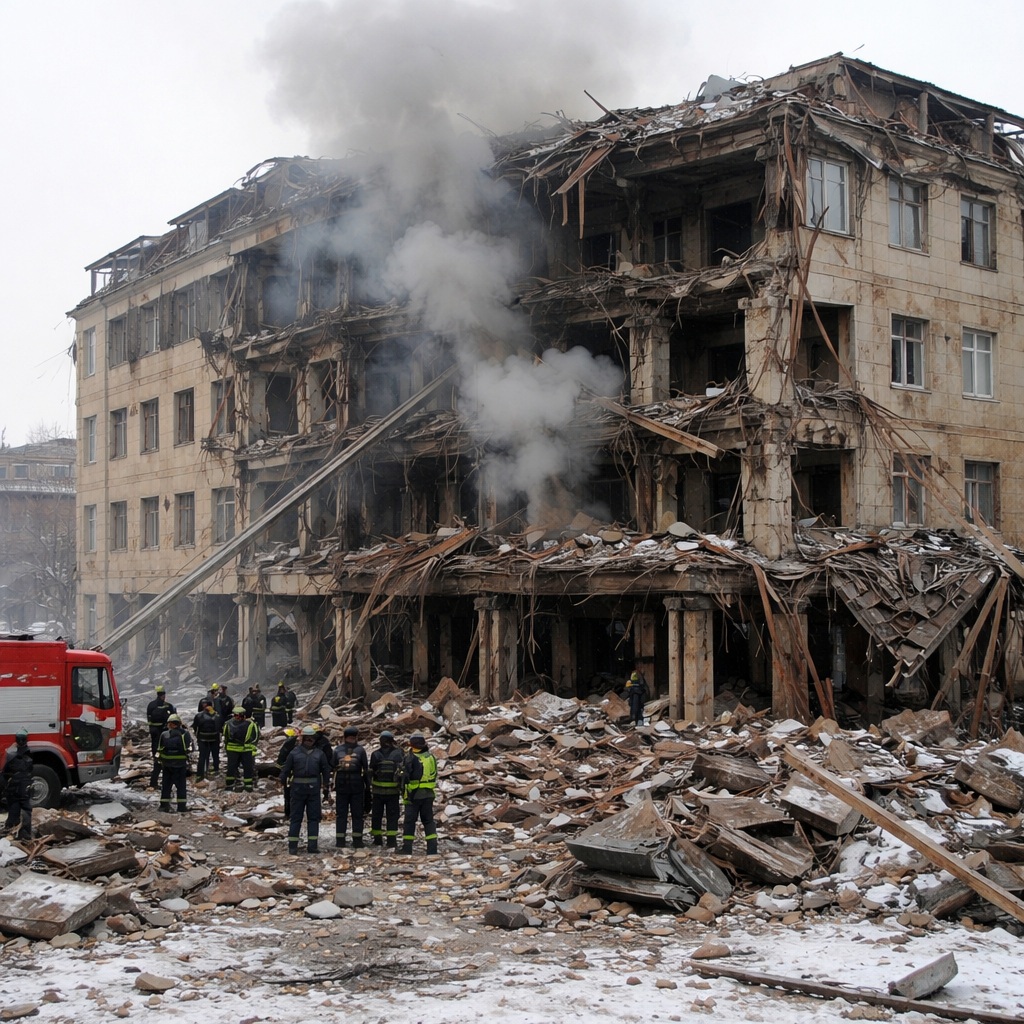
Ukraine rejects Moscow’s claims over a lethal blast in the southern city, as both sides trade accusations and civilian harm again dominates the narrative of war.

KYIV — Ukrainian authorities have forcefully denied Russian allegations that Kyiv’s forces deliberately targeted a hotel in the southern city of Kherson, after a deadly strike killed dozens of people and reignited international concern over the protection of civilians in the nearly four-year war.
The blast, which tore through a multi‑story hotel near the center of Kherson, sent shockwaves across Ukraine and beyond. Video footage circulating on social media showed shattered windows, scorched facades, and rescue workers sifting through debris as sirens wailed through the night. Russian officials were quick to claim the strike was a calculated Ukrainian attack on civilian infrastructure. Kyiv dismissed the accusation as “disinformation” and accused Moscow of manipulating the tragedy to obscure its own military actions in the region.
Ukrainian military spokespeople said their forces had not conducted any strike on the hotel and suggested the explosion was either the result of Russian shelling, a misfired air-defense interceptor, or an internal blast linked to Russian military use of civilian buildings. “Ukraine does not target civilian hotels,” a senior defense official said, speaking on condition of anonymity due to the sensitivity of the incident. “We adhere to international humanitarian law, even as Russia continues to violate it daily.”
Kherson, a strategic port city on the Dnipro River, has remained a focal point of fighting despite shifting front lines elsewhere in the country. Since Ukrainian forces retook the city earlier in the war, it has been subjected to persistent shelling from Russian positions across the river. Civilians who remained in Kherson have lived under near‑constant threat, with residential buildings, markets, and medical facilities repeatedly struck.
Russian authorities, however, presented a different account. Officials in Moscow claimed the hotel was housing military personnel and foreign advisers, framing the strike as a legitimate act of war. State media amplified these assertions, while also accusing Ukraine of attempting to conceal the “truth” by blaming Russia for the destruction. Independent verification of these claims has proven difficult, as access to the site remains restricted and the area continues to face intermittent bombardment.
Local residents interviewed by Ukrainian media described the hotel as a mixed‑use building that had accommodated aid workers, journalists, and displaced civilians at various points during the conflict. “People stayed there because there was nowhere else,” said one Kherson resident, whose apartment was damaged in the blast. “Whether soldiers were there or not, civilians were definitely inside.”
The incident has once again highlighted the murky information environment surrounding the war, where competing narratives emerge within minutes of any major strike. Analysts say both sides are acutely aware that international opinion can be shaped by early claims, images, and casualty figures. “Control of the story is almost as important as control of territory,” said a European security analyst based in Brussels. “Civilian harm, especially when it involves identifiable locations like hotels, carries enormous symbolic weight.”
Ukraine’s government has called for an independent investigation into the Kherson strike, urging international organizations to examine the site once security conditions allow. Officials emphasized that Russia has a documented history of stationing troops and equipment in civilian buildings, a practice prohibited under the laws of war. Moscow denies the charge and accuses Ukraine of using civilians as human shields — an allegation Kyiv rejects outright.
The deadly blast comes at a time when diplomatic efforts to reduce civilian suffering have stalled. Recent talks aimed at expanding humanitarian corridors and protecting critical infrastructure failed to produce tangible results, with both sides accusing the other of bad faith. The Kherson incident has further hardened rhetoric, with Ukrainian leaders warning that Russian accusations are part of a broader campaign to justify continued attacks on urban areas.
International reactions have been cautious but concerned. Several European governments called for restraint and reiterated the need to protect civilians, while stopping short of assigning blame. Human rights organizations said the strike underscored the urgent need for independent monitoring mechanisms capable of rapidly assessing incidents in active war zones.
For residents of Kherson, the debate over responsibility offers little comfort. Emergency crews worked for hours to recover bodies and treat the wounded, even as the risk of follow‑up strikes loomed. “We are tired of being statistics,” said a volunteer medic at the scene. “Every explosion becomes an argument between governments, but for us it is just loss.”
As winter deepens and the conflict drags on, the hotel strike stands as another grim reminder of how blurred the line between civilian and military targets has become. With Kyiv and Moscow locked in an information war alongside the fighting on the ground, accountability remains elusive — and civilians continue to pay the highest price.