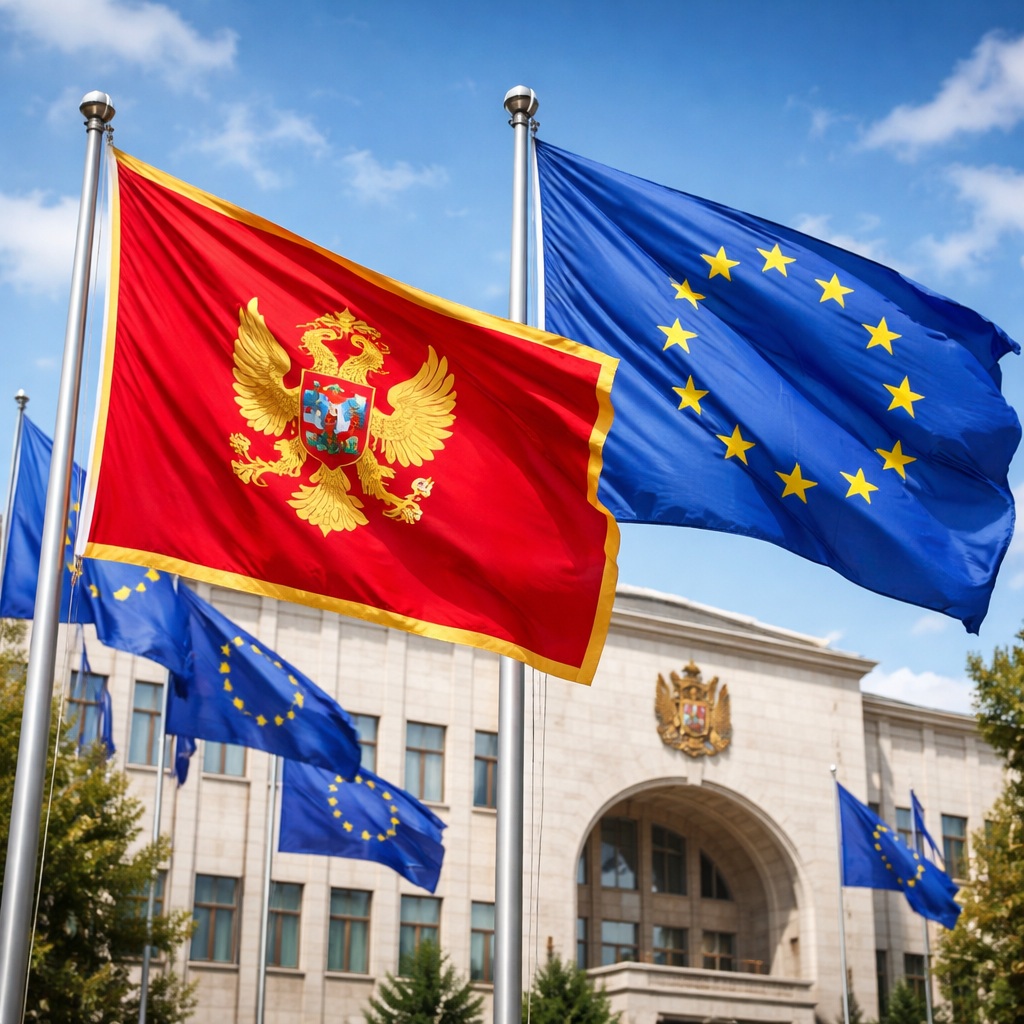
Podgorica warns that stalling negotiations could dent the bloc’s credibility and weaken the enlargement agenda

By early January, the European Union’s enlargement agenda has returned to a familiar crossroads, with Montenegro pressing Brussels to bring long-running accession talks to a close. For Podgorica, the message is blunt: completing negotiations would reinforce the EU’s promise to aspiring members, while failure to advance risks undermining the bloc’s credibility at a moment of renewed geopolitical competition.
Montenegro, the smallest country in the Western Balkans by population, has been negotiating EU membership for more than a decade. It has opened all negotiating chapters and provisionally closed several, a technical milestone that successive governments have portrayed as proof of commitment to the European project. Yet progress has slowed, caught between domestic reform fatigue and a more cautious EU mood shaped by internal divisions and enlargement fatigue.
Officials in Podgorica argue that the stakes now go beyond Montenegro itself. They warn that a prolonged stalemate would send a discouraging signal to other candidate countries across the Western Balkans, where EU membership remains the primary strategic anchor. In private briefings and public statements, Montenegrin leaders stress that credibility is the EU’s most valuable currency in the region — and that it is being tested.
At the heart of the debate lies the rule of law. Brussels has repeatedly insisted that judicial independence, anti-corruption measures, and media freedom must be demonstrably entrenched before talks can be concluded. Montenegro has passed a series of reforms aimed at strengthening prosecutorial oversight and judicial transparency, but EU officials say implementation, not legislation, remains the decisive benchmark.
The country’s political landscape has added complexity. Coalition governments have struggled to maintain momentum, while polarisation has occasionally stalled parliamentary work on key reforms. Even so, recent months have seen renewed efforts to stabilise institutions and push through outstanding measures linked to chapters on the judiciary and fundamental rights.
From the EU’s perspective, Montenegro is often described as a “front-runner” — a test case for whether the enlargement process can still deliver tangible results. Diplomats in Brussels note that success would bolster the EU’s influence in a region where Russia, China, and other actors have expanded their footprint. Failure, by contrast, could reinforce scepticism about the sincerity of the EU’s open-door policy.
The timing is sensitive. With institutional transitions and strategic debates unfolding inside the EU, enlargement risks slipping down the priority list. Several member states remain wary of committing to new accessions without assurances that reforms are irreversible. Others argue that delaying countries that have largely done what was asked of them risks breeding instability and disillusionment.
Montenegro’s government has sought to frame the issue as a shared responsibility. Officials emphasise that completing talks does not mean automatic membership, but rather acknowledges technical readiness and preserves momentum. “This is about keeping the process credible,” one senior official said, adding that clear signals from Brussels would help sustain public support for reforms at home.
Public opinion in Montenegro remains broadly supportive of EU membership, though enthusiasm has softened compared to earlier years. Analysts warn that prolonged uncertainty could erode trust, particularly among younger voters who see accession as a gateway to economic opportunity and mobility.
In Brussels, the language is cautious but attentive. EU officials say they are monitoring reform efforts closely and acknowledge Montenegro’s advanced status. At the same time, they stress that standards will not be lowered and that lessons from previous enlargements continue to shape policy.
As the informal deadline approaches, both sides are keenly aware of what is at stake. For Montenegro, concluding talks would mark a symbolic and practical breakthrough after years of effort. For the EU, it would demonstrate that enlargement remains a viable and strategic tool — not an empty promise.
The coming weeks are likely to determine whether Montenegro’s bid can move into its final phase or whether it will join the growing list of candidates left waiting at the door. Either way, the outcome will resonate well beyond Podgorica, shaping perceptions of the EU’s role and resolve in its own neighbourhood.

 The Tower Post