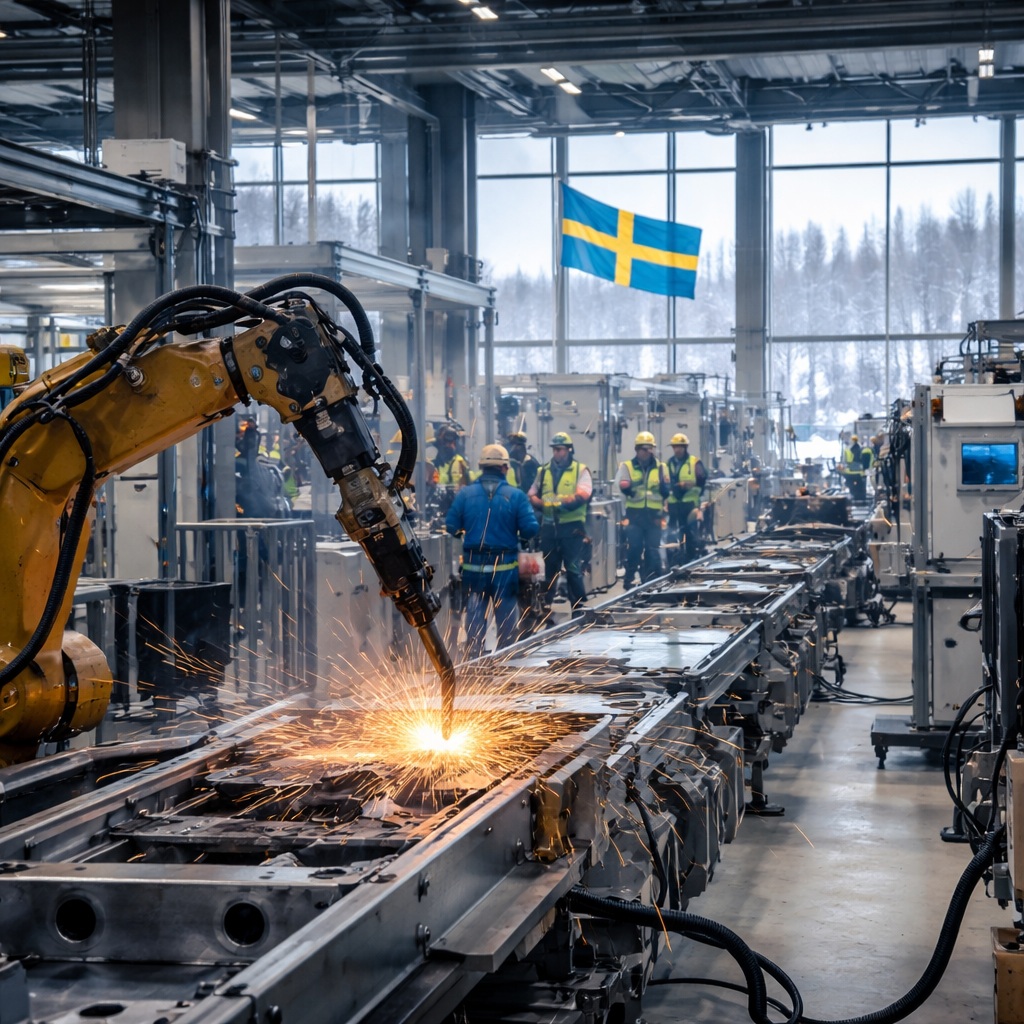
A December rebound in industrial output and new orders points to improving demand, even as hiring lags behind renewed confidence.
By early January, fresh data from Sweden’s industrial sector suggest that manufacturing ended the year on a firmer footing than many executives had anticipated just a few months earlier. After a prolonged period of hesitation marked by weak external demand and elevated costs, factories across the country reported a broad-based rebound in December, driven primarily by stronger new orders and a gradual normalization of supply conditions.
The pickup in industrial output does not yet amount to a full-fledged boom, but it marks an important psychological and economic turning point. Manufacturers describe a shift from defensive planning toward cautious expansion, as order books refill and customers signal greater willingness to commit to forward contracts. For an export-oriented economy like Sweden’s, this change in tone is as significant as the underlying production figures.
At the heart of the rebound lies a recovery in new orders, both domestic and foreign. Swedish producers of machinery, electrical equipment, and intermediate goods report that clients in Europe have begun restocking after months of running down inventories. At the same time, demand from North America has stabilized, offering a more predictable backdrop for planning capacity and investment.
Several executives interviewed in recent surveys note that uncertainty has not disappeared, but it has become more manageable. Energy prices have steadied compared with the volatility seen earlier, and logistics bottlenecks have eased. These improvements have allowed firms to shorten delivery times and reduce the buffers that had weighed on efficiency. As one plant manager in southern Sweden put it, “We are no longer planning for disruption every week. That alone makes a difference.”
The December rebound also reflects a modest improvement in domestic demand. While household consumption remains constrained by earlier inflationary pressures, spending on durable goods has shown tentative signs of recovery. Public investment projects, particularly in infrastructure and energy transition, have provided additional support for industrial suppliers. Together, these factors have helped smooth the cyclical trough that characterized much of the previous year.
Yet the recovery is uneven, and employment remains the clearest weak spot. Despite rising output, many manufacturers continue to operate with lean workforces, relying on overtime and productivity gains rather than new hires. Caution around staffing reflects lingering concerns about the durability of demand and the cost of labor in a competitive global market. As a result, job creation has lagged the rebound in production, tempering the broader economic impact.
Labor representatives acknowledge the improvement in orders but warn that without clearer signals on long-term demand, companies are unlikely to accelerate hiring. This hesitancy underscores a key feature of the current cycle: firms are prioritizing resilience over rapid expansion. Automation and digitalization investments, already well advanced in Swedish industry, are further reducing the immediate need for additional labor even as volumes rise.
Despite these constraints, business confidence is clearly improving. Sentiment indicators point to a more optimistic outlook heading into 2026, with expectations for output and orders strengthening across most subsectors. Manufacturers cite better visibility on costs, more stable financing conditions, and a sense that the worst of the recent slowdown is over. This shift in expectations is crucial, as confidence often shapes investment decisions months before they appear in hard data.
Exporters, in particular, are watching global demand closely. Sweden’s industrial base is deeply integrated into European value chains, making it sensitive to developments abroad. The recent stabilization in key partner economies has reduced fears of a prolonged downturn, even if growth remains modest. For now, manufacturers appear willing to plan on the assumption of steady, if unspectacular, external demand.
Looking ahead, analysts caution against overinterpreting a single month’s improvement. Structural challenges remain, including high competition, the need for continued innovation, and the transition toward greener production methods. Nevertheless, the December rebound provides evidence that Swedish manufacturing retains considerable underlying strength. When conditions stabilize, the sector has shown an ability to respond quickly.
As the new year begins, the prevailing mood in factories across Sweden is one of guarded optimism. Output is rising, order books are healthier, and confidence is returning. Employment may still be a drag, but if demand continues to firm, pressure to expand payrolls is likely to build. For now, December’s performance has given manufacturers a welcome boost, suggesting that the path into 2026, while not without obstacles, may be more solid than feared just months ago.




 The Tower Post