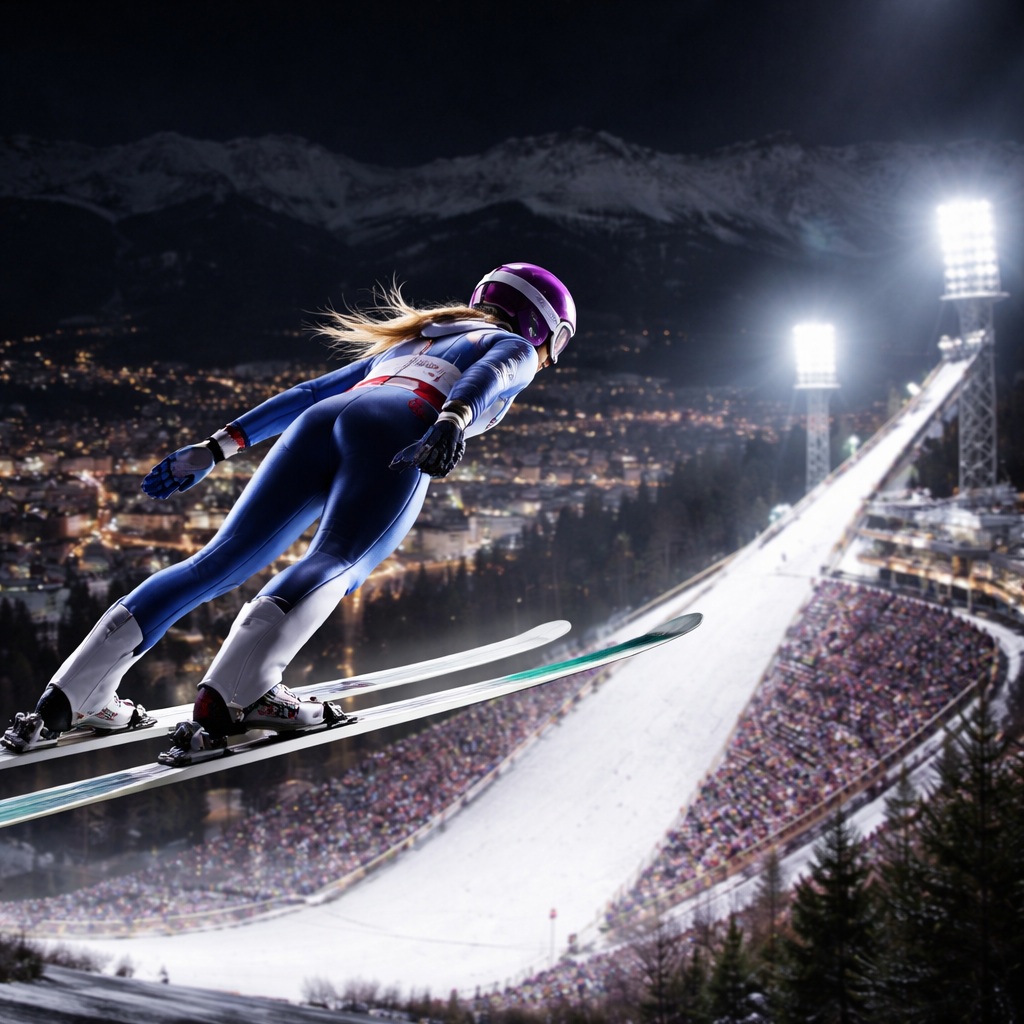
Under new floodlights in Innsbruck, ski jumping’s most traditional stage opens fully to women, signaling a long-awaited shift in elite winter sport.

By early January, as the New Year rhythm settles and winter sport reaches its annual crescendo, ski jumping stands at a turning point. For the first time in the long and storied history of the Four Hills Tournament, women are set to compete across the entire series in the upcoming season. The decision follows the installation of new floodlights in Innsbruck, removing the final technical barrier and completing a symbolic circle for one of winter sport’s most tradition-bound events.
For generations, the Four Hills Tournament has been ski jumping’s sacred ground. The sequence of competitions across Germany and Austria is not merely a set of events but a ritual, followed obsessively during the holiday period, discussed over family tables, and etched into the collective memory of winter sport fans. Until now, that ritual belonged exclusively to men. The inclusion of women across all four venues marks a cultural shift as significant as any rule change or record-breaking jump.
The missing piece was Innsbruck. While women’s ski jumping has grown rapidly in recent years, the lack of adequate lighting at the Bergisel venue prevented the staging of evening competitions that match the tournament’s established format. With the new floodlights now in place, organizers can align women’s events with the same professional standards, broadcast requirements, and competitive rhythm long reserved for the men’s field.
Officials describe the move not as an experiment but as a correction. Women have already proven their sporting legitimacy on the World Cup circuit, drawing increasing audiences and delivering performances that match the drama and technical excellence expected at the highest level. The Four Hills Tournament, with its uncompromising pressure and cumulative scoring, represents the final frontier of recognition.
For athletes, the announcement carries emotional weight. Many grew up watching the tournament during the first days of the year, aware that its stages were out of reach. Now, the chance to compete on the same hills, under the same lights, and with the same global attention is viewed as a validation of years spent pushing against structural limits rather than sporting ones.
The timing is also symbolic. As the season turns and winter sport dominates the early January calendar, the inclusion of women reshapes the narrative of tradition itself. The Four Hills Tournament has always balanced reverence for history with the need to evolve — from changes in equipment to judging systems. Gender inclusion now becomes part of that evolutionary story, not a footnote to it.
Broadcasters and sponsors have welcomed the development, anticipating expanded coverage and a broader audience. The presence of women throughout the tournament opens new storytelling possibilities, from emerging rivalries to fresh interpretations of hills that have defined careers for decades. Organizers insist the focus will remain sporting excellence, with equality expressed through identical competitive standards rather than symbolic gestures.
Not everyone believes change will be seamless. Purists worry about diluting the tournament’s identity, while others question whether logistical integration will strain an already intense calendar. Yet similar concerns accompanied earlier expansions in women’s ski jumping, most of which have since faded as performances spoke louder than skepticism.
By the time fans gather around screens in early January, the sight of women launching into the winter air at Innsbruck will feel less like a novelty and more like an overdue arrival. The floodlights will illuminate not just the hill, but a broader shift in how elite winter sport defines its traditions.
The Four Hills Tournament remains what it has always been: a demanding test of nerve, precision, and consistency at the heart of the ski jumping season. What changes now is who gets to take part. And as the New Year atmosphere lingers, the sport enters a chapter that feels both historic and entirely in step with its future.