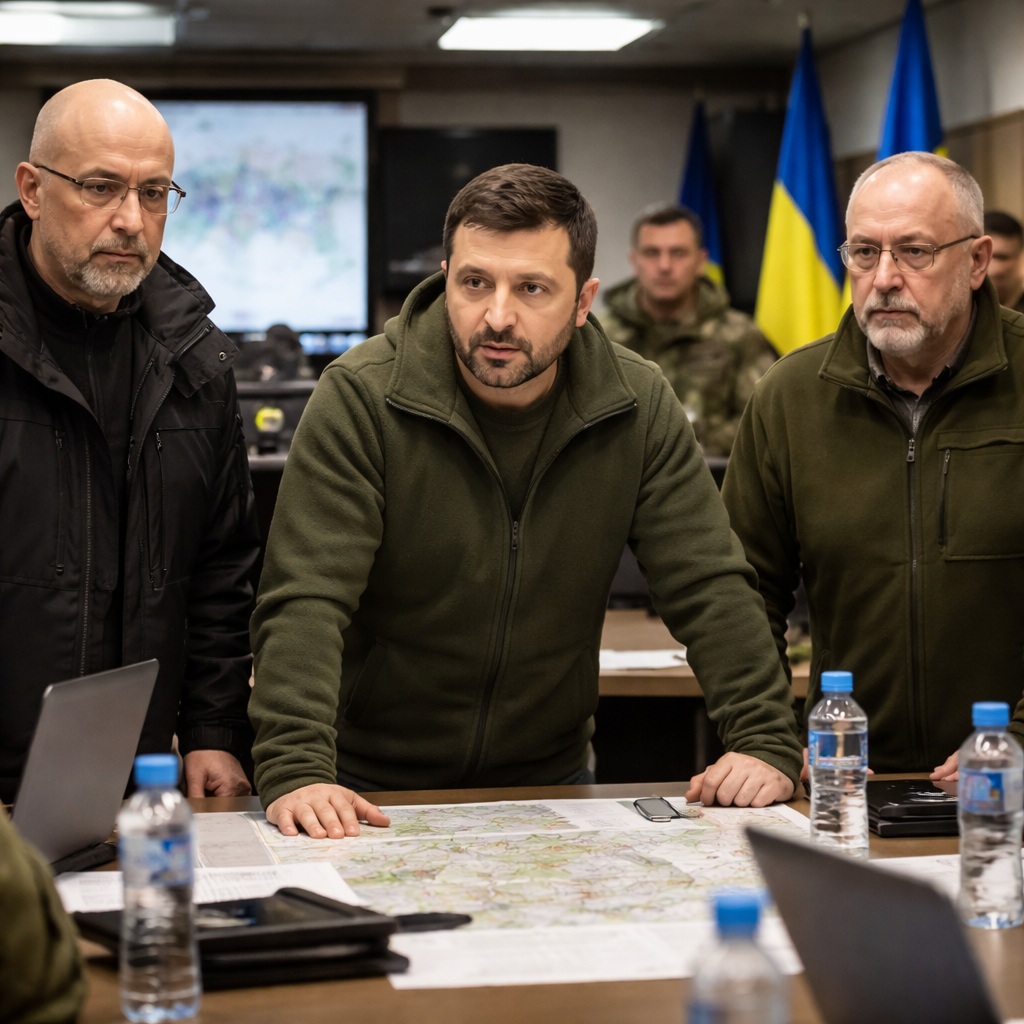
The Ukrainian president moves to reposition key figures in his cabinet, proposing Defence Minister Denys Shmyhal for the energy portfolio as Kyiv seeks greater resilience against Russian pressure after years of grinding conflict.
Ukraine’s President Volodymyr Zelenskiy has unveiled a significant reshuffle of the country’s leadership, signaling a renewed attempt to adapt the state apparatus to the prolonged strains of war. The proposed changes, announced in early January, reflect both the exhaustion of a conflict entering another hard winter phase and Kyiv’s determination to reinforce critical sectors that underpin national survival.
At the center of the reshuffle is the proposal to move Defence Minister Denys Shmyhal into the role of energy minister, a shift that underscores how closely Ukraine’s energy security has become intertwined with its military strategy. After years of sustained Russian attacks on power stations, transmission lines, and fuel infrastructure, energy has effectively become a second front in the war.
The presidential administration framed the move as a pragmatic response to extraordinary conditions. Officials close to the decision say the aim is to place crisis-tested leadership in charge of the energy sector, which continues to face missile and drone strikes alongside chronic shortages of equipment and skilled labor. In this calculus, experience managing logistics under fire is considered as valuable as technical expertise.
Shmyhal, who has held senior government roles throughout the conflict, is widely regarded as a steady administrator rather than a political showman. His tenure at the defense ministry coincided with periods of both intense fighting and delicate negotiations with Western partners over arms deliveries and production. Supporters argue that this background equips him to coordinate the complex web of domestic producers, regional authorities, and foreign donors that now sustain Ukraine’s energy grid.
The reshuffle also reflects broader pressures on Zelenskiy himself. Nearly four years into a full-scale invasion, the Ukrainian president faces a population fatigued by war, rolling blackouts, and economic uncertainty. While public trust in the leadership remains comparatively high, expectations are shifting from wartime rhetoric to tangible improvements in daily life.
Energy has become the most visible test of that transition. Russian forces have repeatedly targeted power generation and heating systems, seeking to undermine civilian morale and industrial output. Although emergency repairs and Western-supplied air defenses have prevented total collapse, the system remains fragile. Any prolonged disruption risks cascading effects across manufacturing, healthcare, and military production.
Analysts note that assigning a former defense chief to the energy ministry sends a symbolic message: that the sector will be treated as a strategic battlefield rather than a technocratic portfolio. “This is about command-and-control as much as kilowatts,” said one Kyiv-based policy analyst. “The government wants someone who understands pressure, secrecy, and rapid decision-making.”
The leadership changes extend beyond the energy post. Zelenskiy has proposed adjustments across several ministries and state agencies, aiming to streamline decision-making and reduce bureaucratic friction. While the full scope of the reshuffle still requires parliamentary approval, it marks one of the most notable overhauls since the early stages of the invasion.
Opposition lawmakers have responded cautiously. Some have welcomed the focus on energy resilience, acknowledging that the sector needs stronger coordination. Others warn against over-militarizing civilian governance, arguing that technical challenges require specialized knowledge rather than command discipline. The debates are expected to intensify as parliament reviews the nominations.
International partners are watching closely. Ukraine’s energy system has become deeply dependent on foreign assistance, from emergency generators to grid synchronization and fuel imports. Western diplomats say continuity and credibility in Kyiv’s leadership are essential to maintaining support, particularly as donor countries grapple with their own political and economic pressures.
For Zelenskiy, the reshuffle is also a reminder of the narrowing margin for error. Each winter brings renewed anxiety over heating and electricity, while the battlefield situation remains fluid and costly. The president has repeatedly emphasized that Ukraine must learn to function under constant threat, rather than waiting for a decisive military breakthrough.
The proposed appointment of Shmyhal to the energy ministry embodies that philosophy. It suggests a governing style shaped by endurance rather than optimism, focused on managing scarcity and risk over the long term. Whether this approach can deliver measurable improvements remains an open question.
Much will depend on how quickly the new leadership can translate authority into results. Repair crews still operate under fire, and spare parts remain difficult to source. At the same time, Ukraine is pushing to expand domestic energy production and protect key assets through layered defenses, a task that demands close coordination with the military.
As the conflict drags on, Zelenskiy’s latest move highlights a sobering reality: in Ukraine, the boundaries between war and governance have blurred. Ministries once defined by peacetime responsibilities are now instruments of national survival. The reshuffle is less about political renewal than about adaptation to a war that shows no sign of ending.
For ordinary Ukrainians, the success of this strategy will be measured not in policy statements but in the reliability of light, heat, and work. In that sense, the appointment of a battle-hardened administrator to oversee the energy sector is a bet that wartime experience can help keep the country running—one power line, and one winter, at a time.



 The Tower Post