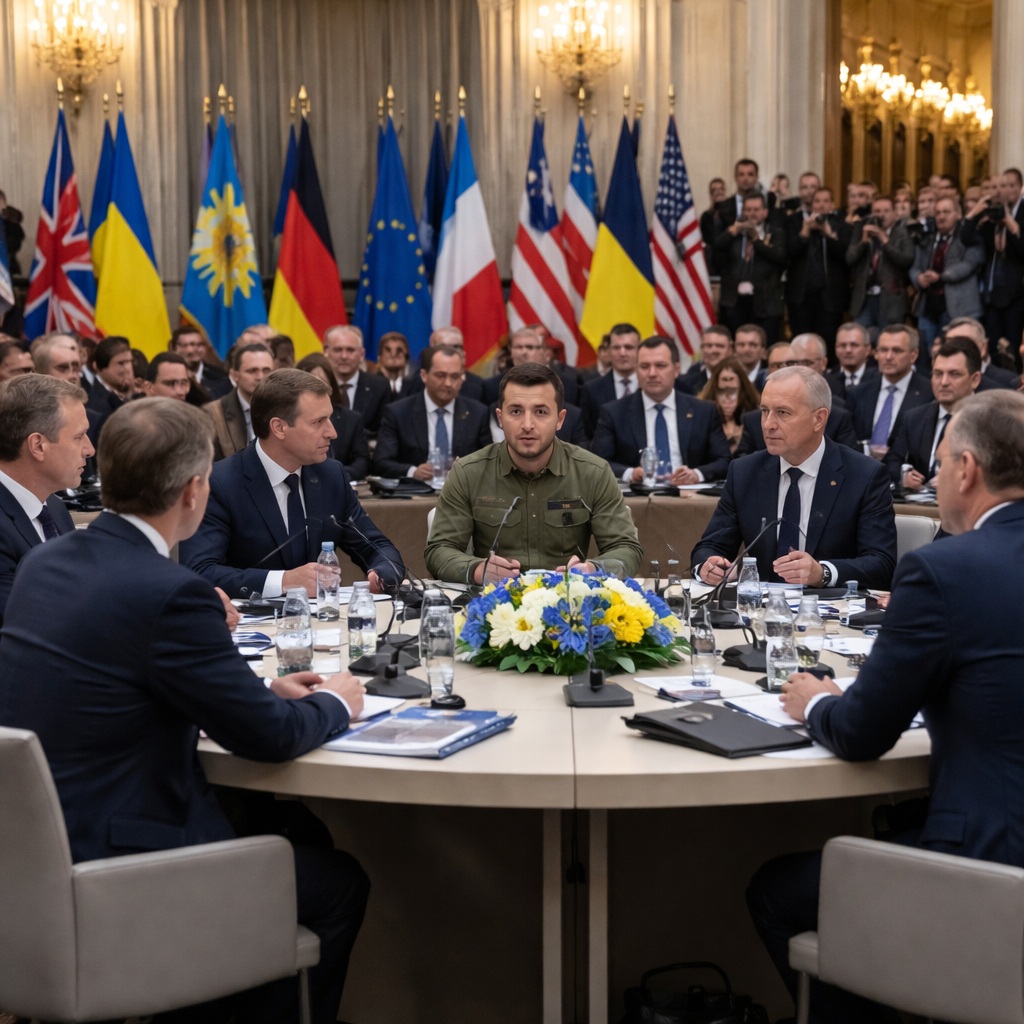
European and partner leaders meeting in Paris converge on enforceable guarantees to deter future aggression and stabilize a fragile path toward peace.
PARIS — In early January, European and allied leaders gathering in Paris moved closer to a decisive shift in how they support Ukraine: transforming political pledges into binding security guarantees. The talks, held against the backdrop of a grinding war and tentative discussions about a possible ceasefire, reflected a shared conclusion that Ukraine’s future cannot rest on assurances alone. If fighting pauses, leaders argued, the protections that follow must be enforceable, durable, and credible enough to deter renewed aggression.
At the heart of the discussions was a simple premise shaped by hard experience. Ukraine has repeatedly faced promises of support that proved insufficient when tested. This time, diplomats and defense officials said, commitments would need to be written, coordinated, and backed by mechanisms that activate automatically if Ukraine is attacked again. The aim is not only to secure Ukraine’s borders, but to close what many see as a dangerous gap between war and peace — the period when a ceasefire may hold, but the risk of relapse remains high.
Participants described a framework that would bind supporting states to provide assistance across several domains. Military backing would include pre‑positioned equipment, rapid reinforcement plans, and joint training designed to keep Ukraine’s forces interoperable with European and allied militaries. Intelligence cooperation would deepen, with shared early‑warning systems and secure channels intended to detect preparations for renewed offensives. Logistics and industrial support, often overlooked in public debates, featured prominently as well, reflecting lessons learned about the decisive role of supply chains, maintenance, and ammunition production.
Unlike previous arrangements, the draft guarantees discussed in Paris are meant to be triggered by conditions rather than political discretion. Officials involved in the talks said the language under consideration would define clear thresholds for response, limiting the delays and internal debates that have slowed reactions in the past. While the precise legal form remains under negotiation, there is broad agreement that the commitments must be binding in practice, even if they stop short of formal alliance membership for Ukraine.
The Paris summit also underscored a broader recalibration in European security thinking. For many governments, the war has dispelled lingering assumptions that large‑scale conflict on the continent is a relic of history. As a result, support for Ukraine is increasingly framed not as an act of solidarity alone, but as an investment in Europe’s own security architecture. Leaders stressed that a stable and defended Ukraine would serve as a bulwark against future destabilization, reducing the likelihood that the conflict could spill beyond its current borders.
Still, the discussions revealed sensitivities among allies. Some governments are wary of commitments that could be interpreted as automatic entry into war, particularly in the absence of a comprehensive peace settlement. Others emphasize the need to maintain unity across a diverse coalition that includes countries with different threat perceptions and domestic constraints. The challenge, diplomats said, is to design guarantees that are strong enough to deter, yet flexible enough to sustain consensus over time.
Ukraine’s representatives, for their part, pressed for clarity and permanence. They argued that ambiguity invites testing by adversaries and undermines public confidence at home. Binding guarantees, Ukrainian officials said, would send a signal not only to Moscow but also to investors and citizens that the country’s future is anchored in a secure European order. Reconstruction, they noted, cannot proceed at scale without confidence that hard‑won gains will not be reversed by force.
The Paris talks also touched on the role of non‑European partners. Allied states from outside the continent are expected to contribute to the guarantees, particularly in intelligence sharing, strategic lift, and advanced capabilities. Their involvement is seen as reinforcing the credibility of the arrangement and distributing the burden more evenly. While the details of participation vary, the message emerging from the summit is one of collective responsibility rather than ad‑hoc support.
Critics caution that guarantees on paper are only as strong as the political will behind them. They point to past agreements that failed to prevent conflict and warn that deterrence requires sustained attention, resources, and readiness. Supporters of the Paris initiative counter that the very process of codifying commitments — aligning doctrines, planning jointly, and preparing contingencies — creates facts on the ground that make backsliding less likely.
As the meetings drew to a close, officials described the atmosphere as sober but determined. There was no illusion that binding guarantees would be a panacea or that they could substitute for a negotiated end to the war. Instead, they are intended as a bridge: a way to ensure that if guns fall silent, they do not simply reload in the shadows.
In that sense, the Paris summit may mark a turning point. By moving from expressions of support to enforceable obligations, Ukraine’s allies are signaling that the security of the continent cannot depend on hope alone. Whether the draft guarantees now taking shape will prove sufficient to deter future aggression remains to be seen. But for the first time since the war began, the emphasis is shifting decisively from reacting to crisis toward preventing its return.


 The Tower Post