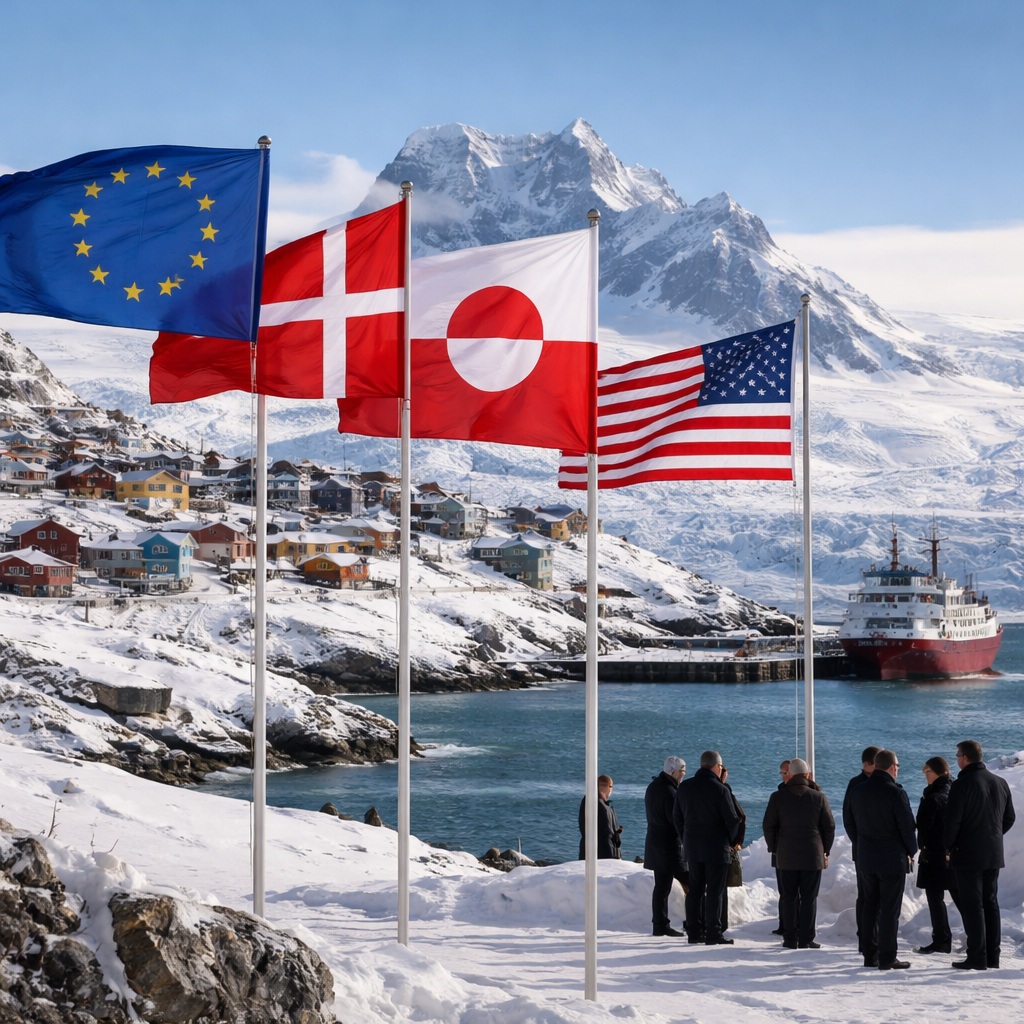
Major European powers reaffirm Denmark’s sovereignty over the Arctic territory after renewed U.S. presidential rhetoric stirs diplomatic concern.
European leaders have moved swiftly to express solidarity with Greenland and Denmark after renewed rhetoric from the President of the United States revived questions about the Arctic island’s strategic future. The coordinated response from Europe’s largest capitals underscores growing sensitivity around sovereignty, security, and influence in the High North, a region increasingly shaped by climate change and great‑power competition.
In a joint statement released this week, key European governments reaffirmed their “full and unequivocal” support for Denmark’s sovereignty over Greenland, stressing that the island’s status is not open to negotiation. The declaration followed a series of public remarks from Washington that once again framed Greenland in transactional terms, triggering unease among diplomats on both sides of the Atlantic.
Greenland, an autonomous territory within the Kingdom of Denmark, occupies a pivotal position in the Arctic. As melting ice opens new shipping lanes and access to untapped resources, the island has become central to broader geopolitical calculations involving security, trade, and climate science. For Europe, the issue cuts to the heart of international law and the principle that borders and sovereignty cannot be reshaped by pressure or purchase.
European officials were careful to strike a measured tone, avoiding direct confrontation with Washington while leaving little doubt about their position. “Greenland belongs to the people of Greenland, within the framework of the Danish realm,” said one senior European diplomat. “Its future cannot be discussed without Copenhagen and Nuuk at the table.”
The statement was backed by Europe’s major powers as well as institutions in Brussels, reflecting a rare moment of unity at a time when the continent faces multiple external challenges. Behind closed doors, diplomats acknowledge concern that repeated comments from the White House risk normalizing the idea that strategic territories can be bargained over, undermining long‑standing norms.
Denmark welcomed the show of support, calling it a clear signal that European partners stand firm on issues of sovereignty. Greenlandic leaders, while cautious not to inflame tensions, reiterated that the island is not for sale and emphasized their right to self‑determination within existing constitutional arrangements.
From Washington, officials sought to downplay the controversy, describing the president’s remarks as exploratory and focused on security cooperation. The United States maintains a long‑standing military presence in Greenland and views the Arctic as a critical frontier for missile defense and early‑warning systems. European leaders, however, are wary that rhetoric alone can carry consequences, particularly in a region where Russia and China are also expanding their footprint.
Analysts say the episode highlights a broader recalibration in transatlantic relations. While cooperation remains deep, Europe is increasingly assertive in defending its interests and legal principles, especially when they intersect with sensitive regional dynamics. “This is less about Greenland alone and more about how allies talk to each other in an era of strategic competition,” said a senior fellow at a European think tank.
Climate change looms large in the background of the dispute. As Arctic ice retreats, Greenland’s importance will only grow, intensifying debates over governance, environmental protection, and indigenous rights. European leaders are keen to ensure that these discussions unfold within established international frameworks rather than through unilateral pressure.
For now, the diplomatic temperature remains controlled, but the message from Europe is clear. Greenland’s status is settled in legal and political terms, and any future evolution will be determined by its people in cooperation with Denmark. As the Arctic moves from the periphery to the center of global politics, Europe appears determined to draw firm lines around sovereignty, even when addressing its closest ally.


 The Tower Post