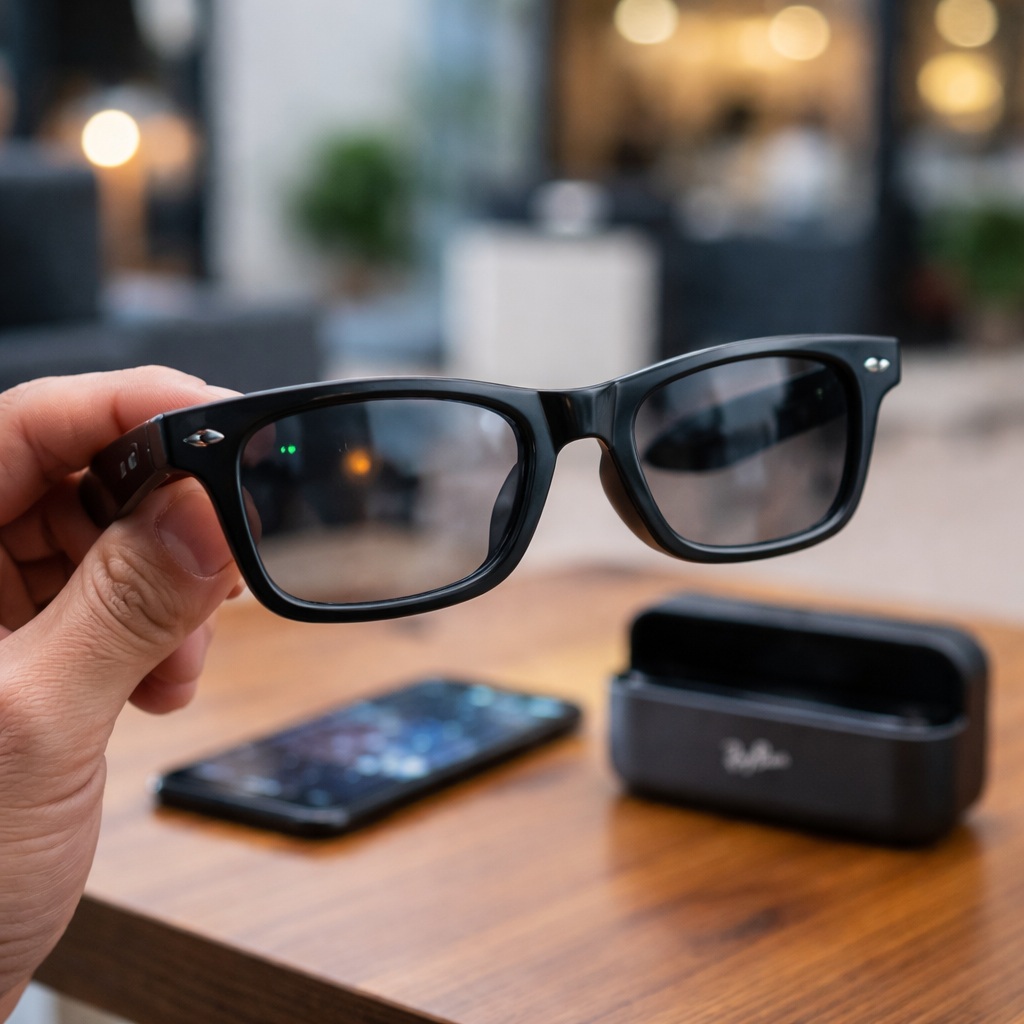
Supply constraints and surging U.S. demand slow international expansion, testing Meta’s mixed reality momentum
As the year opens with renewed scrutiny on big technology bets, Meta Platforms has quietly recalibrated expectations around one of its most visible hardware initiatives. The company has delayed the international rollout of its Ray-Ban Display smart glasses, citing supply constraints exacerbated by unexpectedly strong demand in the United States. The decision underscores both the commercial promise of wearable displays and the operational fragility that continues to challenge mixed reality at scale.
The Ray-Ban Display glasses, developed in partnership with EssilorLuxottica, represent Meta’s most consumer-friendly expression yet of augmented and mixed reality. Designed to blend familiar eyewear aesthetics with discreet digital functionality, the glasses signal notifications, capture photos and video, and integrate with Meta’s AI assistant. They stop short of full holographic overlays, but are widely seen as a bridge product toward more immersive AR experiences.
According to people familiar with the matter, demand in the U.S. has exceeded internal forecasts, placing strain on component sourcing and assembly capacity. Rather than dilute the launch with limited availability abroad, Meta opted to prioritize its home market while suppliers ramp up production. The move delays planned entries into Europe, Asia, and Latin America, regions where Meta had hoped to test broader consumer appetite for wearable displays.
The postponement lands at a delicate moment for Meta’s Reality Labs division, which has absorbed heavy investment over recent years. While the company’s Quest headsets dominate the consumer VR market, mixed reality glasses remain the long-term prize: lightweight, socially acceptable, and worn throughout the day. The Ray-Ban line is intended to normalize the idea of smart eyewear before more advanced displays become technically and economically viable.
Industry analysts note that supply bottlenecks are not uncommon for first-generation hardware, particularly when devices rely on custom chips, micro-displays, and compact batteries. What is notable in Meta’s case is that demand appears to be the binding constraint, not consumer indifference. That distinction allows the company to frame the delay as a success problem rather than a strategic misstep.
Still, the international pause risks ceding mindshare in markets where competitors are experimenting with their own smart glasses concepts. Chinese manufacturers, in particular, have accelerated releases of camera- and audio-enabled eyewear, while Apple is widely expected to deepen its spatial computing strategy beyond the Vision Pro. For Meta, maintaining momentum outside the U.S. will be critical to shaping global developer and consumer ecosystems.
Internally, Meta continues to position the Ray-Ban Display glasses as part of a longer arc. Executives have emphasized iterative progress over blockbuster launches, arguing that social acceptance, comfort, and everyday utility matter more than technical spectacle. The current delay, they suggest, allows the company to refine logistics and user feedback before exposing the product to the complexities of international regulation and retail.
For partners and retailers abroad, the wait is frustrating but not necessarily discouraging. The strong U.S. reception provides a proof point that smart glasses can move beyond novelty. If Meta can stabilize supply and preserve quality, the eventual global rollout may arrive with greater confidence—and higher expectations.
As mixed reality inches toward mainstream relevance, Meta’s latest adjustment serves as a reminder that the path forward is as much about factories and freight as it is about vision and code. The glasses may be ready for faces worldwide, but for now, they remain a limited glimpse of a future still constrained by the present.




 The Tower Post