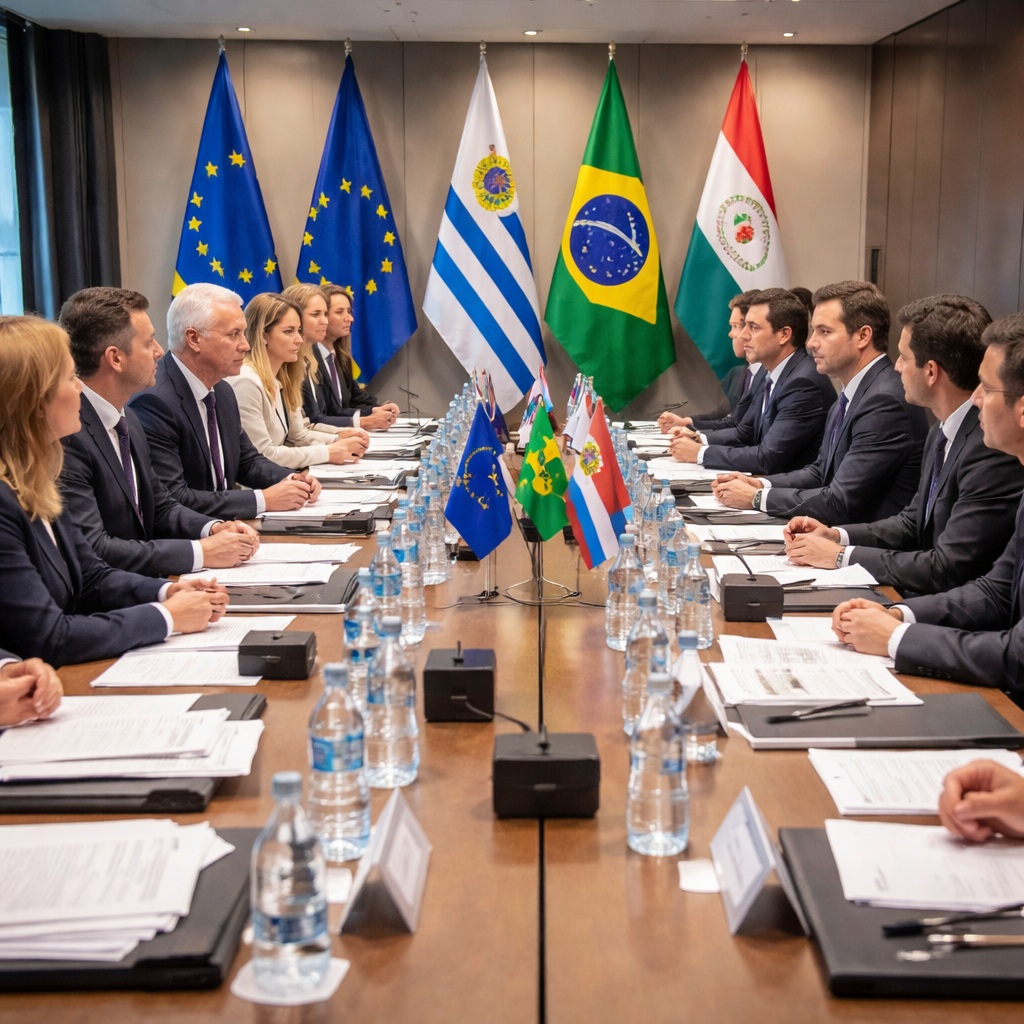
The European Commission intensifies diplomatic outreach to reassure sceptical member states, framing the Mercosur agreement as a strategic, balanced deal that protects domestic interests while opening global markets.

The European Commission has stepped up efforts to dispel lingering doubts surrounding the long-negotiated trade agreement between the European Union and the Mercosur bloc, as political momentum builds to bring the pact across the finish line. In recent weeks, senior Commission officials have engaged in a renewed campaign of briefings, bilateral meetings and public messaging aimed at convincing hesitant member states that the agreement can deliver economic and strategic benefits without undermining Europe’s social, environmental and agricultural standards.
At the heart of the debate lies a familiar European tension: how to reconcile the promise of expanded trade with the protection of domestic industries and values. The Mercosur deal, which would create one of the world’s largest free trade areas by linking the EU with Argentina, Brazil, Paraguay and Uruguay, has long been touted by Brussels as a growth engine for exporters and a geopolitical signal of Europe’s commitment to open markets. Yet resistance from several capitals has slowed progress, fuelled by concerns ranging from farm competition to environmental enforcement.
Commission officials now argue that the context has shifted. Global trade routes are under strain, supply chains are being reconfigured, and geopolitical rivalries are intensifying. Against this backdrop, the EU sees the Mercosur agreement as both an economic opportunity and a strategic necessity. “This is not just about tariffs,” a senior EU official said recently. “It is about securing long-term partnerships with regions that share an interest in rules-based trade.”
Economic modelling presented by the Commission suggests that European exporters of machinery, chemicals, pharmaceuticals and services stand to gain significantly from reduced barriers in South American markets. At the same time, Mercosur countries would benefit from improved access to the EU, particularly for agricultural goods. Critics, however, warn that this asymmetry could expose European farmers to unfair competition, especially in sectors such as beef, poultry and sugar.
To address these fears, Brussels has emphasised the safeguards embedded in the agreement. Tariff reductions would be phased in gradually, allowing sensitive sectors time to adjust. Quotas and protective clauses are designed to prevent market disruption, while monitoring mechanisms would enable the EU to act swiftly if imports surge unexpectedly. The Commission has also highlighted accompanying measures, including support funds and transition assistance for affected industries.
Environmental concerns remain another major fault line. Opponents of the deal have pointed to deforestation in the Amazon and questioned whether Mercosur governments can be trusted to uphold sustainability commitments. In response, the Commission has stressed that the agreement includes binding provisions on environmental protection and labour rights, aligned with international standards. Officials argue that engagement, rather than isolation, offers the EU greater leverage to promote sustainable practices.
“There is a growing recognition that trade agreements can be tools for change,” said a trade policy analyst in Brussels. “The Commission is trying to reframe Mercosur not as a threat, but as a platform for influence.” This narrative has gained some traction among member states previously on the fence, though scepticism has not disappeared.
Domestic politics continue to shape the debate. In several EU countries, agricultural lobbies wield significant influence, and rural communities remain wary of globalisation. National governments must also contend with fragmented parliaments and vocal protest movements. The Commission’s strategy has therefore focused on tailoring its message, addressing country-specific concerns and underlining the costs of inaction.
From Brussels’ perspective, failure to ratify the Mercosur deal would carry reputational risks. The EU has positioned itself as a champion of open, rules-based trade at a time when protectionist pressures are rising worldwide. Abandoning a flagship agreement after years of negotiations could weaken its credibility with current and future partners.
Supporters of the pact also point to the broader strategic calculus. Strengthening ties with South America could help diversify supply chains for critical raw materials and agricultural inputs, reducing dependence on a narrow set of suppliers. It could also reinforce political ties with democracies in a region where external powers are increasingly active.
Still, the path ahead remains complex. Ratification requires the backing of all member states, and any one of them can stall the process. The European Parliament, too, will scrutinise the deal closely, with lawmakers expected to press for clear guarantees on sustainability and enforcement.
As the Commission intensifies its outreach, the Mercosur agreement has become a test case for Europe’s trade policy in a more contested world. Can the EU strike a balance between openness and protection, ambition and caution? Brussels believes it can — and that the benefits of engagement outweigh the risks. Whether that argument convinces all capitals will determine if Europe’s long courtship of Mercosur finally yields results.

 The Tower Post