
Italian prime minister urges rejection of violence and calls for national unity as tensions rise in an increasingly polarized political climate.
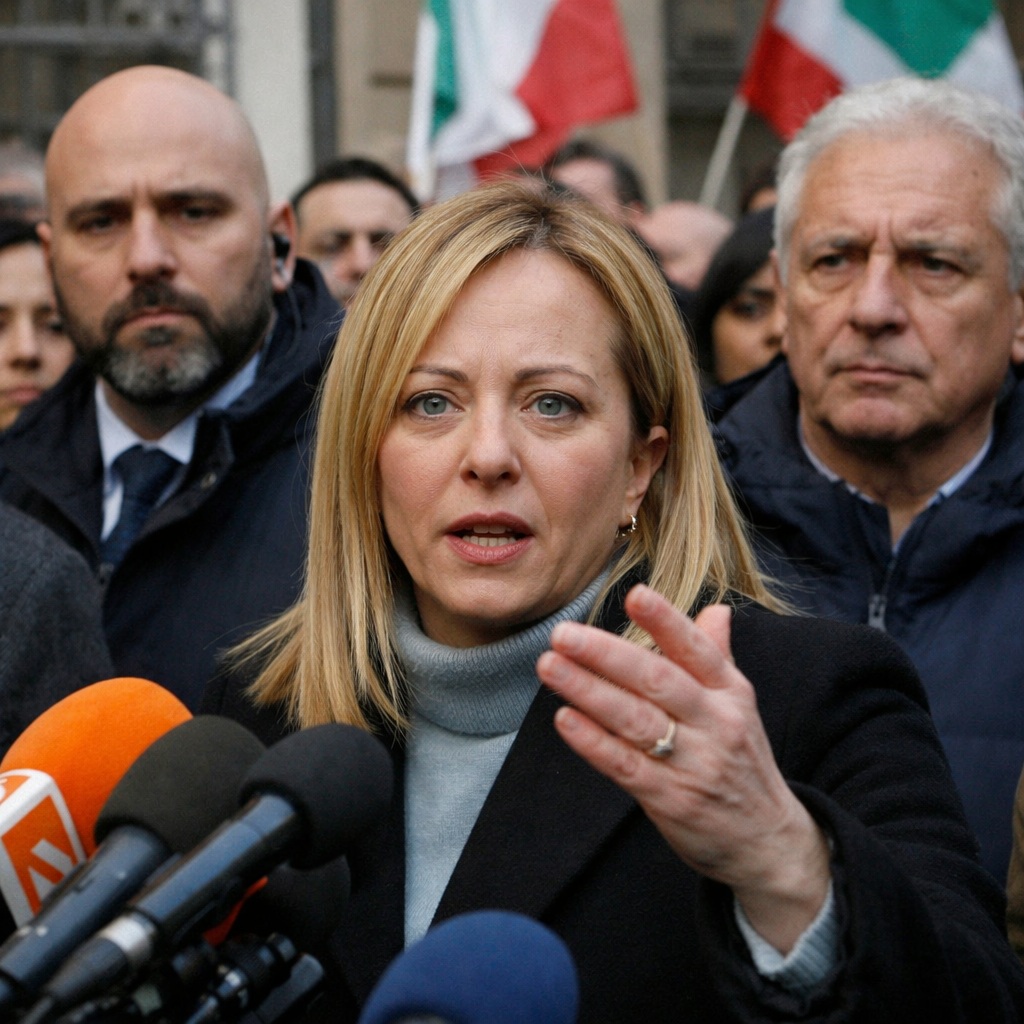
Italy’s prime minister, Giorgia Meloni, has issued a forceful condemnation of political hatred following a series of assaults targeting activists affiliated with her party, warning that escalating hostility risks corroding democratic life and social cohesion.
Speaking in a sober tone aimed at de-escalation, Meloni rejected all forms of political violence and urged Italians to draw a clear line between legitimate democratic opposition and acts of intimidation. “No idea, no cause, can ever justify aggression,” she said, framing the attacks as an alarm bell for the country’s broader political climate rather than an isolated security issue.
The incidents, which involved activists engaged in routine political activities, have reignited debate over the sharpness of Italy’s public discourse. While details of the assaults remain under investigation, their symbolic impact has been immediate, prompting reactions across the political spectrum and renewing concerns about the normalization of verbal and physical hostility in politics.
Meloni’s remarks appeared calibrated to project firmness without inflaming tensions. Rather than singling out political adversaries, she appealed to shared democratic values, calling on parties, media, and civil society to lower the temperature of political confrontation. The prime minister emphasized that disagreement is the lifeblood of democracy, but warned that when conflict turns personal or violent, it undermines the very institutions meant to channel dissent peacefully.
Italy, like many European countries, has been grappling with a more polarized political environment. Economic uncertainty, migration pressures, and cultural debates have all contributed to a climate in which political identities can harden quickly. Analysts note that social media has amplified confrontational rhetoric, often rewarding provocation over nuance and making it harder for moderate voices to be heard.
In this context, the attacks on activists have become a flashpoint in a wider discussion about extremism. Security experts caution that political violence rarely emerges suddenly; it is often preceded by a steady erosion of norms and an increase in dehumanizing language. Meloni’s intervention, they argue, reflects an awareness that leadership carries a responsibility not only to govern, but to set boundaries for acceptable political behavior.
Opposition figures have broadly condemned the assaults, though some have stressed the need to address what they describe as deeper causes of social anger. Several parties have called for renewed investment in civic education and dialogue, arguing that long-term prevention of political violence depends on rebuilding trust between institutions and citizens.
Within Meloni’s governing coalition, the prime minister’s stance has been presented as a reaffirmation of the state’s duty to protect political participation at all levels. Party officials have insisted that activists must be able to campaign, leaflet, and organize without fear, regardless of ideology. “Democracy does not belong to one side,” one senior ally said. “It belongs to everyone, or it weakens for all.”
The debate also touches on Italy’s historical memory. The country’s past experiences with political extremism remain a powerful reference point, serving both as a warning and as a reminder of the costs of allowing violence to infiltrate political life. Commentators have noted that invoking this legacy can help frame current tensions within a broader commitment to democratic resilience.
As investigations into the assaults continue, Meloni has called for calm and responsibility, urging citizens to resist the temptation to respond to provocation with further hostility. Her message, delivered at a moment of heightened sensitivity, seeks to position national unity as a safeguard against radicalization.
Whether the appeal will translate into a lasting reduction in tensions remains uncertain. What is clear is that the attacks have exposed underlying fractures in Italy’s political culture. By condemning hatred and emphasizing restraint, the prime minister has placed the issue squarely at the center of the national conversation, challenging political actors and the public alike to reaffirm the rules of democratic engagement.
In a country where politics has long been passionate and confrontational, the coming days will test whether calls for moderation can compete with the forces driving polarization. For now, Meloni’s intervention stands as a reminder that democratic debate, however fierce, must stop short of violence if it is to remain legitimate.


 The Tower Post