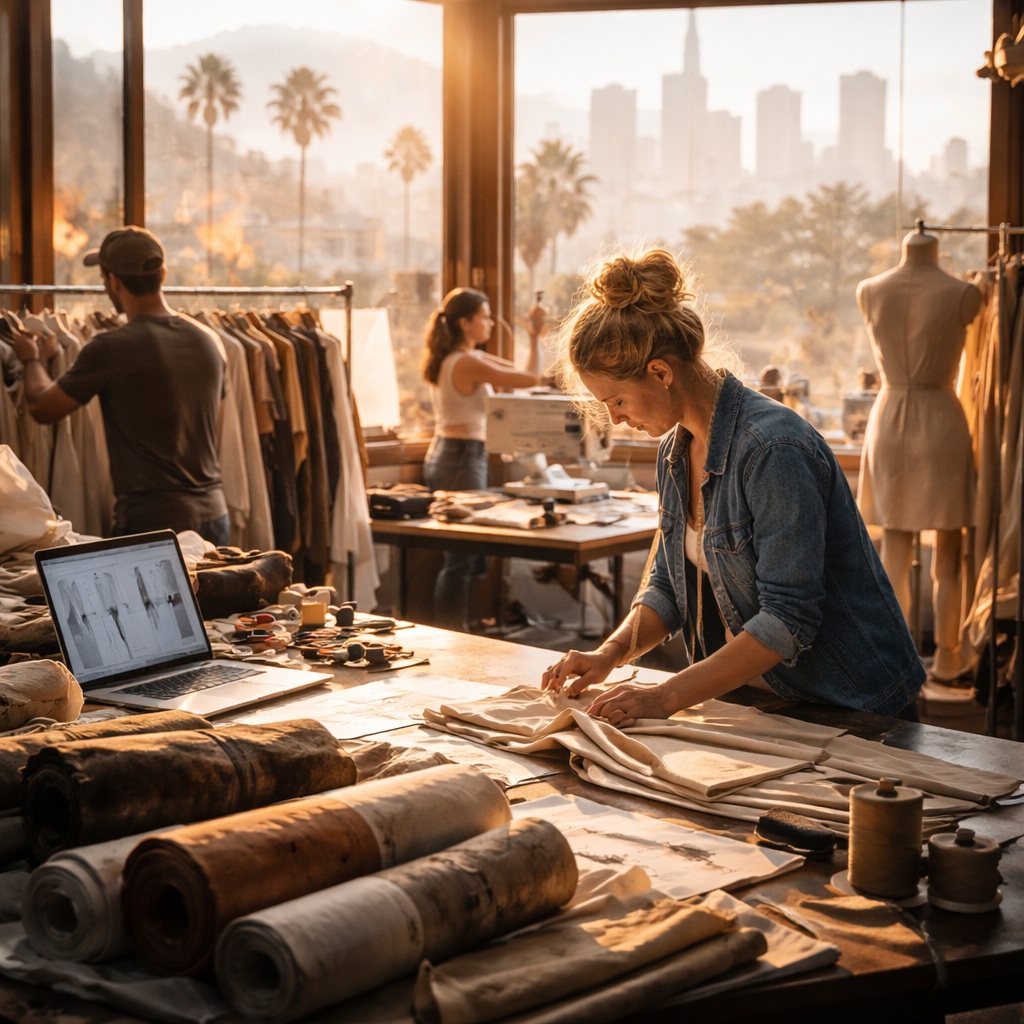
How Los Angeles fashion is rebuilding, rethinking supply chains, and redefining creative leadership after wildfire disruption
LOS ANGELES — In the wake of another wildfire season that left scars across hillsides and industrial corridors alike, Los Angeles’ fashion ecosystem is engaged in a quieter, more intricate recovery. Unlike the dramatic rebuilding of homes and highways, the fashion industry’s response is unfolding behind warehouse doors, in shared studios, and across newly reconfigured supply routes. What is emerging is not simply a return to business as usual, but a recalibration of how this city designs, produces, and leads.
For decades, Los Angeles has occupied a unique position in global fashion: a manufacturing hub with deep technical know-how, a design capital driven by youth culture, and a bridge between American retail and Pacific supply chains. The recent fires disrupted that balance. Sample rooms were temporarily shuttered, cutting rooms lost power or access, and logistics slowed as transportation routes were compromised. For many independent labels and mid-sized manufacturers, the challenge was not only physical damage but uncertainty—about timelines, materials, and labor continuity.
Yet disruption has also accelerated changes that were already underway.
Manufacturers across the region report a renewed emphasis on local redundancy. Rather than relying on a single cutting facility or dye house, brands are spreading production across multiple partners within Southern California. The approach adds short-term complexity, but it reduces vulnerability to localized disasters. Several factory owners describe informal cooperatives forming in the aftermath of the fires, with equipment shared, orders redistributed, and skilled workers temporarily absorbed by neighboring shops.
Supply chains, long stretched across oceans, are also being shortened. While overseas production remains essential for scale, designers are increasingly keeping early-stage development close to home. Prototyping, small-batch runs, and limited releases are now more often produced within Los Angeles County, allowing brands to respond quickly to market shifts while minimizing logistical risk. The fires underscored a lesson many learned during earlier global disruptions: distance magnifies fragility.
Creative leadership, too, is evolving. Designers affected by the fires speak less about seasonal trends and more about stewardship—of teams, communities, and infrastructure. There is a visible shift toward collaborative direction, where creative directors work alongside operations and sourcing leads from the earliest stages of a collection. The goal is resilience by design: garments conceived with material availability, transport constraints, and environmental impact already in mind.
This pragmatic creativity is reshaping aesthetics as well. Collections emerging this winter lean into utility, modularity, and longevity. Convertible silhouettes, repairable constructions, and fabrics chosen for durability are not framed as compromises, but as expressions of a distinctly Angeleno sensibility—one forged in a landscape where climate realities are impossible to ignore.
Labor remains a central concern. Many garment workers faced temporary displacement or reduced hours during and after the fires. In response, several brands are experimenting with guaranteed-hour agreements and cross-training programs that allow workers to move between roles as demand shifts. Advocates say these measures are modest but meaningful steps toward stabilizing a workforce that has historically absorbed the shock of every crisis.
Public and private support has played a role, though industry leaders note that recovery has been uneven. Larger brands with diversified production recovered faster, while smaller labels relied heavily on community fundraising, shared studio spaces, and extended credit from suppliers. The gap has fueled conversations about long-term structural support for local manufacturing, including zoning protections for industrial spaces that are increasingly threatened by real estate pressure.
Environmental accountability has become inseparable from rebuilding. Fire-resistant building materials, upgraded ventilation systems, and energy backups are now standard considerations in factory renovations. At the same time, designers are questioning the carbon cost of constant newness. Capsule collections and made-to-order models are gaining traction, reducing excess inventory and aligning production more closely with real demand.
Los Angeles has always been a city defined by reinvention, and its fashion industry is no exception. What distinguishes this moment is the clarity of purpose emerging from adversity. The fires did not just interrupt production; they forced a reckoning with how vulnerable—and how interconnected—the system truly is.
As the city moves forward, the industry’s recovery is becoming a case study in adaptive manufacturing and values-driven leadership. In studios rebuilt with borrowed machines and in collections shaped by constraint, Los Angeles fashion is quietly stitching itself back together—stronger, leaner, and more aware of the ground it stands on.


 The Tower Post