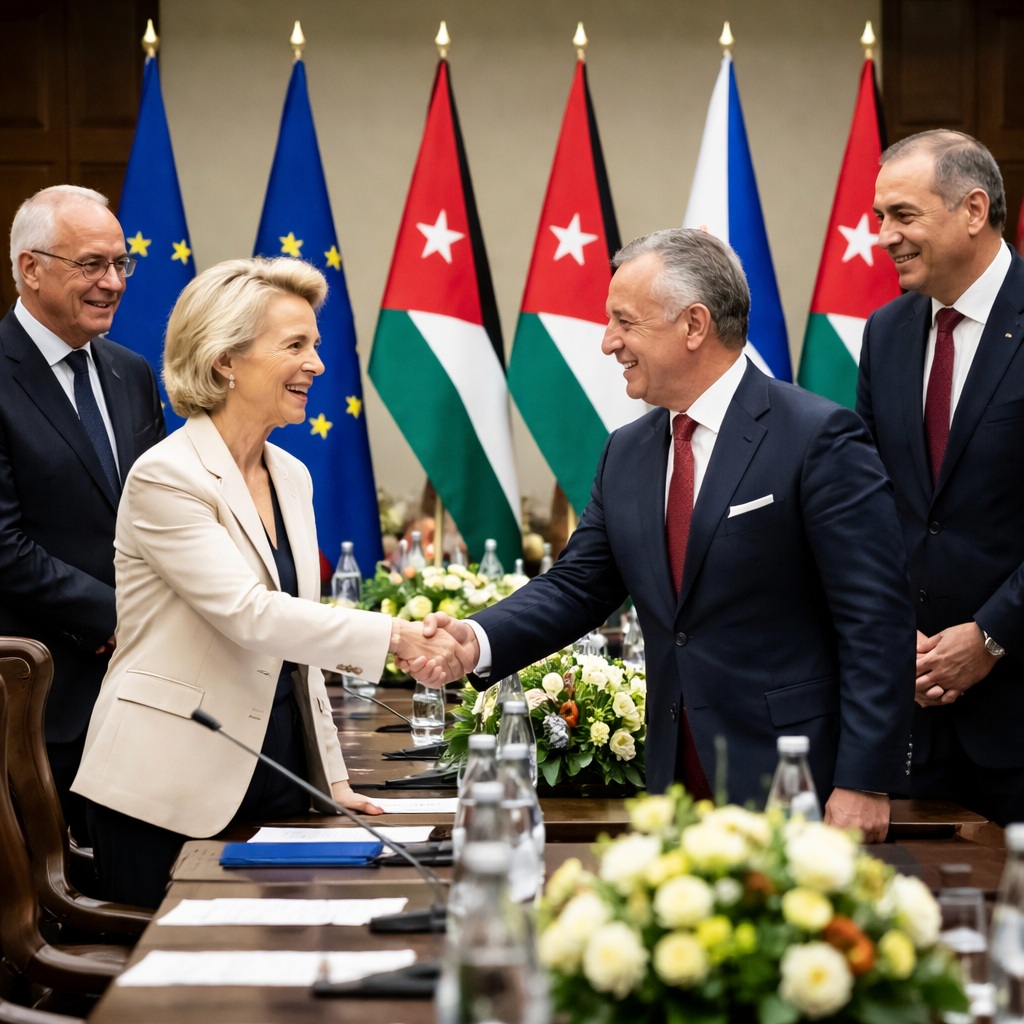
A landmark political and strategic meeting signals a new phase in relations, with diplomacy, security, and economic cooperation at the core.

In early January 2026, the European Union and the Hashemite Kingdom of Jordan marked a significant moment in their long-standing relationship by convening their first-ever summit at the highest political level. The meeting, widely seen as a turning point, underscored a shared determination to elevate cooperation amid a volatile regional environment and growing global uncertainty.
For Brussels, the summit represented more than a ceremonial milestone. It was a clear signal of intent to anchor its Middle East policy in stable, trusted partnerships. For Amman, it reaffirmed Jordan’s role as a reliable interlocutor between Europe and a region shaped by overlapping crises, from protracted conflicts to humanitarian pressures and economic fragility.
The discussions reflected a broad and ambitious agenda. Leaders focused on political dialogue, regional security, trade and investment, energy transition, and cooperation on migration and refugees. At the heart of the talks was a shared understanding that the challenges facing Europe and the Middle East are increasingly interconnected and require coordinated responses.
Jordan’s strategic position featured prominently. Nestled between areas of persistent instability, the country has long been a pillar of moderation and continuity. European officials praised Jordan’s diplomatic engagement and its efforts to promote dialogue, while acknowledging the heavy social and economic burden it carries, particularly in hosting large refugee communities.
Security cooperation was one of the most sensitive and substantive topics. Participants emphasized the importance of intelligence sharing, counterterrorism coordination, and border management. With threats evolving rapidly across regions, both sides stressed the need for trust-based mechanisms that go beyond short-term crisis management and instead build long-term resilience.
Economic cooperation emerged as another cornerstone of the summit. The European Union reiterated its interest in deepening trade ties and supporting Jordan’s economic reform agenda. Discussions explored ways to stimulate investment, improve access to European markets, and encourage innovation and job creation, particularly for young people. Jordanian leaders highlighted the importance of predictable partnerships that can help buffer external shocks and sustain growth.
Energy and climate issues also featured high on the agenda. Jordan’s ambitions in renewable energy and water management were presented as areas ripe for enhanced collaboration. European representatives pointed to the alignment between Jordan’s priorities and the EU’s broader climate and sustainability goals, suggesting that joint projects could deliver both environmental and economic dividends.
Migration and humanitarian cooperation, long central to EU-Jordan relations, were addressed with renewed urgency. The summit acknowledged Jordan’s continued role as a host country for displaced populations and the strain this places on public services and infrastructure. European leaders signaled a commitment to sustained financial and technical support, framing it as both a moral responsibility and a strategic investment in regional stability.
Beyond sectoral cooperation, the summit carried symbolic weight. It elevated the relationship to a more structured and visible political level, creating a framework for regular high-level engagement. Diplomats described this as a move toward a more mature partnership, one in which Jordan is not only a beneficiary of European policies but an active partner in shaping shared priorities.
Observers noted that the timing of the summit was particularly significant. As global power dynamics shift and traditional alliances are tested, both sides appear keen to reinforce dependable partnerships. For the European Union, strengthening ties with Jordan aligns with a broader effort to diversify its external relationships and reinforce its southern neighborhood. For Jordan, closer engagement with Europe offers political backing and economic opportunities at a moment of regional flux.
The tone of the meeting was described as pragmatic yet forward-looking. While acknowledging persistent disagreements on certain regional issues, leaders emphasized dialogue and mutual respect. This approach, analysts suggest, reflects a recognition that durable partnerships are built not on complete alignment, but on the ability to manage differences constructively.
As the summit concluded, both sides expressed confidence that the meeting would not remain a one-off event. Commitments were made to translate political declarations into concrete initiatives, supported by regular follow-up and institutional coordination. The coming months are expected to test how quickly and effectively these ambitions can be realized.
For now, the first EU-Jordan summit stands as a clear statement of intent. It signals a shared belief that closer cooperation is not only desirable, but necessary in a world marked by overlapping crises and interdependence. Whether this momentum can be sustained will depend on continued political will and the ability to deliver tangible results for citizens on both sides of the Mediterranean.


 The Tower Post