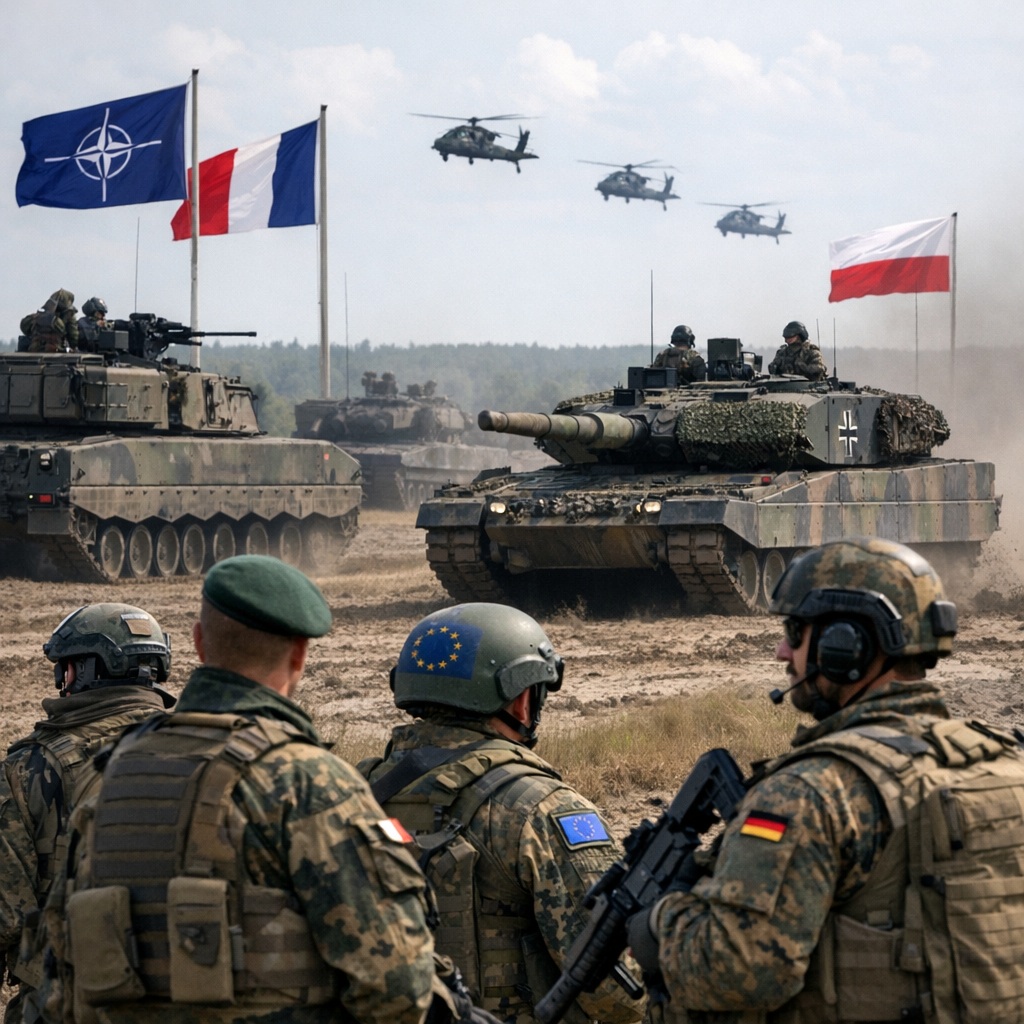
As security assumptions fracture, European nations race to rearm for a long war, betting that readiness, resilience, and industrial revival can deter a harsher era.
Across Europe, the quiet certainties that shaped defense policy for a generation have dissolved. Military parades and procurement plans now carry a different weight, no longer symbolic gestures but signals of a continent bracing for endurance. Governments from the Atlantic coast to the eastern frontier are rebuilding armed forces not for brief crises, but for the possibility of a long, grinding confrontation that could test political resolve, industrial capacity, and social cohesion.
The shift is visible in budget debates that once focused on marginal increases and now revolve around structural change. Defense spending has surged from a niche concern into a central pillar of national strategy. Parliaments debate ammunition stockpiles with the same urgency once reserved for energy security. Conscription, long considered politically radioactive, has returned to public discussion in several countries as planners confront the limits of professional armies stretched thin by sustained commitments.
Behind the urgency lies a shared anxiety: the fear that Europe may no longer be able to rely indefinitely on American military guarantees. While transatlantic ties remain intact, European leaders increasingly speak of responsibility rather than reassurance. The language has shifted from dependence to autonomy, from backup to burden-sharing. In closed-door meetings, officials describe scenarios in which the United States is distracted by crises elsewhere, forcing Europe to hold its own line for longer than previously imagined.
Eastern member states, already hardened by proximity to conflict, have been the most outspoken. For them, the concept of long war readiness is not abstract. It means layered air defenses, deep reserves of artillery shells, and civilian infrastructure prepared to support military logistics. Rail networks, ports, and fuel depots are being reassessed not only for efficiency but for survivability under stress.
Western Europe, meanwhile, is rediscovering skills it allowed to atrophy. Shipyards are expanding shifts. Armor plants that once produced in small batches are retooling for volume. Governments are revisiting procurement rules that favored peacetime efficiency over wartime surge capacity. The emphasis is on speed, standardization, and the ability to repair and replace equipment under pressure.
Industry sits at the heart of this transformation. Defense manufacturers, long constrained by uncertain orders, are now fielding multi-year contracts designed to justify investment in new machinery and skilled labor. The goal is not simply to buy weapons, but to rebuild an ecosystem capable of sustaining production through prolonged demand. Officials speak openly about bottlenecks in explosives, electronics, and specialized metals, and about the need to secure supply chains that extend far beyond Europe’s borders.
The social implications are profound. Preparing for a long war is not only a military challenge but a civic one. Governments are testing communication strategies to explain why higher defense spending does not crowd out social priorities but protects them. Civil defense campaigns, once relics of another era, are being quietly modernized. The message is cautious but clear: resilience is a collective effort.
This new posture also reshapes Europe’s diplomacy. Investments in arms and readiness are paired with intensified outreach to partners in Asia, the Middle East, and Africa, where competition for resources and influence is sharpening. European officials argue that credible defense strengthens diplomacy by reducing the temptation for adversaries to test resolve. Deterrence, in this view, is not about escalation but about preventing miscalculation.
Critics warn of risks. They question whether sustained military spending can be politically maintained once immediate fears fade, and whether industrial expansion might outpace oversight. There are concerns about fragmentation, with national programs multiplying rather than converging. European cooperation has improved, but joint projects remain complex, vulnerable to delays and divergent priorities.
Yet even skeptics acknowledge that the strategic environment has changed. The assumption that major war on the continent was unthinkable has been replaced by a colder realism. Long war readiness is less about predicting conflict than about refusing to be surprised by it. It is an attempt to buy time, options, and leverage in a world where certainty is scarce.
As winter debates give way to spring decisions, Europe’s rearmament drive is still taking shape. Success will depend not only on money and machines, but on political stamina. Preparing for endurance means accepting that security is no longer a background condition, but an ongoing project. For a continent built on the promise of peace, that realization marks a sobering turn—and a defining test of its ability to adapt.




 The Tower Post