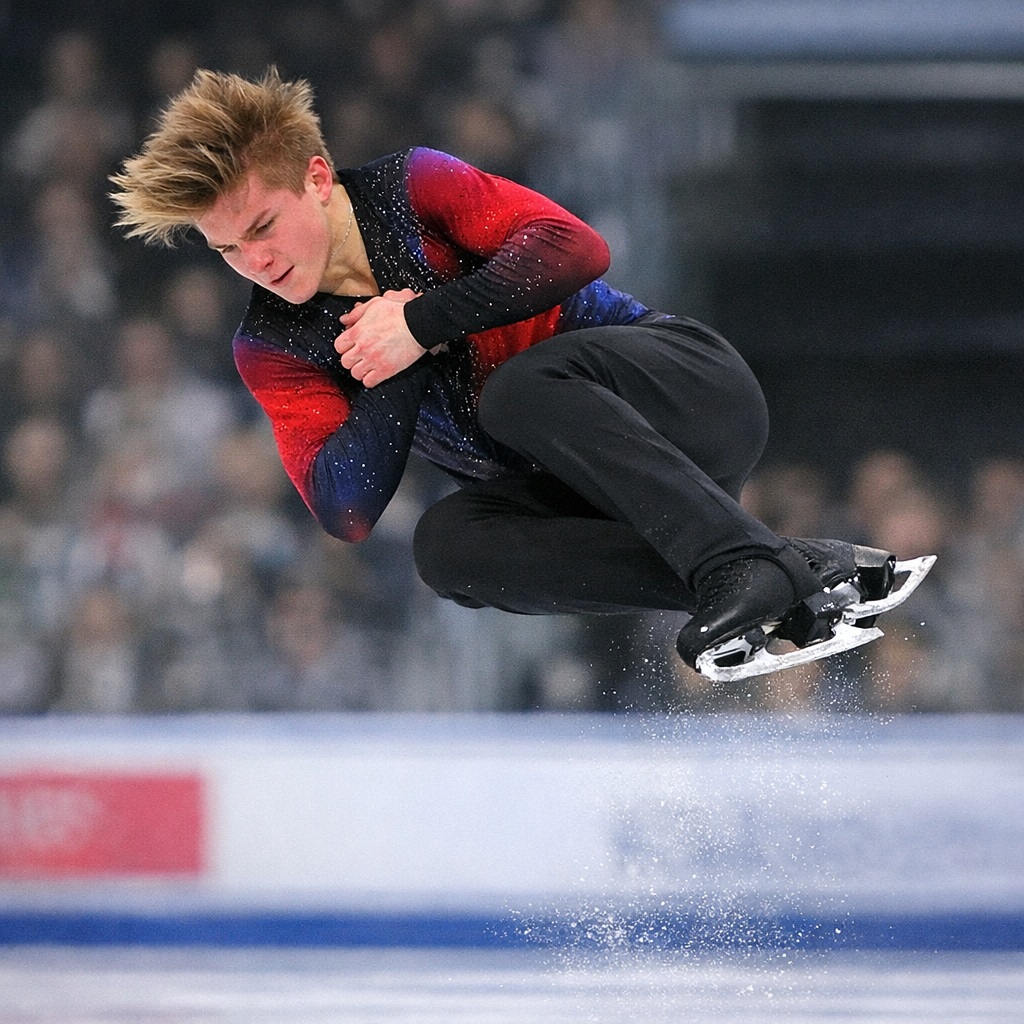
The American prodigy pushes technical boundaries in Manchester, reshaping expectations for men’s figure skating as the Olympic season gathers momentum.

In a sport where history is measured in rotations and risk, Ilia Malinin is skating beyond the margins. The American figure skating star arrived in Manchester this winter not simply to win, but to test how far the modern men’s game can be stretched before it breaks. What unfolded on the ice was less a competition than a statement: the future of figure skating is already here, and Malinin is forcing everyone else to catch up.
Still in his teens but already a defining figure of his generation, Malinin has built a reputation on audacity. While rivals carefully balance difficulty and execution, the American continues to expand the technical frontier, anchoring programs around jumps that once belonged more to theory than reality. In Manchester, he again demonstrated why he is widely considered the most technically advanced skater the sport has ever seen.
His free skate featured a layout that would have been unthinkable at the start of the last Olympic cycle. Quadruple jumps were not used as isolated highlights but as the backbone of the program, executed with a confidence that suggested repetition rather than experimentation. Most striking was his approach to the quad Axel, the four-and-a-half-rotation jump that has become his signature. Where others see danger, Malinin sees possibility.
The performance sent a clear message ahead of the Milan-Cortina Olympic Games: technical difficulty is no longer a bonus in men’s skating — it is the baseline. Judges, coaches, and competitors are now grappling with the implications. Malinin is not merely raising the bar; he is redefining where the bar exists.
Yet the Manchester outing also showed a skater in transition. Once viewed as a pure technician, Malinin is investing visibly in musical phrasing, body line, and connection to the audience. His skating skills have matured, his transitions grown denser, and his interpretation more intentional. The result is a program that no longer asks the audience to forgive artistry in exchange for difficulty, but invites them to appreciate both.
This evolution matters in an Olympic context. The modern judging system rewards balance, and while Malinin’s technical base value gives him a formidable cushion, the margins at the top of the sport are narrowing. Rivals from Japan, Europe, and North America are pushing their own limits, chasing higher rotations and cleaner executions in response to the standard he has set.
What makes Malinin’s rise particularly significant is its timing. As the sport moves toward the next Winter Games, figure skating finds itself at a crossroads. There are ongoing debates about whether technical escalation risks alienating audiences or endangering athletes. Malinin, intentionally or not, has become central to that conversation.
Supporters argue that innovation has always driven skating forward, from the first triple jumps to the quad revolution of the last decade. Critics worry that the relentless pursuit of difficulty leaves little room for individuality and expression. In Manchester, Malinin appeared to offer a rebuttal to both sides: technical ambition need not exclude creativity.
Behind the scenes, coaches and federations are already adjusting. Training methodologies are evolving, with younger skaters introduced earlier to complex jump mechanics once reserved for elite seniors. Malinin’s success has accelerated this shift, making Manchester feel less like an isolated event and more like a preview of what the Olympic ice may soon look like.
For Malinin himself, the focus remains narrow. He speaks often about process rather than medals, about landing jumps in practice before trusting them under pressure. That discipline was evident in Manchester, where risk was matched by preparation. Every element appeared planned, every gamble calculated.
As the Olympic season approaches, expectations will only intensify. American figure skating has not had a men’s Olympic champion in decades, and Malinin carries that history with him each time he steps onto the ice. Manchester did not settle the question of Olympic gold, but it clarified something just as important: the limits of men’s figure skating are no longer fixed.




 The Tower Post