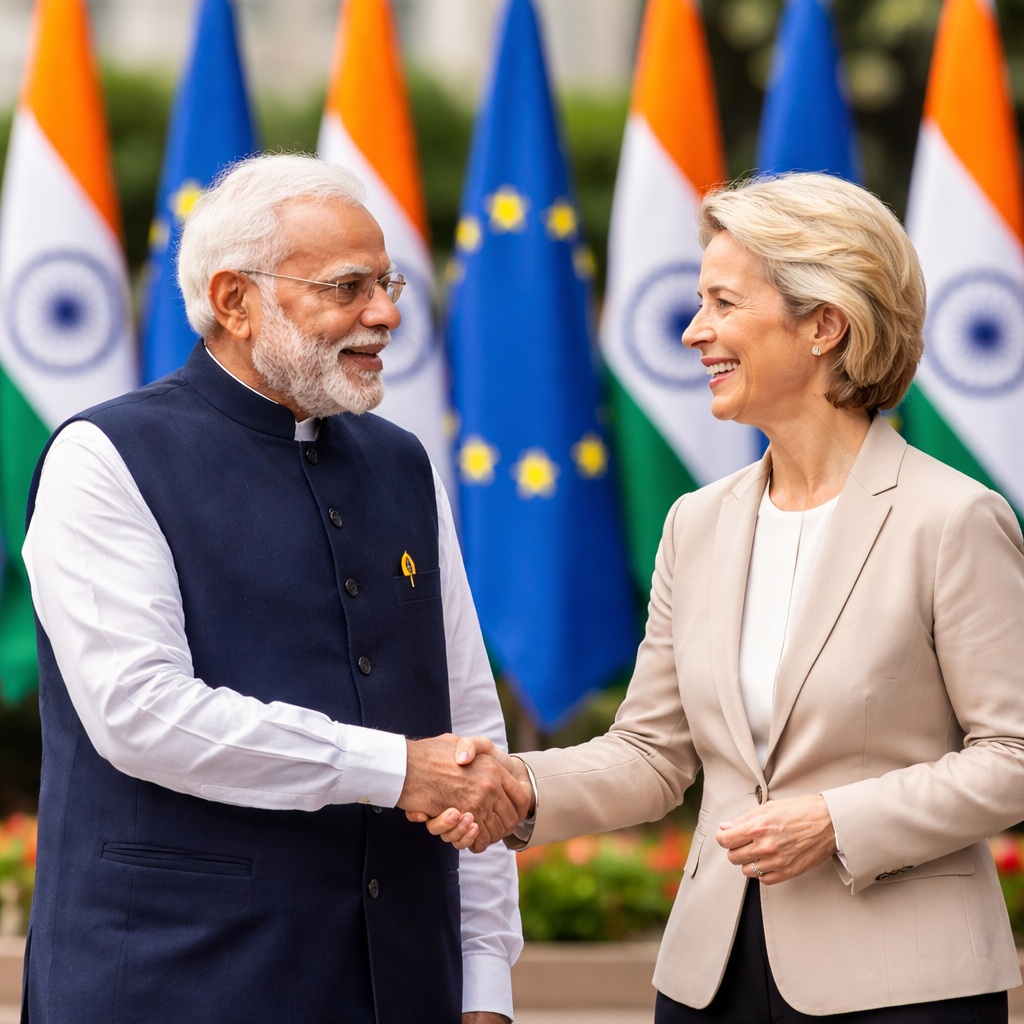
From trade and technology to climate finance, New Delhi and Brussels argue that deeper coordination can act as a stabilising force amid worldwide uncertainty.

By early January, global markets remain on edge. Growth is uneven, supply chains are still adjusting to geopolitical shocks, and governments face the dual challenge of reviving investment while containing social pressures at home. Against this backdrop, India and Europe are making a coordinated case: closer cooperation between the two could help stabilise the global economy at a moment when predictability is in short supply.
Officials and policymakers on both sides point to a convergence of interests that has grown more visible in recent years. Europe is seeking resilient partners to diversify trade, secure critical technologies, and advance its green transition. India, meanwhile, wants greater access to markets, capital, and advanced know‑how as it positions itself as a central engine of global growth. Together, they argue, the partnership can act as a counterweight to volatility elsewhere.
At the core of this effort is trade. Negotiators have been working to reduce barriers and align standards, with the stated aim of making cross‑border commerce smoother and more predictable. For European firms, India represents one of the largest and fastest‑growing consumer markets in the world. For Indian exporters, Europe offers not just scale but regulatory stability and high‑value demand. Supporters of the partnership say that deeper trade ties can soften the impact of shocks by spreading risk across regions rather than concentrating it.
Beyond trade, technology has emerged as a central pillar. Europe’s strengths in advanced manufacturing, clean energy systems, and regulation intersect with India’s vast digital talent pool and rapidly expanding tech sector. Cooperation in areas such as semiconductors, digital public infrastructure, and cybersecurity is framed as mutually reinforcing. Policymakers stress that shared standards and joint investment can reduce fragmentation in the global tech landscape, which many fear could otherwise slow innovation and growth.
Climate and energy policy add another layer of strategic alignment. Europe is pushing ahead with ambitious decarbonisation goals, while India is scaling up renewable energy at unprecedented speed to meet rising demand without locking in high emissions. Joint financing initiatives, technology transfers, and cooperation on green supply chains are presented as tools not only to meet climate targets but also to create new sources of employment and investment. In a world where climate shocks increasingly disrupt economies, advocates argue that coordinated action here is itself a stabilising force.
Financial cooperation is also gaining prominence. European institutions are looking at ways to channel long‑term capital into Indian infrastructure, while Indian authorities see Europe as a reliable partner for sustainable finance. Such flows, officials say, can help cushion global markets by supporting productive investment rather than speculative cycles.
Still, the partnership is not without friction. Differences over regulation, data governance, and market access persist, and both sides face domestic political constraints. Critics caution that expectations should be tempered and that progress will likely be incremental. Yet even sceptics acknowledge that dialogue itself has value at a time when multilateral forums are under strain.
What gives the India‑Europe narrative particular resonance is its timing. As major economies elsewhere grapple with slower growth or political uncertainty, New Delhi and Brussels are presenting cooperation as a form of economic insurance. The message is less about grand declarations and more about steady alignment: building rules, institutions, and investments that can absorb shocks rather than amplify them.
In doing so, India and Europe are positioning their relationship as part of a broader effort to restore confidence in the global economy. Whether this ambition translates into lasting stability will depend on execution. For now, the signal they are sending is clear: in a fragmented world, partnership is being cast as a pragmatic path to resilience.