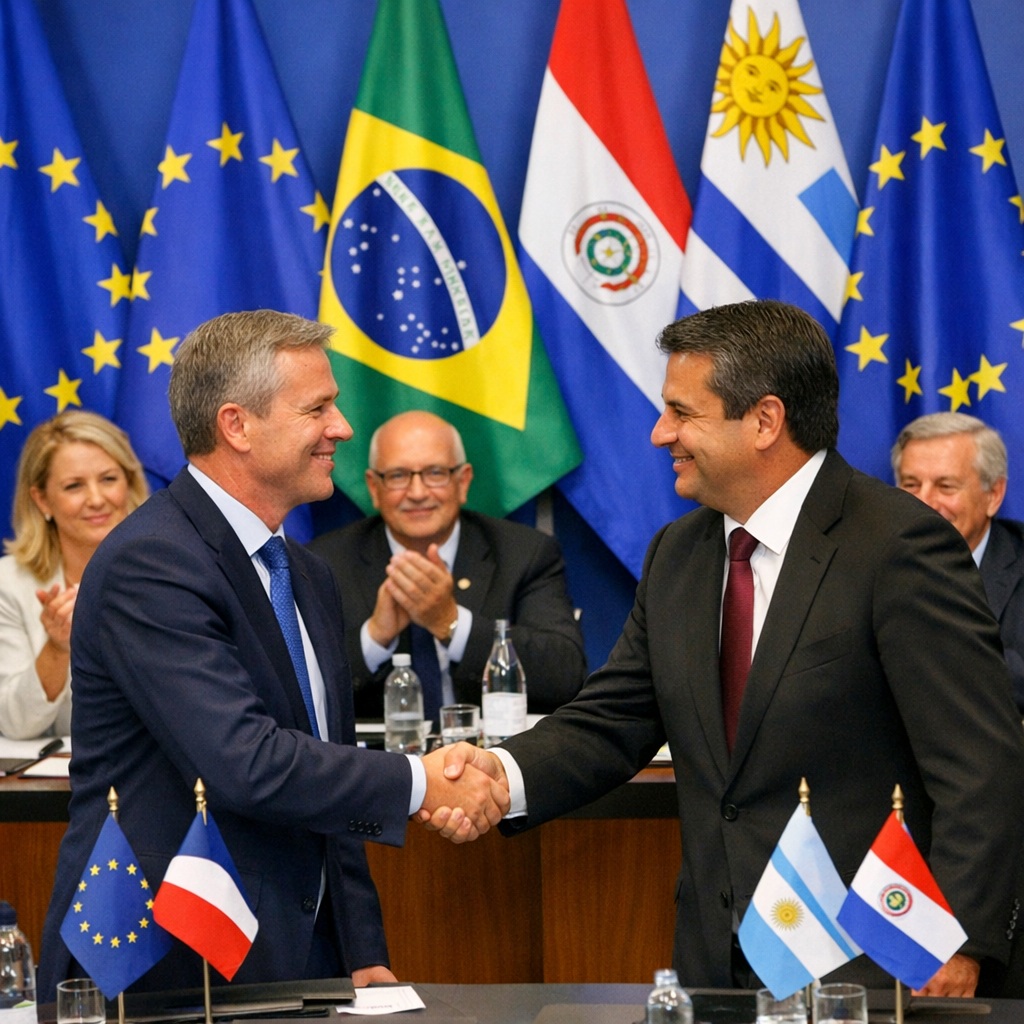
A historic EU–Mercosur deal edges closer to approval after a quarter-century of talks, signaling Europe’s bid to deepen ties with Latin America and reposition itself in a more competitive global economy.

By early January, momentum had visibly shifted in Brussels. After more than two decades of negotiations, European Union member states have moved closer to endorsing a landmark trade agreement with the Mercosur bloc—Brazil, Argentina, Paraguay, and Uruguay—reviving a pact long stalled by political hesitation, environmental concerns, and shifting global priorities.
The agreement, first conceived at the turn of the millennium, would create one of the world’s largest free trade areas, linking nearly 800 million consumers across two continents. For European leaders, its revival reflects a strategic recalibration: diversifying trade partnerships, reinforcing political alliances, and responding to intensifying competition from China and the United States in Latin America.
“This is not just a trade deal,” said one senior EU diplomat involved in the talks. “It is a geopolitical signal that Europe remains committed to open markets, shared rules, and long-term partnerships.”
A Deal Decades in the Making
Negotiations between the EU and Mercosur began with high expectations but soon became mired in complexity. Agricultural market access, industrial tariffs, public procurement, and regulatory standards proved difficult to reconcile. European farmers feared an influx of South American beef, poultry, and sugar, while Mercosur countries pushed for greater access for their commodities and fewer restrictions.
Environmental policy later emerged as the most contentious obstacle. Several EU governments, backed by vocal civil society groups, questioned whether closer trade ties with Brazil could align with Europe’s climate commitments, particularly amid concerns over deforestation in the Amazon. For years, these objections froze political approval even after negotiators announced a provisional agreement.
What has changed is the broader context. Global supply chains remain fragile, multilateral trade rules are under strain, and geopolitical rivalries are reshaping economic diplomacy. In this environment, EU capitals increasingly see the Mercosur agreement as a stabilizing anchor rather than a liability.
Strategic Calculations on Both Sides
For Mercosur members, the deal promises improved access to the world’s largest single market. European tariffs on agricultural exports would be reduced, while South American consumers would gain cheaper access to European machinery, pharmaceuticals, cars, and high-end manufactured goods.
Brazil, the bloc’s largest economy, views the agreement as a pathway to reindustrialization and technological upgrading. Argentina hopes it will attract investment and support export growth at a time of economic fragility. Paraguay and Uruguay, smaller but export-oriented economies, see opportunities to integrate more deeply into global value chains.
From the European perspective, the benefits extend beyond commerce. The agreement would reinforce political ties with democratic partners in South America, at a time when influence in the region is increasingly contested. European officials privately acknowledge that China’s expanding footprint—through infrastructure investment, commodity trade, and finance—has sharpened the urgency of concluding the deal.
Environmental Guarantees Under Scrutiny
To unlock political support, the European Commission has emphasized additional safeguards tied to sustainability. These include commitments to uphold the Paris climate goals, strengthen environmental enforcement, and provide mechanisms to address violations.
Supporters argue that engagement, rather than isolation, offers Europe greater leverage to promote environmental standards. Critics remain skeptical, warning that enforcement mechanisms may prove weak once the agreement is in force.
Several national parliaments are expected to scrutinize the environmental chapters closely. The debate is likely to be intense, reflecting broader tensions within Europe between free trade ambitions and green policy priorities.
Economic Impact and Political Risks
Independent studies suggest the agreement would deliver modest but positive economic gains for both sides, with particularly strong benefits for export-oriented sectors. Yet the distributional effects are uneven. European agriculture remains sensitive, and governments are preparing mitigation measures to reassure farmers wary of increased competition.
Politically, the deal carries risks. Ratification requires approval by EU member states and, in some cases, regional parliaments—an often unpredictable process. Past trade agreements have stumbled at this stage, and opponents of globalization remain vocal.
Still, the prevailing mood in Brussels is cautiously optimistic. Diplomats describe a “window of opportunity” driven by shared strategic interests and fatigue with prolonged uncertainty.
A Signal to the World
If approved, the EU–Mercosur agreement would send a message beyond Europe and South America. At a time when protectionism is rising and the global trade system is fragmenting, it would stand as a rare example of a comprehensive, rules-based accord between major regions.
For Europe, it would underscore its ambition to act as a global economic and political player, capable of shaping standards and building alliances. For Mercosur, it would mark a long-sought step toward deeper integration with advanced economies.
After 25 years of negotiations, the deal is not yet guaranteed. But as January unfolds, the balance appears to be tipping toward approval—suggesting that persistence, changing geopolitics, and mutual interest may finally bring one of the world’s most elusive trade agreements across the finish line.
 The Tower Post