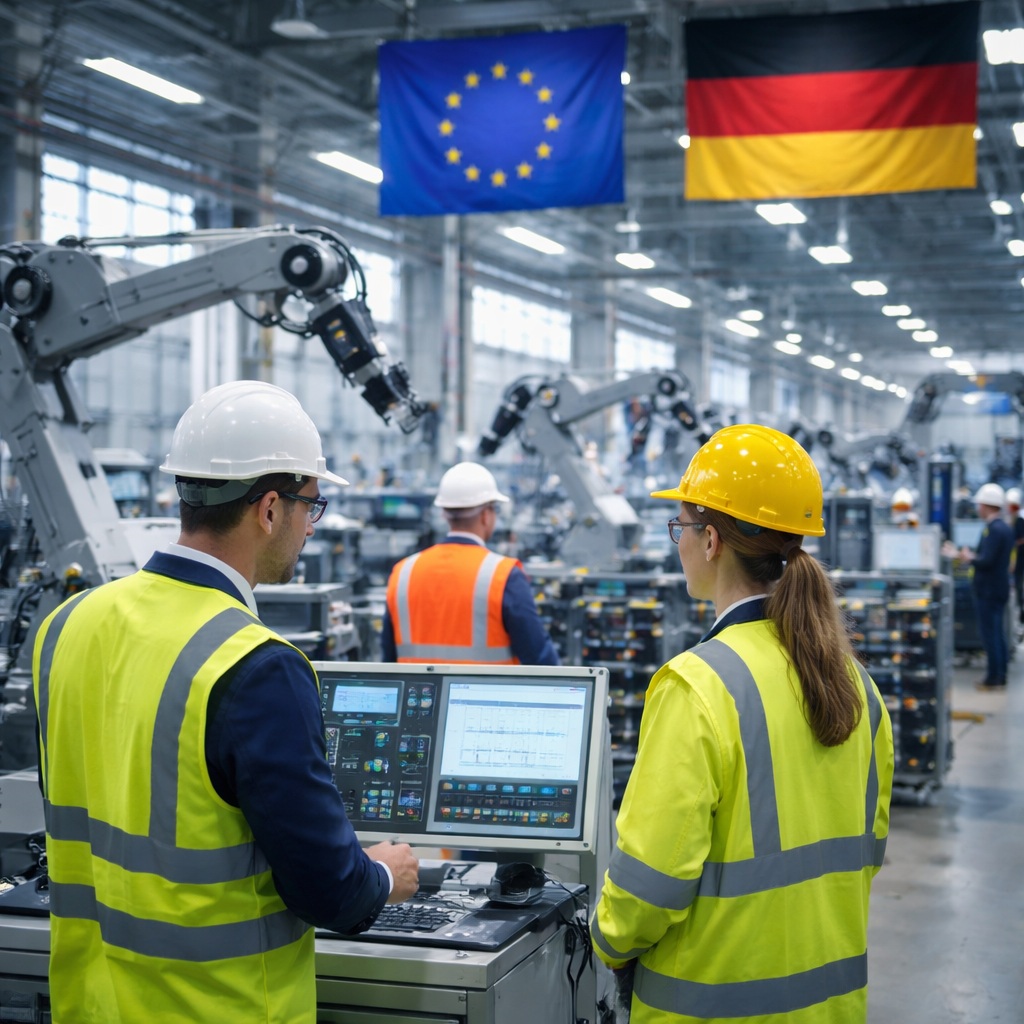
Manufacturing output across the eurozone continues to expand modestly as investors await fresh signals from Germany
European industrial output is showing signs of steady, if increasingly cautious, progress at the start of the year. Recent indicators suggest that factories across the eurozone are still producing more than they were in the previous period, but the momentum that characterized earlier months has eased. The picture that emerges is one of resilience under pressure, shaped by cautious demand, persistent cost concerns, and a complex global backdrop.
Survey-based data and national production releases point to rising output in several euro area economies, particularly in sectors tied to machinery, transport equipment, and intermediate goods. Southern European producers have continued to benefit from earlier investment cycles and infrastructure-related demand, while parts of Central Europe remain supported by export-oriented manufacturing. However, the breadth of the expansion appears narrower than before, with fewer industries reporting strong gains.
Economists describe the current phase as a transition rather than a downturn. “What we are seeing is not a reversal, but a normalization,” said one eurozone-focused analyst at a major investment bank. “The post-pandemic catch-up and inventory rebuilding phases are largely behind us. Growth is still there, but it is more dependent on real end-demand.”
That demand remains uneven. Household consumption across the currency bloc has improved only gradually, restrained by still-elevated prices for services and housing-related costs. At the same time, corporate clients are taking longer to commit to large capital expenditures, reflecting uncertainty about energy prices, global trade conditions, and the direction of monetary policy.
Germany, Europe’s largest industrial economy, is once again in the spotlight. Markets are bracing for a busy day of economic releases that are expected to provide fresh insight into the health of its manufacturing base. German factories have struggled more than some of their peers with weaker external demand and structural challenges in energy-intensive industries. As a result, any sign of stabilization or renewed weakness is likely to influence sentiment well beyond the country’s borders.
“Germany matters not just because of its size, but because of its role in regional supply chains,” noted an economist at a European policy institute. “When German output slows or accelerates, the effects ripple across neighboring economies.”
Despite the softer tone, there are reasons for guarded optimism. Supply chain conditions remain broadly stable, delivery times have normalized, and labor markets continue to provide a degree of support to industrial activity. Several manufacturers have also reported that order books, while thinner, are no longer deteriorating sharply.
Financial markets have taken a measured view. Equity investors have favored industrial firms with diversified revenue streams and exposure to long-term themes such as electrification and automation. Bond markets, meanwhile, are closely watching how industrial trends feed into broader growth and inflation expectations.
Looking ahead, analysts caution against reading too much into short-term fluctuations. The consensus view is that European industry is entering a period of slower, more sustainable expansion rather than renewed contraction. Much will depend on whether domestic demand can strengthen and whether external conditions, particularly global trade flows, remain supportive.
For now, Europe’s factories are still running, but with a finger firmly on the brake. The coming data, especially from Germany, are set to play a key role in shaping expectations for the months ahead.




 The Tower Post