Italy steps forward to unlock a long-stalled agreement, offering political weight and sector safeguards as Brussels eyes a vast transatlantic market.

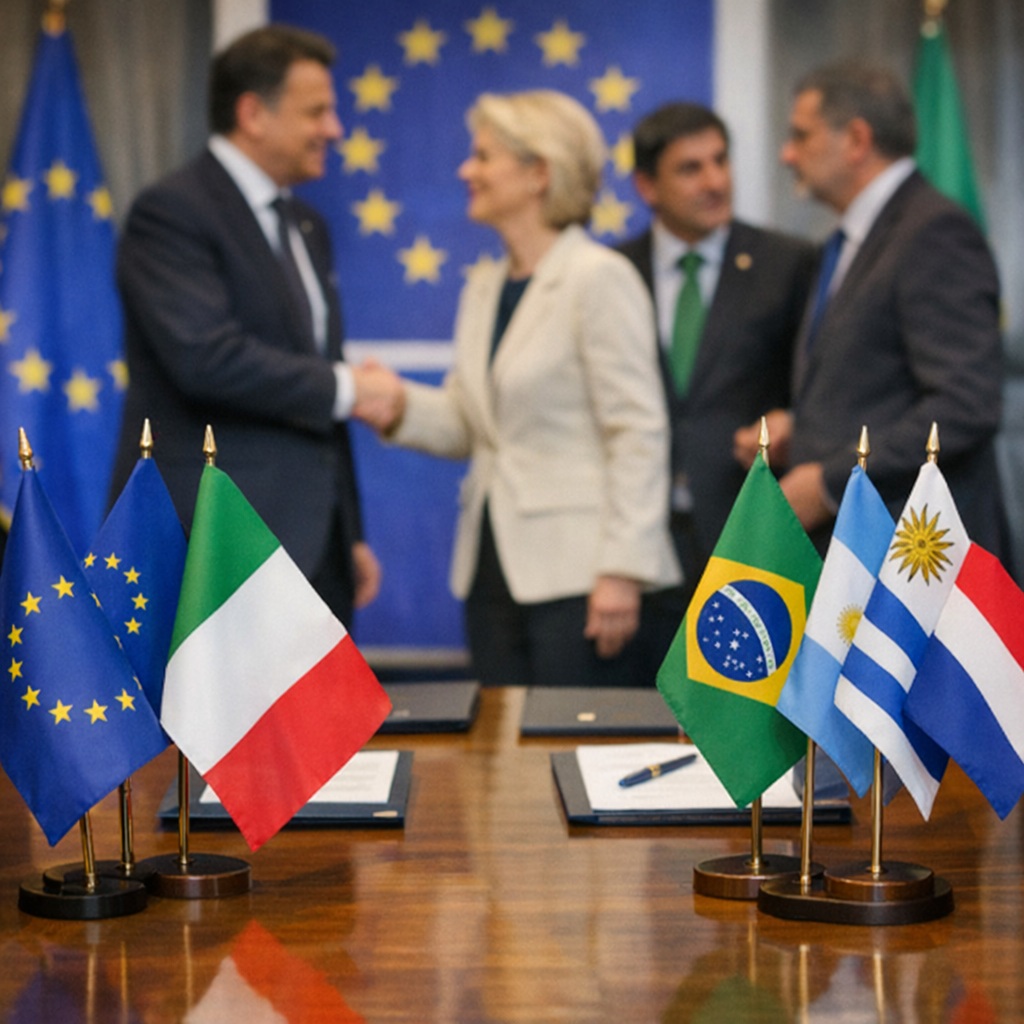
By early January 2026, Italy has emerged as a pivotal supporter of the European Union’s long-negotiated free trade agreement with the Mercosur bloc, giving fresh momentum to one of the most ambitious and controversial trade pacts ever attempted by Brussels. After years of hesitation and internal debate, Rome’s endorsement is being widely interpreted in European capitals as a potential turning point, capable of reshaping the balance of forces around a deal that has divided governments, farmers, and environmental groups across the continent.
The EU–Mercosur agreement, concluded in principle but still awaiting full ratification, would link the European Union with Brazil, Argentina, Uruguay, and Paraguay, creating a vast free trade area encompassing roughly 780 million people. Advocates describe it as a strategic necessity in a world marked by rising protectionism and geopolitical competition, while critics warn of social, environmental, and economic risks—particularly for Europe’s agricultural sector.
Italy’s decision to give key political backing has not come lightly. Successive governments have approached the pact with caution, mindful of the concerns voiced by farmers, regional authorities, and consumer groups. In recent weeks, however, Italian leaders have signaled that a combination of stronger safeguards and strategic opportunity now outweighs the perceived risks.
At the heart of Rome’s position is a demand for robust protections for sensitive agricultural products. Italian officials have insisted that any implementation of the agreement must include effective quotas, safeguard clauses, and strict enforcement of European standards. These measures are intended to shield sectors such as beef, poultry, sugar, and rice from sudden import surges, while defending the integrity of Europe’s geographical indications system—crucial for iconic Italian products like Parmigiano Reggiano, Prosciutto di Parma, and extra-virgin olive oil.
Government sources in Rome stress that support for the deal is conditional, not unconditional. Italy has aligned itself with other cautious member states in calling for binding commitments on sustainability, traceability, and labor standards. The message, officials say, is that trade liberalization must not come at the expense of food safety, environmental protection, or fair competition.
Beyond agriculture, Italy sees significant upside in the agreement for its industrial and manufacturing base. Mercosur countries represent fast-growing markets for European machinery, automotive components, pharmaceuticals, fashion, and high-end consumer goods—sectors in which Italian companies are particularly strong. By reducing tariffs and cutting red tape, the pact could give Italian exporters a decisive advantage over competitors from Asia and North America.
Business associations have welcomed Rome’s stance, arguing that the agreement could help offset sluggish demand within Europe and diversify export destinations at a time of global uncertainty. Small and medium-sized enterprises, a backbone of the Italian economy, are seen as potential beneficiaries if accompanied by adequate support and market access tools.
Italy’s backing also carries symbolic weight within the European Union. As one of the bloc’s largest economies and a country with a powerful agricultural lobby, Rome’s position may influence other hesitant governments. Observers in Brussels note that Italy’s move could help build the qualified majority needed in the Council, while also strengthening the European Commission’s hand in defending the agreement before the European Parliament.
That parliamentary hurdle remains a major obstacle. The EU–Mercosur deal must still be approved by the European Parliament, where opposition spans multiple political groups. Environmental concerns, particularly linked to deforestation in the Amazon and climate commitments, continue to dominate the debate. Italian lawmakers are expected to play a significant role in shaping the final outcome, with Rome promising an active push for additional guarantees and monitoring mechanisms.
Internationally, Italy’s endorsement is being read as part of a broader European effort to reaffirm its role as a global trading power. With supply chains under strain and trade relations increasingly politicized, Brussels sees the Mercosur agreement as a way to anchor long-term partnerships with like-minded regions and secure access to critical raw materials and markets.
For Mercosur countries, Italy’s support is equally significant. It signals that Europe’s internal divisions may be narrowing, offering renewed hope that a deal years in the making could finally move from paper to practice. Leaders in South America have repeatedly emphasized the importance of European engagement as a counterbalance to dependence on a narrow set of global partners.
Still, the road ahead is uncertain. Ratification processes at both EU and national level are complex, and public opinion remains divided. Italy’s leaders are betting that a carefully calibrated approach—combining openness to trade with firm protections—can help reconcile economic ambition with social and environmental responsibility.
As January unfolds, Italy’s shift has injected fresh energy into a debate many believed was stuck in permanent limbo. Whether this momentum will be enough to carry the EU–Mercosur agreement across the finish line remains to be seen. What is clear, however, is that Rome has chosen to step into a central role, shaping not only the future of the pact but also Europe’s broader trade strategy in an increasingly fragmented world.