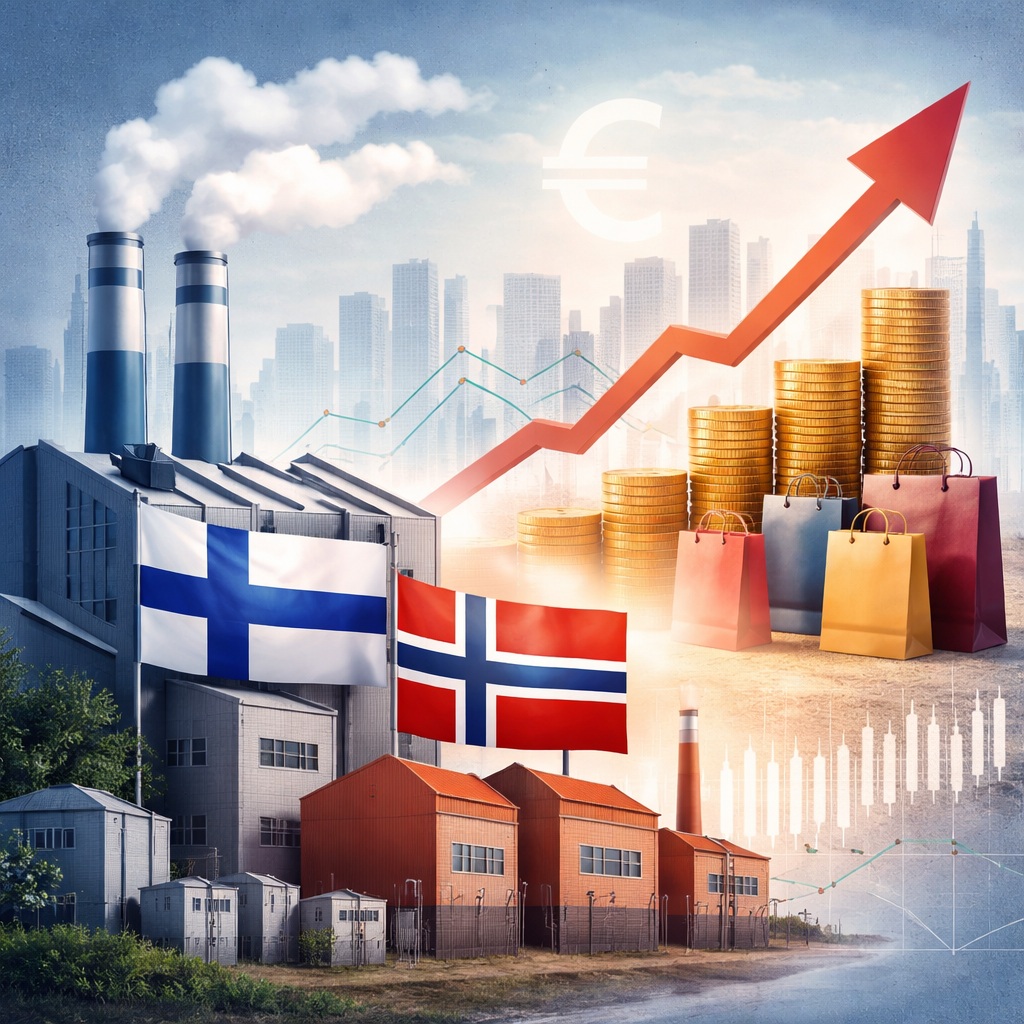
Industrial momentum in Finland contrasts with rising prices in Norway as euro area retail activity strengthens
Industrial indicators from Northern Europe are offering a nuanced picture of the region’s economic trajectory as the new year settles in. Recent data show Finland recording a year‑over‑year increase in industrial output, while neighboring Norway is grappling with firmer consumer price pressures. At the same time, retail sales across the euro area have posted broadly encouraging gains, adding another layer to the evolving European outlook.
In Finland, manufacturing and energy‑related production have provided a welcome boost after a period marked by uneven demand and cautious investment. Analysts point to improving external orders, particularly from core European partners, alongside a gradual normalization of supply chains that had previously constrained output. The uptick is being interpreted as a sign that Finnish industry is adapting to a slower but steadier growth environment, balancing competitiveness with higher operating costs.
Business leaders in Helsinki describe the trend as cautiously positive rather than exuberant. While factories are busier than a year ago, capacity expansion remains selective. Companies are prioritizing efficiency gains, automation, and energy optimization over aggressive scaling, reflecting lingering uncertainty about global demand and geopolitical risks. Still, the improvement in production is helping stabilize employment expectations within the industrial sector.
Across the border in Norway, the focus has shifted toward prices rather than production volumes. Consumer inflation has edged higher, driven by a mix of domestic cost pressures and imported inflation. Energy‑related expenses, services, and food categories have all contributed to the upward movement, complicating the task of policymakers who are trying to balance price stability with economic activity.
Households in Oslo and other urban centers are feeling the squeeze more acutely, as wage growth struggles to fully offset rising living costs. Economists note that Norway’s strong public finances and energy revenues provide buffers, but inflation remains a sensitive issue for consumers and businesses alike. Expectations are that monetary authorities will maintain a vigilant stance, signaling caution rather than a rapid shift toward easing.
Beyond the Nordic region, the euro area has delivered a comparatively brighter signal on the consumption front. Retail sales figures show a broad‑based improvement, suggesting that consumers are gradually regaining confidence despite higher prices and tighter financial conditions. Essential goods remain the backbone of spending, but discretionary categories have also shown tentative resilience.
This pickup in retail activity is being closely watched by policymakers in the common currency bloc. Stronger consumption can help support growth at a time when industrial activity in several member states remains subdued. However, officials are mindful that sustained gains will depend on real income dynamics and the trajectory of inflation across the region.
Taken together, the latest developments highlight the uneven nature of Europe’s economic adjustment. Finland’s industrial rebound underscores the role of export‑oriented manufacturing in anchoring growth, while Norway’s inflationary pressures serve as a reminder that price stability challenges have not fully receded. The euro area’s retail momentum, meanwhile, offers cautious optimism that domestic demand can help carry the recovery forward.
As markets digest these signals, the broader narrative is one of resilience tempered by restraint. Northern Europe is not moving in lockstep, but the combination of improving output, vigilant inflation management, and steadier consumption suggests a region navigating transition rather than crisis. The coming weeks will test whether these early‑year trends can hold amid a complex global backdrop.




 The Tower Post