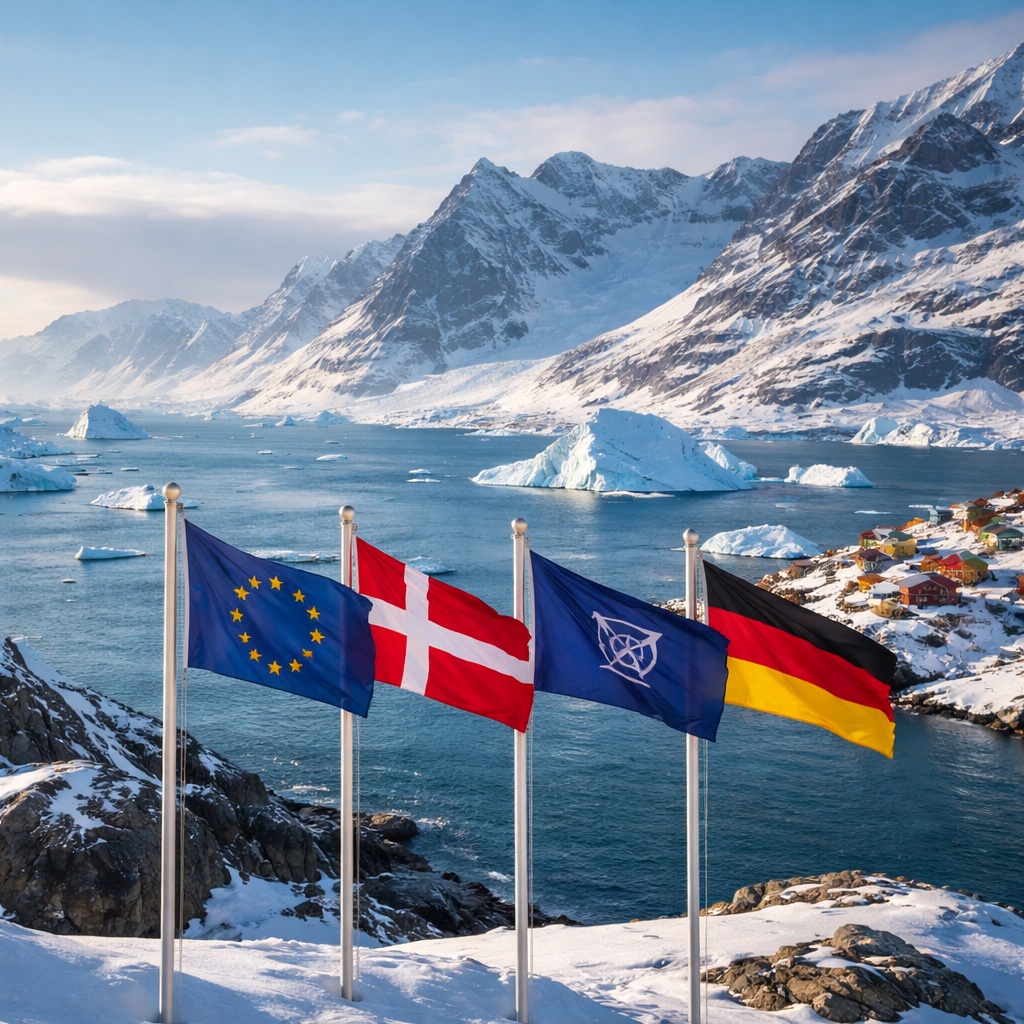
As Washington rhetoric unsettles the Arctic, European allies rally behind Denmark and warn that Greenland’s sovereignty is non-negotiable.

European capitals are closing ranks over Greenland, responding with unusual unity to renewed signals from Washington that have unsettled diplomats and defense planners across the North Atlantic. Led by Germany and backed by a broad coalition of European Union and NATO partners, governments have reaffirmed that Greenland’s status as an integral part of the Kingdom of Denmark is not open to negotiation, sale, or coercion.
The coordinated message, delivered through parallel statements and high-level consultations, reflects growing concern that U.S. pressure—whether political, economic, or strategic—could destabilize one of the world’s most sensitive regions. While officials stress their commitment to the transatlantic alliance, they are also making clear that Arctic sovereignty and European security interests cannot be treated as bargaining chips.
At the center of the response is Denmark, which exercises sovereignty over Greenland while granting the island extensive self-rule. Copenhagen has welcomed the show of solidarity, describing it as essential at a time when the Arctic is rapidly becoming a theater of global competition. European officials privately note that the issue goes beyond Denmark alone, touching on principles of territorial integrity that underpin the postwar order.
Germany has emerged as a key coordinator, using its diplomatic weight to align positions among northern and central European partners. According to senior diplomats, Berlin views the Greenland question as a test case: if borders and sovereignty can be challenged in the Arctic, similar pressure could follow elsewhere. France, the Netherlands, and the Nordic states have echoed this assessment, emphasizing that any attempt to alter Greenland’s status would trigger a collective response.
Security considerations loom large. Greenland occupies a strategic position between North America and Europe, hosting critical infrastructure and sitting astride emerging Arctic sea routes. European defense officials acknowledge the importance of close cooperation with the United States in the region, but they also insist that cooperation must rest on mutual respect. NATO, they say, is strongest when allies trust that their sovereignty will be defended, not debated.
Beyond defense, economic and environmental factors are driving the European stance. Melting ice is opening access to minerals and shipping lanes, raising fears of a resource rush that could marginalize local communities. European governments argue that Greenland’s future must be shaped by its people, in accordance with international law, rather than external strategic ambitions.
Diplomatically, the European message has been calibrated to avoid open confrontation. Public statements stop short of accusing Washington of formal territorial claims, instead warning against “pressure” or “ambiguity” that could undermine stability. Behind closed doors, however, officials say contingency planning is underway, including coordinated diplomatic démarches and potential economic measures should tensions escalate.
The episode underscores a subtle but significant shift in transatlantic relations. While Europe continues to rely on U.S. military power, it is increasingly willing to assert red lines when core interests are at stake. The Arctic, once seen as a remote frontier, has become a proving ground for that evolving balance.
For Greenland itself, the international attention is a double-edged sword. Local leaders welcome investment and security guarantees but remain wary of becoming an object of great-power rivalry. European officials insist that their support is aimed at preserving space for Greenland’s own democratic choices, not constraining them.
As winter tightens its grip on the Arctic, the diplomatic climate is anything but frozen. Europe’s message is clear: solidarity with Denmark is firm, collective action is prepared, and Greenland’s sovereignty is not up for discussion—even among allies.

 The Tower Post