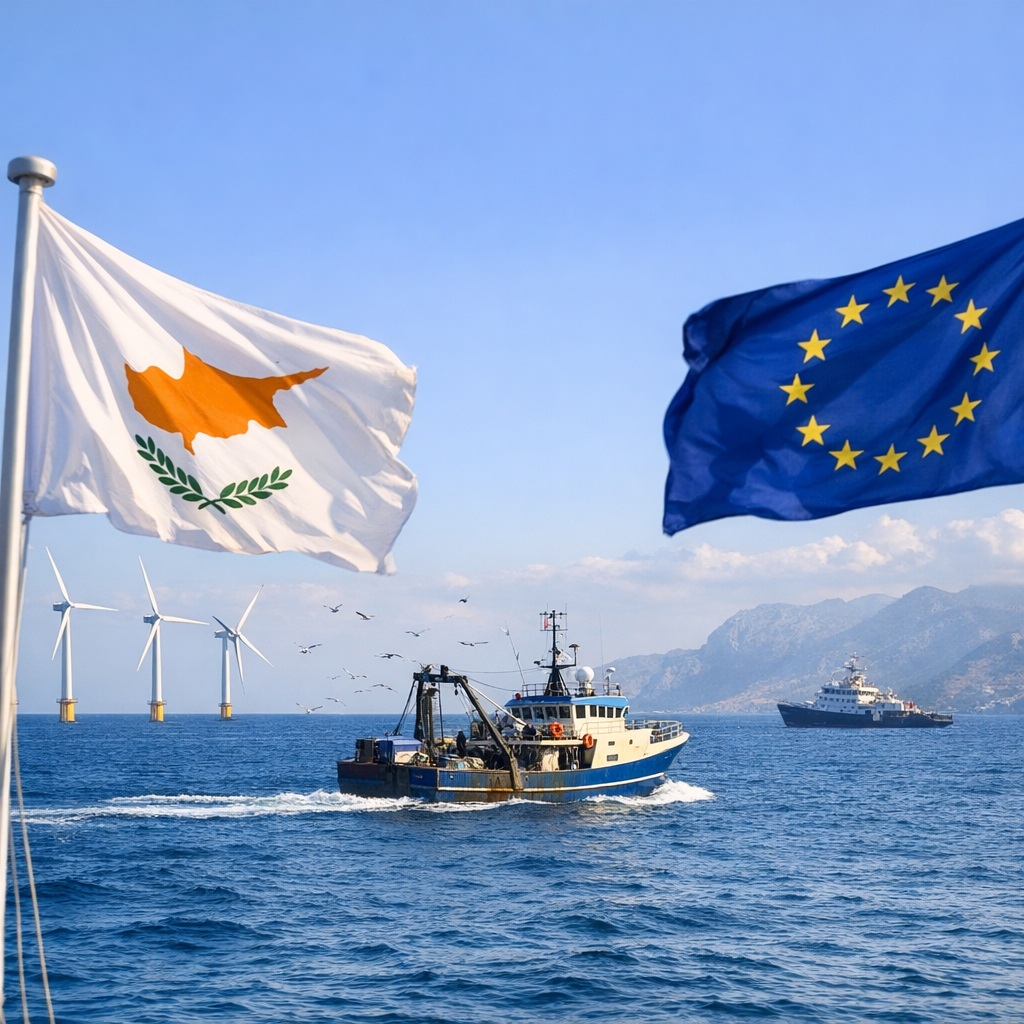
As Cyprus assumes leadership of the EU Council, maritime governance, sustainable fisheries, and the future of Europe’s seas rise to the top of the political agenda.
Cyprus has taken over the rotating presidency of the Council of the European Union at a moment when the bloc’s relationship with the sea is under renewed scrutiny. As the eastern Mediterranean island steers discussions in Brussels and across member state capitals, ocean governance and fisheries policy have emerged as defining priorities, reflecting growing concern over climate pressures, food security, and the strategic importance of maritime spaces.
For Cyprus, a country whose history, economy, and culture are deeply intertwined with the sea, the focus is both political and personal. The presidency’s agenda highlights sustainable fisheries management, marine biodiversity protection, and the modernization of EU ocean law, positioning maritime policy as a central pillar of Europe’s green and geopolitical ambitions.
The timing is significant. European seas are warming faster than many global averages, fish stocks face mounting stress, and coastal communities are grappling with economic uncertainty. Against this backdrop, Cyprus is framing its presidency as an opportunity to reconnect European policymaking with the realities of life at sea, while advancing consensus among often-divergent national interests.
At the heart of the debate lies the reform and implementation of fisheries legislation. Long-standing rules designed to prevent overfishing and ensure stock recovery are under pressure from rising fuel costs, changing migration patterns of fish, and competition from non-EU fleets. Cyprus has signaled that it will push for a balanced approach, combining scientific advice with social considerations for small-scale fishers, particularly in the Mediterranean.
Officials involved in the presidency have emphasized that sustainability cannot be treated as an abstract goal. Instead, they argue, it must translate into workable policies that protect ecosystems while keeping coastal economies viable. This framing resonates with several southern member states, where artisanal fishing remains a cultural backbone but struggles to survive in an increasingly industrialized sector.
Ocean governance, however, extends well beyond fisheries. Cyprus is also expected to advance discussions on marine spatial planning, offshore renewable energy, and the protection of sensitive habitats. The Mediterranean, often described as a climate change hotspot, serves as a testing ground for policies that may later be scaled up across the Atlantic and northern seas.
A key challenge for the presidency will be aligning environmental ambition with political reality. Northern and western member states, with larger industrial fleets and broader maritime zones, often prioritize different policy tools than their southern counterparts. Cyprus, positioned at the crossroads of Europe, the Middle East, and North Africa, is seeking to play the role of mediator, encouraging compromise without diluting core environmental objectives.
International dimensions also loom large. The EU is a major global actor in fisheries management, negotiating access agreements and sustainability standards with partners worldwide. Cyprus has indicated that it will use its presidency to strengthen the EU’s voice in international ocean forums, advocating for stricter enforcement of conservation measures and greater cooperation against illegal, unreported, and unregulated fishing.
Geopolitics adds another layer of complexity. Maritime routes in the eastern Mediterranean are strategically vital, not only for trade but also for energy security. As offshore gas exploration and undersea infrastructure expand, questions of environmental risk, sovereignty, and regional stability intersect with EU ocean policy, providing the presidency with a platform to promote dialogue and reinforce commitment to rules-based maritime governance.
Climate adaptation is expected to feature prominently in discussions. Rising sea levels, coastal erosion, and extreme weather events are already affecting European shorelines, prompting Cyprus to advocate for stronger integration of climate resilience into maritime and fisheries policies and to argue that adaptation measures must go hand in hand with emissions reduction.
Civil society and scientific voices are also being drawn into the conversation. Environmental organizations have welcomed the presidency’s emphasis on oceans while urging concrete action rather than symbolic commitments, and researchers are calling for better data sharing and increased investment in marine science to underpin policy decisions with robust evidence.
As the presidency unfolds, success will be measured less by grand declarations than by incremental progress. Advancing legislation, building consensus, and keeping oceans high on the EU’s crowded agenda will test Cyprus’s diplomatic skill, yet the country’s maritime identity lends credibility to its ambitions and allows it to speak with authority on issues that are existential for island and coastal nations alike.
By placing oceans and fisheries at the center of its term, Cyprus is reminding Europe that the sea is not a peripheral concern but a defining element of its future. In an era of environmental uncertainty and geopolitical flux, the way the European Union governs its waters may prove as important as the policies it adopts on land.


 The Tower Post