
No-confidence motions expose fractures in Paris as trade pact reignites debate over sovereignty, farming, and Europe’s future.
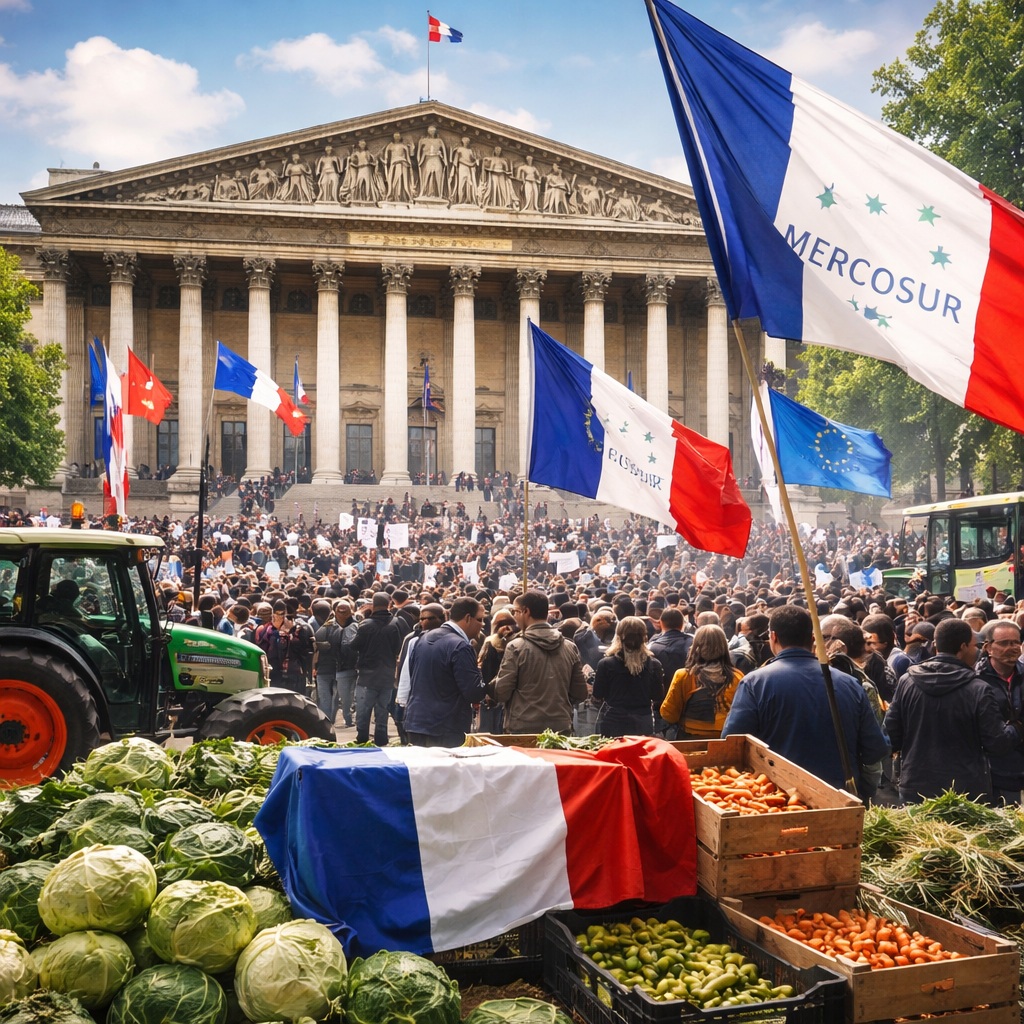
French politics entered a new phase of confrontation this week as opposition parties moved to challenge the government’s legitimacy over its handling of the European Union–Mercosur trade agreement. The filing of no-confidence motions in the National Assembly underscored the intensity of resistance to the deal and highlighted how trade policy has become a lightning rod for broader anxieties about globalization, agriculture, and democratic accountability.
The controversy erupted after the government failed to prevent progress toward the ratification of the long-negotiated accord between the European Union and the Mercosur bloc, which includes Brazil, Argentina, Uruguay, and Paraguay. For critics across the political spectrum, the episode symbolized what they see as a recurring pattern: decisions of far-reaching economic and social consequence being shaped at the European level, while national governments appear constrained or unwilling to intervene decisively.
Opposition lawmakers accused the executive of political weakness and strategic ambiguity. Left-wing parties framed the agreement as a threat to environmental standards and workers’ rights, arguing that imports from South America would undercut French farmers and reward practices incompatible with Europe’s climate ambitions. On the right and far right, the criticism took a more sovereigntist tone, portraying the deal as another example of Brussels overriding national interests and exposing domestic producers to what they call unfair competition.
The government, for its part, has sought to strike a careful balance. Officials reiterated their concerns about environmental safeguards and agricultural protections, while insisting that France remains committed to shaping European trade policy from within rather than blocking it outright. This stance, however, has done little to appease critics who see hesitation as complicity.
At the heart of the dispute lies the agricultural sector, long a sensitive fault line in French politics. Farmers’ unions have warned that increased imports of beef, poultry, and sugar could depress prices and erode already fragile livelihoods. Recent protests in rural areas lent urgency to these fears, reinforcing the perception that the Mercosur agreement touches not only trade balances but also cultural identity and territorial cohesion.
Beyond agriculture, the no-confidence motions reflect deeper institutional tensions. Opposition leaders argue that the government’s approach reveals a democratic deficit, with parliamentary scrutiny lagging behind executive diplomacy. Supporters of the motions say the issue is less about the technical details of the trade deal and more about restoring political accountability in an era of complex international negotiations.
While the likelihood of the government actually falling remains uncertain, the symbolic impact of the challenge is significant. It exposes the fragility of parliamentary alliances and the difficulty of governing in a fragmented Assembly. Even if the motions fail, they force the executive to confront a narrative of isolation at home and diminished influence abroad.
The Mercosur episode also resonates beyond France. Across Europe, the agreement has encountered resistance from member states wary of its environmental and social implications. France’s domestic turmoil thus mirrors a wider European debate about how open the continent should be to global trade, and under what conditions.
As the political standoff continues, the government faces a narrowing margin for maneuver. Any attempt to salvage credibility will require clearer positioning, both toward Brussels and toward voters increasingly skeptical of trade liberalization. For the opposition, the challenge is to transform discontent into a coherent alternative, rather than a temporary convergence of grievances.
In the coming days, the fate of the no-confidence motions will signal more than parliamentary arithmetic. It will offer a snapshot of a country wrestling with its place in Europe and the world, as trade policy becomes a proxy for questions of sovereignty, sustainability, and democratic control.


 The Tower Post