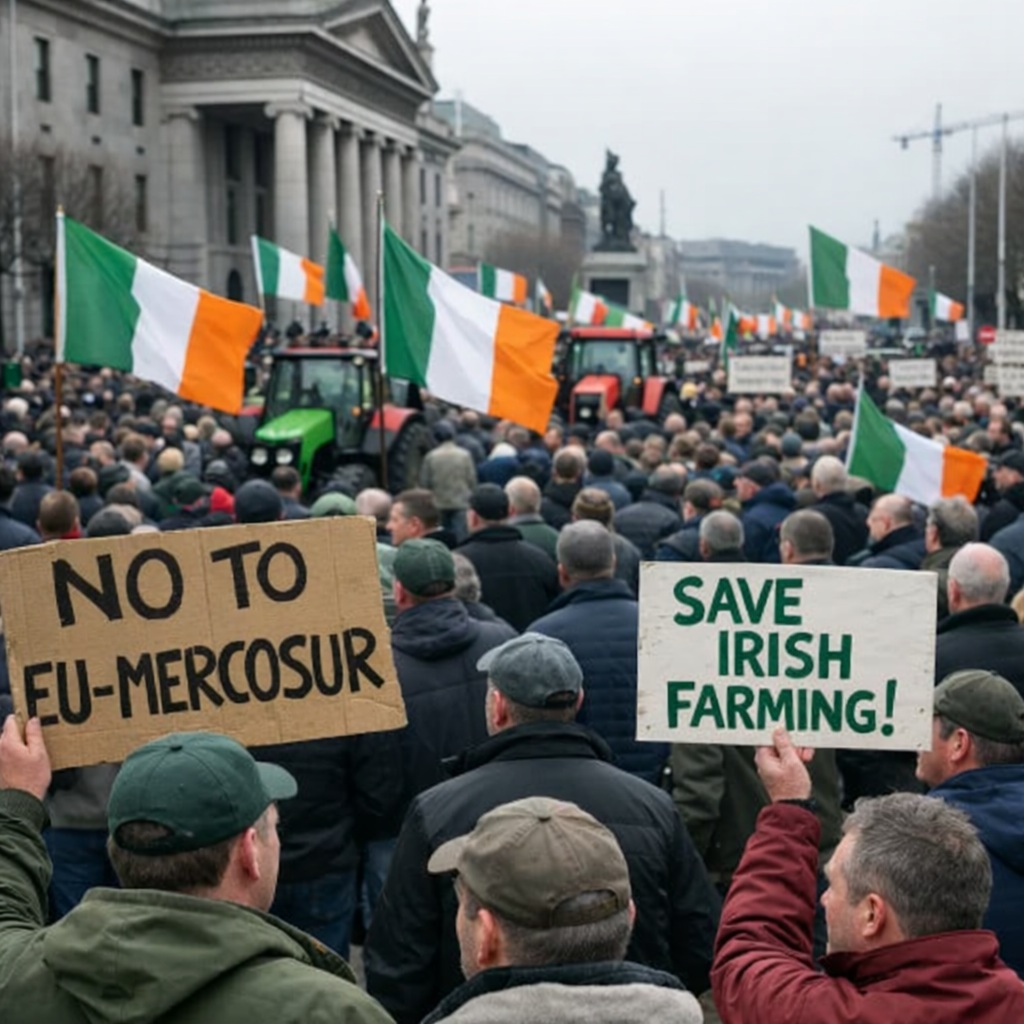
Mass mobilization across Ireland reflects deep concerns over agricultural livelihoods, food standards, and the future of rural communities.
Thousands of Irish farmers have taken to the streets in a coordinated wave of protests, voicing fierce opposition to the proposed European Union–Mercosur trade agreement. The demonstrations, which unfolded across major cities, ports, and rural hubs, underscore a growing unease within Ireland’s farming community over the impact of global trade policies on domestic agriculture.
Carrying placards, driving tractors into city centers, and blocking key transport routes, farmers sent a clear message to policymakers in Dublin and Brussels: the EU-Mercosur pact, in its current form, is viewed as a direct threat to Ireland’s agricultural model. At the heart of the protests lies a fear that increased imports of beef, poultry, and other agricultural products from South America will undercut Irish farmers, who operate under some of the world’s strictest environmental, animal welfare, and food safety standards.
Ireland’s farming sector, particularly beef and dairy, is deeply export-oriented and tightly regulated. Farmers argue that opening the European market to large-scale producers from Mercosur countries—Brazil, Argentina, Uruguay, and Paraguay—creates an uneven playing field. While Irish producers face rising costs linked to climate targets, biodiversity protections, and traceability requirements, they fear competing imports may not be held to equivalent standards.
“This is not about opposing trade,” said one protest organizer at a rally outside a government building. “It’s about fairness, survival, and the future of farming families who have stewarded this land for generations.” Such sentiments echoed through crowds that included multigenerational farmers, young agricultural workers, and representatives of farming organizations from across the country.
The protests also reflect broader anxiety about rural decline. Many farmers warn that sustained price pressure could accelerate the closure of family farms, hollowing out rural communities and concentrating food production in fewer hands. For younger farmers, already struggling with land access and financial viability, the agreement is seen as another barrier to staying in agriculture.
Government officials have sought to calm tensions, emphasizing that the EU-Mercosur agreement remains subject to ratification and includes safeguards for sensitive sectors. Irish authorities have pledged to defend national agricultural interests in ongoing negotiations, while also acknowledging the strategic importance of trade diversification for the European Union.
However, trust between farmers and policymakers appears strained. Protesters argue that previous assurances have failed to prevent income volatility and market shocks. Many point to past trade deals as evidence that compensation mechanisms arrive late or fall short of covering long-term losses.
Environmental groups have also weighed in, some aligning with farmers’ concerns. Critics of the pact argue that increased imports from regions linked to deforestation and high-emission farming practices could undermine the EU’s climate ambitions. For Irish farmers, who are under mounting pressure to reduce emissions, the prospect of importing cheaper, higher-carbon products is seen as contradictory and demoralizing.
At the European level, the EU-Mercosur deal has become increasingly controversial, facing resistance not only from Ireland but from farming communities in several member states. The Irish protests form part of a wider continental debate over how Europe balances free trade, food security, environmental responsibility, and social cohesion.
As tractors rolled through streets and crowds gathered in winter conditions, the demonstrations highlighted the political weight of agriculture in Ireland. Farming remains central not only to the economy but to national identity, and the backlash against the trade deal reflects fears that this identity is being sidelined in favor of global market access.
For now, Irish farmers say their protests will continue until concrete changes are made. They are calling for stronger protections, binding standards for imports, and a rethinking of trade policies that, in their view, prioritize volume over values. The message from the fields to the corridors of power is clear: without meaningful safeguards, the EU-Mercosur agreement risks losing the support of those who feed the nation.


 The Tower Post