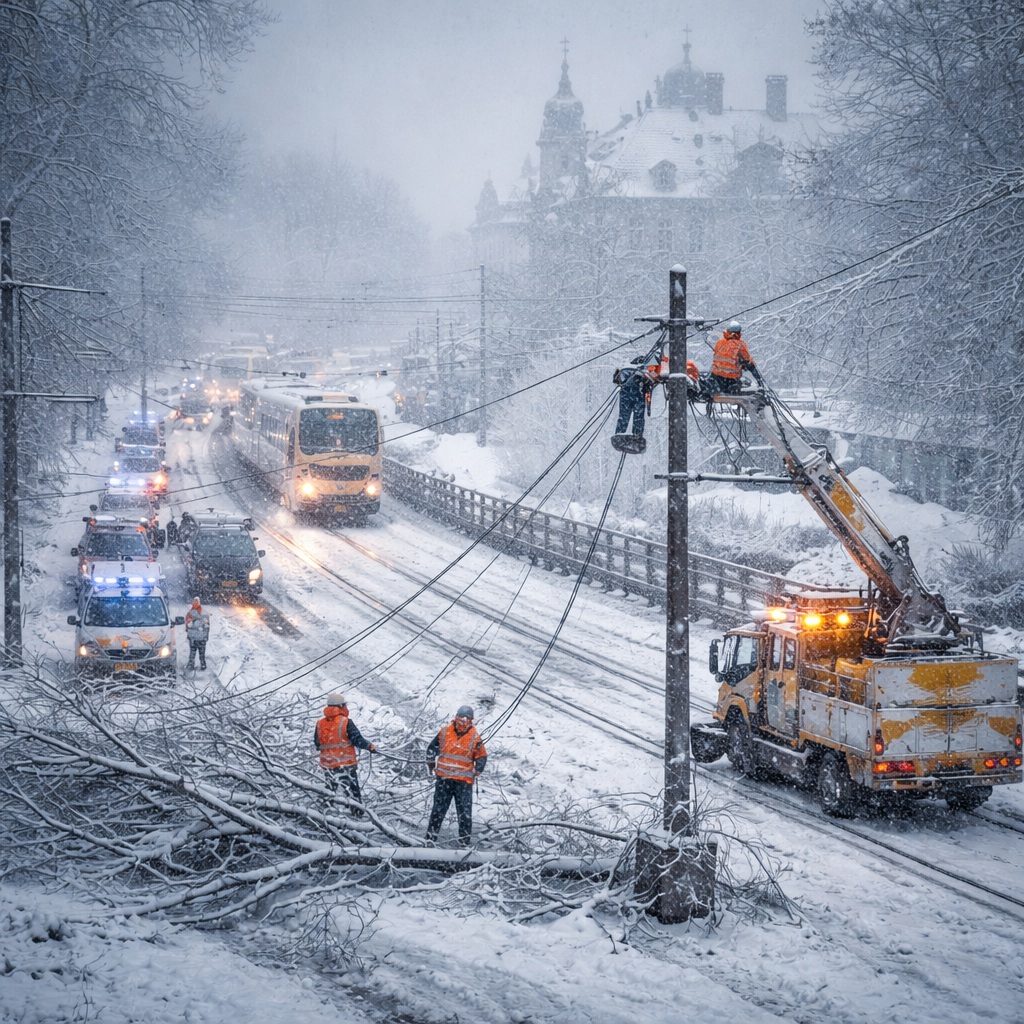
Fierce winds and heavy snow cut power, halt transport, and test emergency services across multiple countries
Storm Goretti swept across northern Europe this week, unleashing a volatile mix of hurricane-force winds, heavy snowfall, and freezing temperatures that plunged millions into darkness and brought large parts of the continent’s transport network to a standstill.
From the Atlantic coasts to inland industrial regions, the storm exposed the fragility of winter infrastructure as electricity grids failed, airports shut down, and rail services were suspended with little warning. Authorities across Britain, France, Germany, and the Netherlands urged residents to stay indoors as conditions deteriorated rapidly, particularly overnight when wind gusts intensified and snow accumulated faster than expected.
In Britain, utility companies worked through the night to restore power after high winds tore down overhead lines and uprooted trees, blocking rural roads and isolating smaller communities. Emergency services reported a surge in call-outs linked to fallen debris, damaged roofs, and traffic accidents on icy roads. Rail operators suspended several intercity routes, citing safety concerns as snowdrifts and ice interfered with signalling systems.
Across the Channel, northern France faced similar disruption. Coastal regions bore the brunt of the storm, with ports temporarily closed and ferry crossings cancelled. Inland, heavy snow blanketed highways, forcing authorities to impose driving restrictions for heavy goods vehicles. Schools in several districts remained closed as local officials assessed structural damage and heating failures.
Germany experienced widespread transport delays as Storm Goretti moved eastward. Airports in major hubs reported grounded flights after runways became unsafe, while long-distance rail connections were halted in parts of the country. Energy providers warned that repairs could be slowed by continued high winds, complicating efforts to reach damaged pylons and substations.
In the Netherlands, where the flat landscape leaves infrastructure exposed, powerful gusts disrupted both air and rail travel. Schiphol Airport operated at reduced capacity, and several regional train lines were suspended. Municipal authorities advised cyclists to avoid open areas and bridges, where wind conditions were described as particularly hazardous.
Meteorologists described Storm Goretti as part of a broader pattern of unstable winter weather affecting northern Europe, driven by sharp contrasts between Arctic air masses and milder Atlantic systems. While such storms are not unprecedented, experts noted that their increasing intensity places added strain on aging infrastructure.
As the storm slowly weakened, attention turned to recovery. Crews continued to clear roads, restore electricity, and inspect transport networks for damage. For many residents, however, the blackout and travel chaos served as a stark reminder of how quickly extreme weather can disrupt daily life across an interconnected Europe.



 The Tower Post