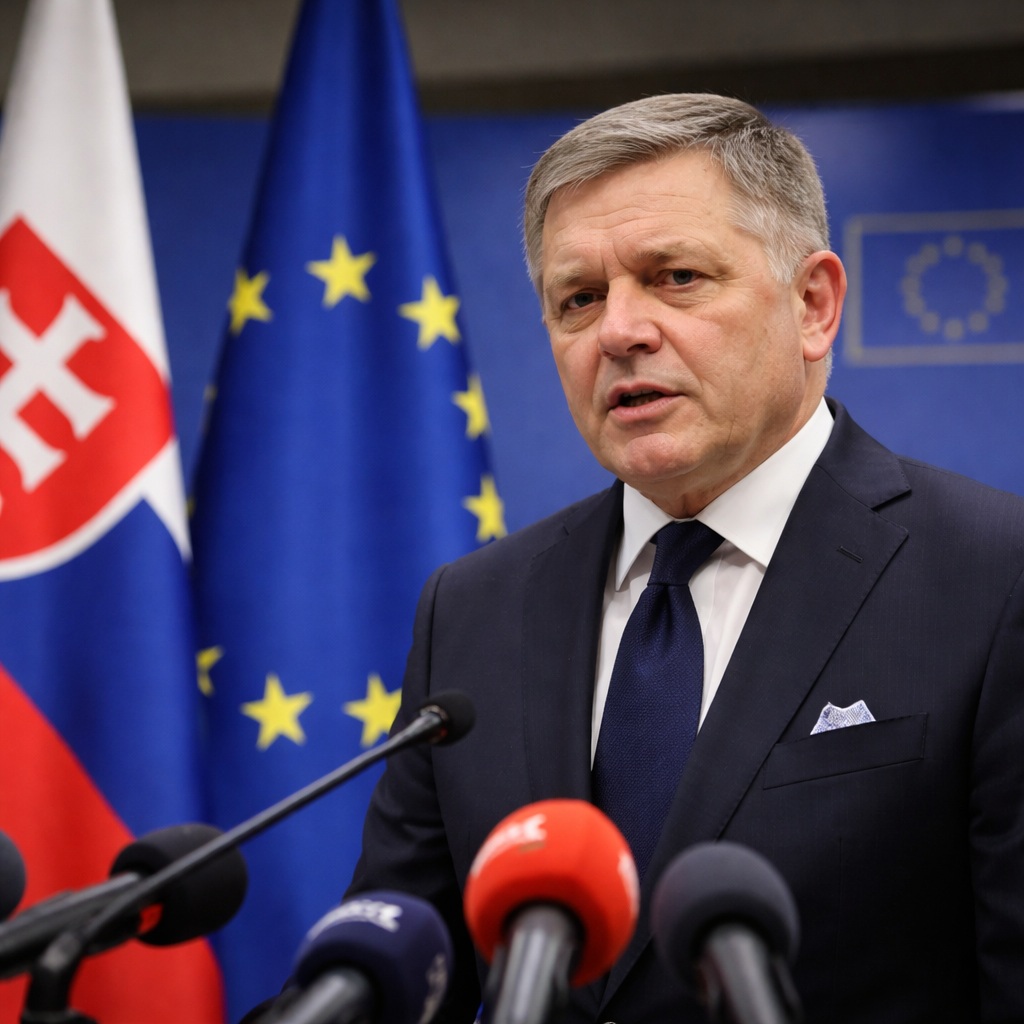
Slovakia’s prime minister insists EU membership is non-negotiable while urging political change at home and questioning the Union’s leadership tone.
Slovakia’s prime minister, Robert Fico, has again placed his country at the center of a wider European debate, arguing that “living space” for national interests still exists within the European Union while openly calling for the departure of EU foreign policy chief Kaja Kallas. The remarks, delivered amid heightened political tension at home and uncertainty abroad, underline a familiar message from Bratislava: Slovakia’s place in the EU is secure, but its voice must be sharper, louder, and less constrained.
Fico’s comments reflect a careful balancing act. On one hand, he reaffirmed that EU membership is not up for discussion, portraying it as a strategic anchor for Slovakia’s economy, security, and international standing. On the other, he framed Brussels as an arena where political contestation is legitimate and even necessary. According to the prime minister, the Union is not a closed ideological space but one that must accommodate divergent national priorities.
At the heart of the controversy is Fico’s criticism of Kallas, whose firm stance on foreign policy and security has drawn praise in some European capitals and unease in others. Fico accused her of adopting an approach that leaves insufficient room for national discretion, particularly for smaller member states navigating complex regional pressures. His call for her exit was not framed as a rejection of EU institutions, but as a demand for leadership that better reflects political plurality.
This rhetoric resonates with Fico’s domestic audience, where skepticism toward centralized EU decision-making has grown alongside concerns about economic pressures and security risks. By insisting that “living space” remains within the EU, Fico is signaling that sovereignty and membership are not mutually exclusive. Instead, he argues, they must coexist through constant negotiation.
Political analysts note that this strategy allows Fico to appeal simultaneously to pro-European voters and to those wary of Brussels’ influence. The message is one of firmness rather than rupture. Slovakia, in this narrative, is not seeking isolation but recalibration.
The timing of the remarks is significant. Across Europe, debates over the Union’s future direction have intensified, with questions about enlargement, defense, and democratic legitimacy dominating the agenda. Fico’s intervention taps into a broader unease about whether EU leadership adequately reflects the diversity of its members.
Critics, however, warn that targeting senior EU officials risks deepening divisions at a moment when unity is crucial. They argue that personalizing disagreements could weaken Slovakia’s leverage rather than strengthen it. Supporters counter that frank confrontation is sometimes necessary to prevent smaller states from being sidelined.
What emerges from Fico’s latest statements is a familiar but sharpened posture: loyalty without deference. By asserting that Slovakia’s EU membership is non-negotiable, he draws a clear boundary against speculation about withdrawal. By demanding change in tone and leadership, he challenges the Union to prove that it remains flexible enough to accommodate dissent.
As Europe continues to navigate geopolitical uncertainty and internal transformation, Slovakia’s prime minister appears determined to test how much space truly exists within the European project. The coming months will show whether this approach translates into greater influence in Brussels or whether it merely adds another layer of friction to an already complex political landscape.


 The Tower Post