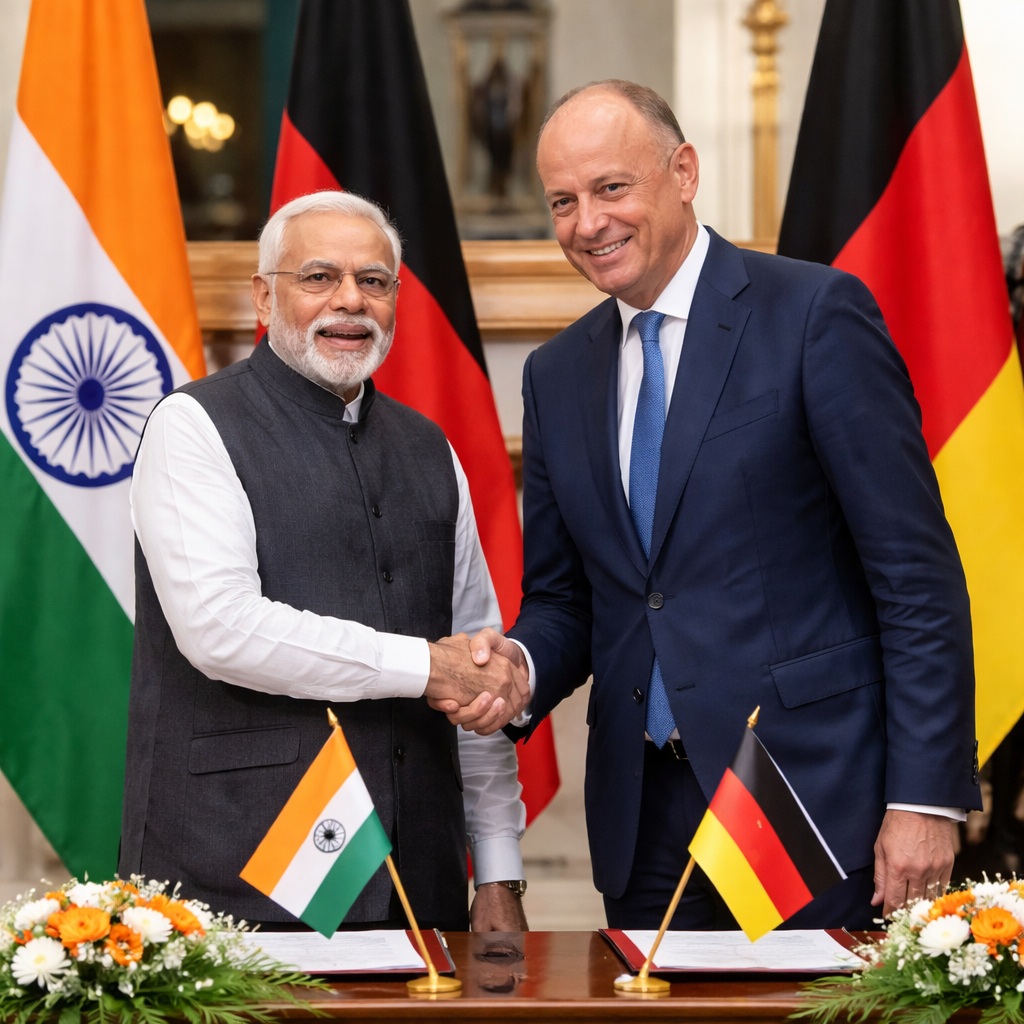
New Delhi and Berlin signal a strategic convergence as Prime Minister Narendra Modi and German Chancellor Friedrich Merz seal agreements aimed at reshaping trade flows and strengthening security cooperation.
India and Germany have entered a new phase of their bilateral relationship, marked by a series of agreements that underscore a growing alignment between Europe’s largest economy and the world’s most populous democracy. The understandings, signed during high-level talks between Prime Minister Narendra Modi and German Chancellor Friedrich Merz, reflect a shared determination to expand economic cooperation while responding to an increasingly complex global security environment.
The discussions took place against a backdrop of geopolitical uncertainty and shifting supply chains, with both sides emphasizing the importance of reliable partnerships. For India, Germany represents a gateway to advanced manufacturing, green technology, and deeper integration with European markets. For Germany, India is emerging as a crucial partner in Asia, offering scale, growth, and strategic balance in a rapidly evolving Indo-Pacific.
Economic cooperation stood at the center of the talks. The agreements aim to facilitate smoother trade flows, encourage joint ventures, and reduce regulatory friction for businesses operating across borders. German companies have long been active in India’s industrial landscape, particularly in automotive engineering, chemicals, and machinery. The new framework seeks to accelerate this presence while opening additional space for Indian firms in the German and wider European markets.
Both leaders highlighted the importance of resilient supply chains, a theme that has gained urgency as global trade faces repeated disruptions. By coordinating standards and promoting technology transfer, New Delhi and Berlin hope to mitigate vulnerabilities and enhance competitiveness. Clean energy, digital infrastructure, and advanced manufacturing were identified as priority sectors for future collaboration.
Beyond economics, security cooperation featured prominently in the joint statements. The agreements outline closer coordination on defense technology, cybersecurity, and intelligence sharing. While neither side framed the partnership as directed against any specific actor, the emphasis on maritime security, counterterrorism, and protection of critical infrastructure points to shared concerns over regional instability and hybrid threats.
Germany’s evolving security posture, shaped by renewed attention to defense and strategic autonomy, has opened space for deeper engagement with partners outside Europe. India, meanwhile, continues to broaden its network of security relationships, balancing longstanding ties with new strategic engagements. The convergence between the two reflects a pragmatic recognition that economic strength and security are increasingly intertwined.
Diplomatically, the talks also carried symbolic weight. They signaled Germany’s intention to remain an active global player despite domestic and regional challenges, and India’s ambition to position itself as a central pillar of a multipolar order. Observers note that the tone of the engagement suggested a relationship moving beyond transactional cooperation toward a more strategic, long-term alignment.
As global power dynamics continue to shift, the strengthened India–Germany partnership illustrates how middle and major powers are recalibrating their alliances. The agreements signed are unlikely to transform the relationship overnight, but they lay the groundwork for sustained collaboration at a moment when both countries are seeking dependable partners.
For businesses, policymakers, and security planners on both sides, the message is clear: New Delhi and Berlin are investing in a shared future, one that blends economic opportunity with strategic coordination. The coming months will test how effectively these commitments translate into action, but the political signal sent by the two leaders is unmistakable.


 The Tower Post