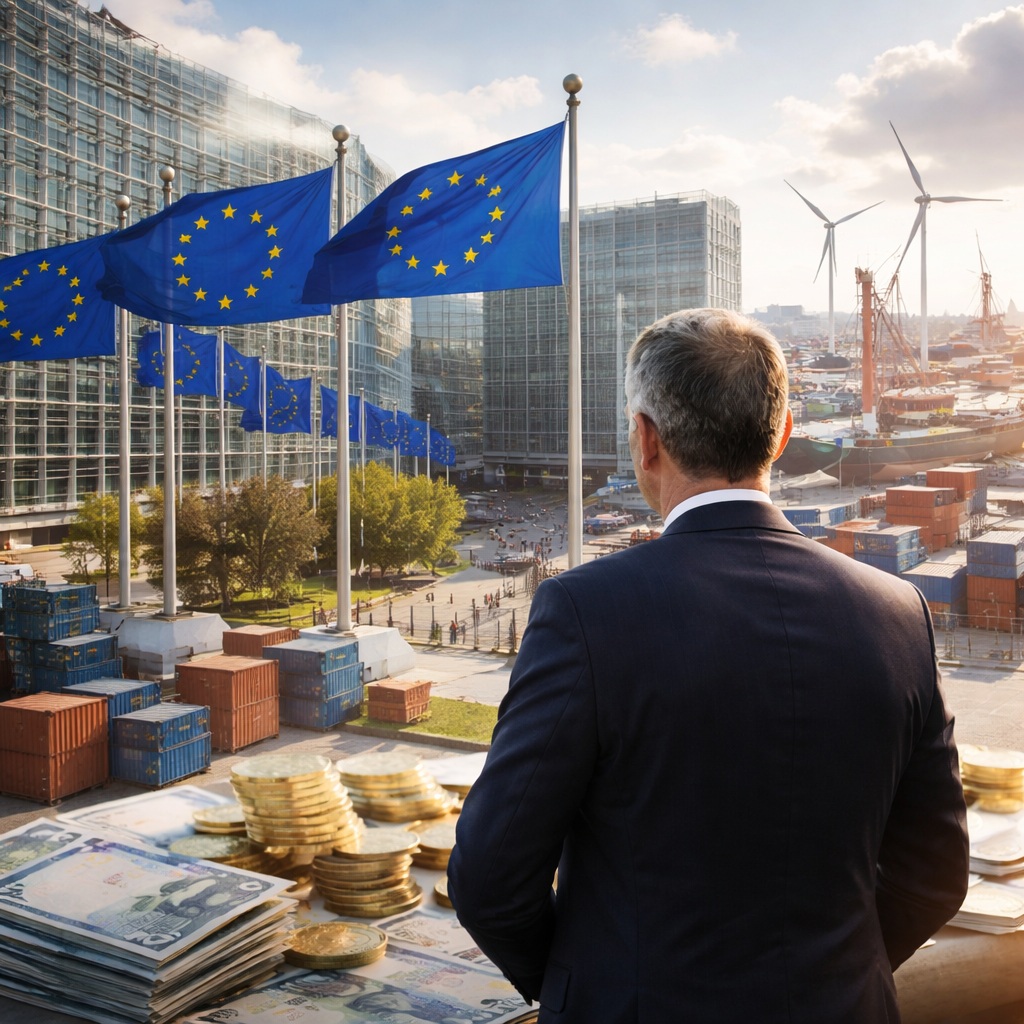
Germany’s finance minister calls for a new industrial creed to protect jobs, reduce strategic vulnerabilities, and strengthen the continent amid intensifying global competition.
In a period marked by sharpening global rivalries and the growing use of trade as a political weapon, Germany’s finance minister has issued a call that resonates well beyond Berlin. Speaking at the heart of Europe’s economic debate, he urged a new era of “European patriotism” in economic policy, arguing that the continent must act with greater unity and resolve if it is to protect its prosperity and social model.
The message was clear: Europe can no longer afford to treat economic policy as a purely national affair or to rely excessively on external partners whose priorities may shift overnight. Instead, the minister advocated a coordinated approach that binds public support, industrial strategy, and market access to the preservation of jobs and know-how within Europe.
At the core of his appeal lies a concern increasingly shared across European capitals. Global competition is no longer just about efficiency or innovation; it is also about power. Tariffs, export controls, and subsidies have become tools of geopolitical influence, blurring the lines between economic policy and national security. In this environment, Europe’s openness, long seen as a strength, risks becoming a vulnerability if it is not matched by strategic foresight.
The finance minister’s proposal centers on a more conditional use of state aid. Public funds, he argued, should come with clear expectations: companies benefiting from European or national support must commit to maintaining production capacity and employment within the continent. The aim is not protectionism in the classic sense, but a rebalancing of incentives so that Europe does not finance its own industrial hollowing-out.
Such ideas reflect a broader shift in European thinking. For decades, the European Union championed strict competition rules and minimal state intervention, believing that open markets alone would deliver resilience. Today, that confidence is being tested. The rise of heavily subsidized competitors abroad and the strategic use of trade barriers have forced policymakers to reconsider the limits of laissez-faire principles.
Another key pillar of the minister’s argument is diversification. Europe’s deep economic ties with the United States remain vital, but recent experience has shown the risks of overdependence on any single market or regulatory framework. When trade relations are strained or when export controls are imposed for strategic reasons, European firms can find themselves caught in the crossfire.
To mitigate these risks, the finance minister called for a deliberate expansion of Europe’s economic partnerships. This means strengthening ties with emerging markets, deepening cooperation within Europe’s own neighborhood, and investing in supply chains that are more resilient and geographically balanced. Diversification, in this view, is not about turning away from traditional allies, but about ensuring that Europe retains room to maneuver.
The appeal to “European patriotism” is also a political signal. It reflects an effort to bridge the gap between economic policy and public sentiment. Across the continent, voters are increasingly skeptical of globalization that appears to benefit corporations while leaving workers exposed. By framing industrial policy in terms of job security and shared European interests, policymakers hope to rebuild trust in the European project.
Critics, however, warn of potential pitfalls. Tying state aid too closely to job preservation could slow necessary restructuring in declining sectors, while an overly interventionist approach risks fragmenting the single market if member states pursue competing national agendas under a European banner. The challenge, they argue, will be to ensure that “European patriotism” strengthens integration rather than undermines it.
Supporters counter that the alternative—strategic passivity—is far riskier. Without a coordinated response, Europe could see critical industries erode, technological leadership slip away, and political cohesion weaken under external pressure. From this perspective, a measured use of state power is not a retreat from European values, but a means of defending them.
The debate comes at a moment when Europe is reassessing its place in the world. Climate transition, digital transformation, and security concerns are converging, placing unprecedented demands on economic policy. The finance minister’s call adds momentum to discussions already under way in Brussels about reforming competition rules, accelerating investment, and defining what strategic autonomy should mean in practice.
Whether the concept of “European patriotism” will translate into concrete policy remains an open question. It will require delicate compromises between member states with different economic structures and political priorities. Yet the fact that such language is now being used by one of Europe’s most influential economic voices underscores how much the context has changed.
What is certain is that Europe’s economic future will be shaped as much by strategic choices as by market forces. In urging his partners to think and act more collectively, Germany’s finance minister has tapped into a growing sense that resilience, solidarity, and competitiveness must go hand in hand if Europe is to navigate an increasingly contested global landscape.
 The Tower Post