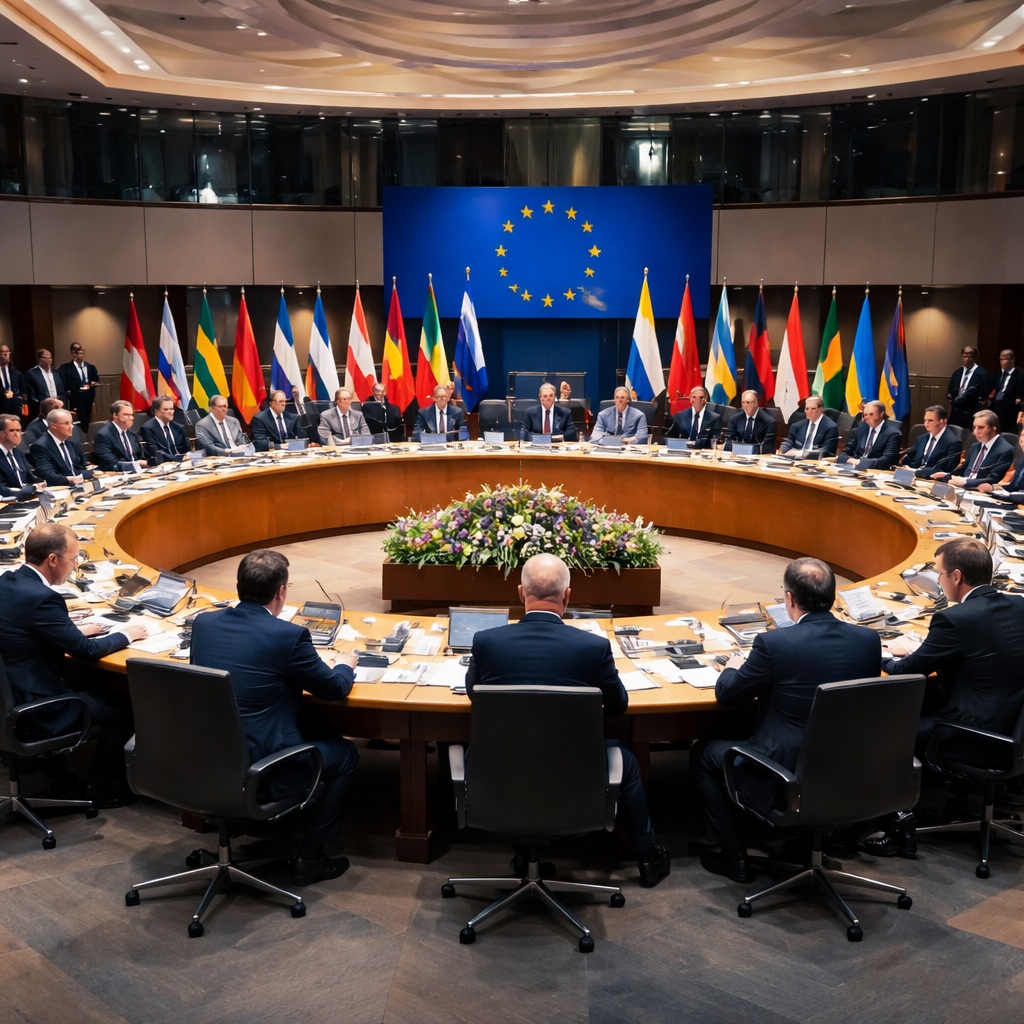
Under the Cyprus presidency, EU leaders weigh strategic priorities as global power balances shift and regional pressures intensify.
Political uncertainty has become a defining feature of Europe’s public life as the continent navigates a rapidly changing geopolitical landscape. From renewed great-power competition to persistent instability on its borders, the European Union finds itself at a crossroads. Under the rotating presidency held by Cyprus, EU leaders are engaged in a complex debate over strategic priorities, seeking cohesion at a moment when unity is both most needed and most fragile.
Across European capitals, the sense of living through a period of transition is unmistakable. Traditional assumptions about security, trade, and diplomacy are being challenged by events beyond the EU’s immediate control. The global order that once offered relative predictability has given way to a more fragmented environment, marked by assertive regional powers, volatile alliances, and growing competition over technology, energy, and influence.
At the heart of current discussions is the question of Europe’s strategic autonomy. Long a topic of academic and diplomatic debate, it has taken on new urgency as external shocks have exposed vulnerabilities in supply chains, defense capabilities, and energy systems. The Cyprus presidency has placed this issue firmly on the agenda, encouraging member states to move from rhetoric toward more concrete policy coordination.
Yet agreement remains elusive. Larger member states tend to emphasize defense and industrial capacity, arguing that Europe must be able to act independently when its interests are at stake. Smaller countries, including those on the Union’s periphery, stress the importance of alliances and international law, wary of initiatives that could weaken transatlantic ties or strain limited national resources. Cyprus, with its own history of regional tension, has sought to bridge these perspectives by framing autonomy not as isolation, but as resilience.
Geography plays a crucial role in shaping these debates. The eastern Mediterranean, where Cyprus sits at a strategic crossroads, has become a focal point of overlapping crises. Conflicts in neighboring regions, irregular migration routes, and competition over maritime resources have all fed into a broader sense of insecurity. For southern member states, these challenges are not abstract scenarios but daily realities that demand coordinated European responses.
Economic pressures further complicate the political picture. Inflationary trends, uneven growth, and concerns about competitiveness have fueled domestic discontent in several countries. Populist and protest movements have capitalized on these anxieties, questioning the effectiveness of EU institutions and, in some cases, the value of integration itself. This internal political fragmentation weakens Europe’s external posture, making it harder to project confidence and coherence abroad.
The Cyprus presidency has emphasized the link between internal stability and external credibility. In policy papers and ministerial meetings, officials have argued that Europe cannot hope to shape its geopolitical environment unless it addresses social and economic disparities within its own borders. This has translated into renewed discussions on fiscal coordination, investment in strategic industries, and the social dimension of the single market.
Energy remains a particularly sensitive topic. The push toward a greener economy continues, but it unfolds against a backdrop of volatile global markets and competing national interests. Some governments prioritize rapid transition as a matter of climate responsibility and long-term security. Others fear social backlash and economic disruption if change moves too quickly. Cyprus has encouraged pragmatic compromise, highlighting the need for diversified energy sources and cross-border infrastructure to reduce dependence on any single supplier.
Relations with neighboring regions also dominate the agenda. The EU’s approach to its eastern and southern neighbors is under review, with calls for more flexible partnerships that go beyond traditional enlargement or aid frameworks. Leaders acknowledge that instability in surrounding regions inevitably spills over into Europe, whether through migration, security threats, or economic shocks. The challenge lies in crafting policies that balance firmness with engagement.
Global power shifts loom large over these conversations. The strategic rivalry between major powers has narrowed Europe’s room for maneuver, forcing difficult choices in trade, technology, and diplomacy. While the EU seeks to uphold a rules-based international order, it must also contend with partners and competitors who do not always share that vision. Under the Cyprus presidency, there is a renewed effort to define where Europe draws its red lines and how it enforces them.
Despite the uncertainties, there are signs of cautious optimism. The very intensity of current debates suggests a growing recognition that complacency is no longer an option. Officials point to incremental progress in defense cooperation, joint procurement, and crisis response mechanisms as evidence that lessons are being learned, albeit slowly.
As Europe looks ahead, the coming months are likely to test both its institutions and its political will. The Cyprus presidency has positioned itself as a facilitator rather than a driver, aware of its limited formal power but determined to keep dialogue moving. Whether this will be enough to forge a more coherent strategic direction remains an open question.
What is clear is that political uncertainty is no longer a temporary condition but a structural feature of Europe’s environment. How the EU adapts to this reality—balancing national interests with collective action, and principles with pragmatism—will shape its role on the world stage for years to come.

 The Tower Post