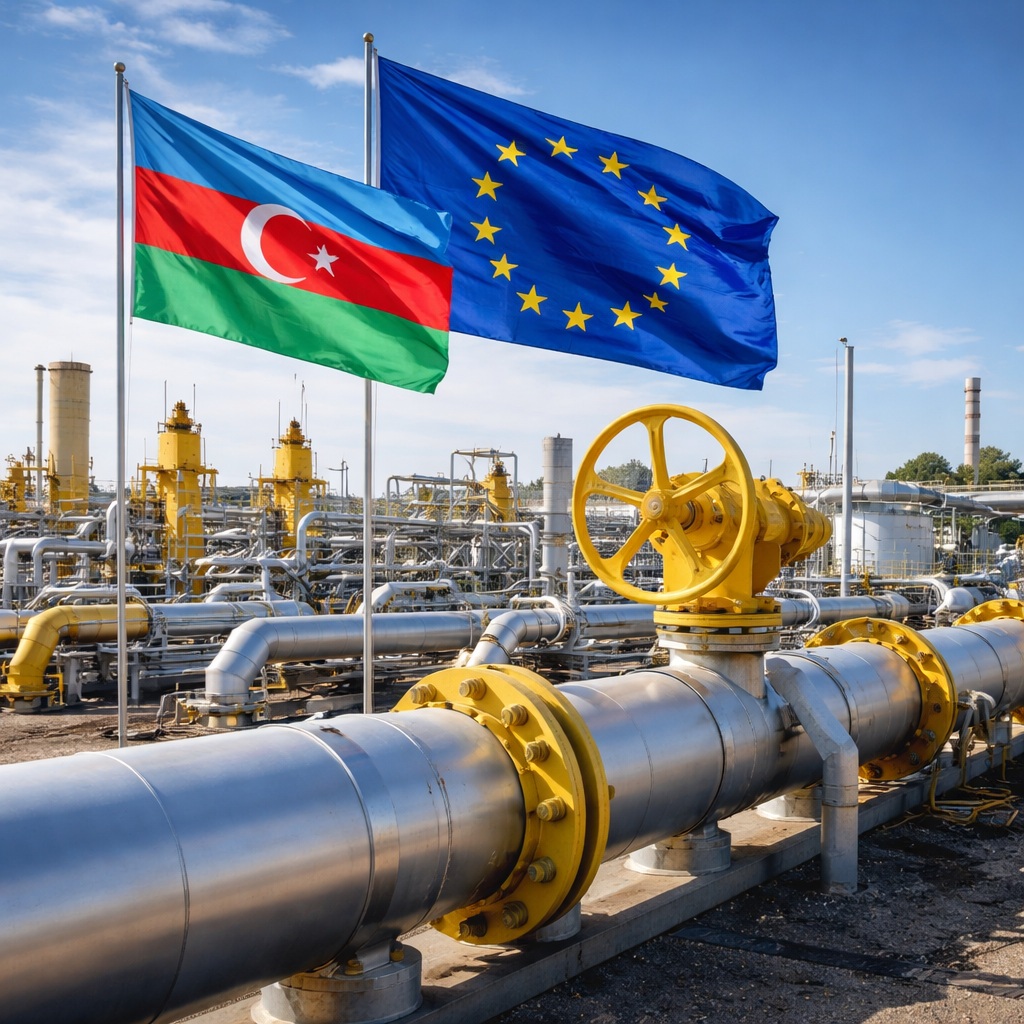
SOCAR’s first deliveries to Western Europe signal a deeper shift in Europe’s energy security strategy
Azerbaijan has begun exporting natural gas directly to Germany and Austria, marking a significant expansion of its role in Europe’s energy landscape. The first flows, delivered by the State Oil Company of the Republic of Azerbaijan (SOCAR), extend the country’s reach beyond Southern Europe into the industrial heart of the continent, reinforcing Europe’s long-term push to diversify energy supplies amid persistent geopolitical strain.
The move reflects months of quiet negotiations between Azerbaijan, European utilities, and transit partners along the Southern Gas Corridor. Until now, Azerbaijani gas had primarily supplied markets in Italy, Greece, and the Balkans. By opening routes toward Germany and Austria, SOCAR is positioning itself as a more central supplier at a moment when European policymakers remain wary of overdependence on any single source.
European officials have framed the development as another layer in a broader resilience strategy rather than a silver bullet. Germany and Austria, both major consumers with complex energy mixes, have spent recent years reshaping procurement portfolios—combining pipeline gas, liquefied natural gas, renewables, and efficiency measures. Azerbaijani gas, they argue, adds flexibility and optionality to that mix.
At the operational level, the deliveries rely on existing infrastructure that has been incrementally expanded and optimized. Gas produced in Azerbaijan’s Caspian fields travels westward through the Southern Gas Corridor before connecting with Central European networks. Industry sources say the initial volumes are modest but scalable, designed to test commercial arrangements and logistical coordination before any potential ramp-up.
For SOCAR, the entry into Western Europe is both commercial and strategic. Company executives have described the step as a natural evolution of Azerbaijan’s long-standing partnership with the European Union. By supplying some of Europe’s most demanding and transparent markets, SOCAR gains pricing benchmarks, credibility, and longer-term contract opportunities—advantages that extend beyond pure export revenues.
The broader context remains one of heightened geopolitical tension. Energy trade has become increasingly intertwined with foreign policy, sanctions regimes, and regional security concerns. In this environment, European governments have sought suppliers perceived as reliable and politically stable, while also avoiding new forms of dependency. Azerbaijan, which has cultivated pragmatic relations with both Western institutions and regional neighbors, has presented itself as a bridge rather than a bloc.
Analysts caution that Azerbaijani gas will not replace other major supply sources, nor is it intended to. Instead, its value lies in diversification. “Every additional corridor reduces systemic risk,” said one energy market analyst in Vienna. “It’s about resilience, not substitution.”
Environmental considerations also shape the debate. European climate targets remain legally binding, and gas is increasingly framed as a transitional fuel rather than a destination. Officials in Berlin and Vienna emphasize that new gas arrangements are paired with accelerated investment in renewables, hydrogen-ready infrastructure, and demand reduction. In that sense, Azerbaijani gas is being positioned as a stabilizer during the transition, not a brake on it.
In Baku, the exports are being portrayed as confirmation of Azerbaijan’s role as a dependable energy partner. Government representatives have pointed to the country’s track record of meeting contractual obligations even during periods of market volatility. They also stress that energy cooperation with Europe extends beyond gas, including discussions on electricity interconnections and future low-carbon projects.
As winter demand tests Europe’s energy systems, the start of Azerbaijani deliveries to Germany and Austria carries symbolic weight. It signals that the continent’s energy map is still being redrawn, corridor by corridor, contract by contract. Whether these new flows grow substantially will depend on market conditions, infrastructure decisions, and the pace of Europe’s energy transition. For now, they stand as another reminder that in an era of uncertainty, diversification has become Europe’s most valuable energy asset.



 The Tower Post