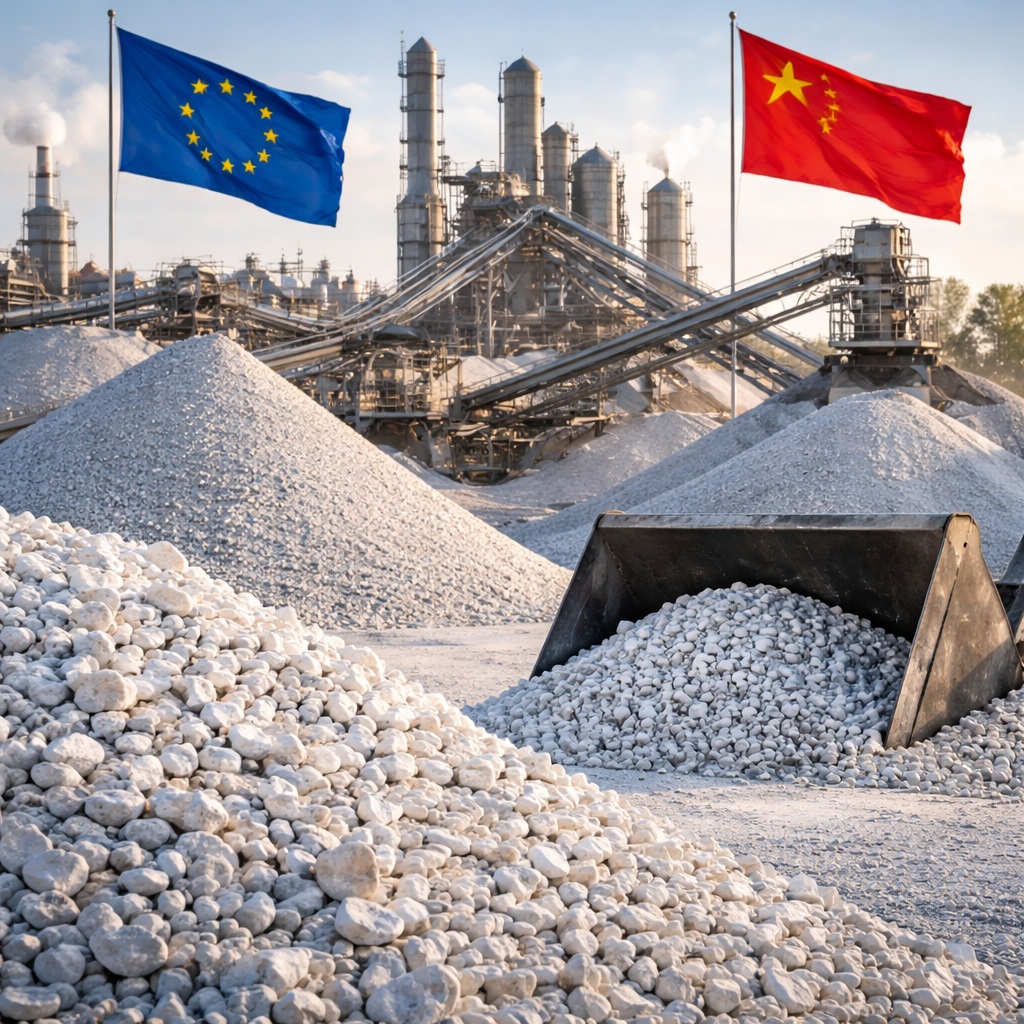
Brussels moves to shield European abrasives producers from alleged unfair pricing as trade tensions with Beijing deepen
The European Union has moved to impose anti-dumping duties on imports of fused alumina from China, marking a significant step in Brussels’ ongoing effort to protect strategic industrial supply chains from what it describes as unfair trading practices. The decision, adopted by the European Commission and endorsed by member states, follows a lengthy investigation into pricing behavior that EU officials say distorted competition in the bloc’s abrasives market.
Fused alumina, a synthetic material derived from alumina and widely used in abrasives, refractories, and high-performance ceramics, sits at the heart of several European manufacturing ecosystems. From automotive components to precision engineering and construction materials, the substance is a quiet but essential input. European producers have long argued that low-priced imports from China were undercutting domestic output, squeezing margins and threatening the viability of plants across several member states.
According to the Commission, the investigation found evidence that Chinese exporters were selling fused alumina into the EU at prices below normal market value. Such practices, Brussels concluded, caused material injury to EU manufacturers, including lost market share, reduced profitability, and delayed investments. The newly imposed duties are designed to level the playing field by raising the cost of imports deemed to benefit from dumping.
“The objective is not to close the European market,” a senior EU trade official said, speaking on condition of anonymity. “It is to ensure that competition takes place on fair terms and that European producers are not forced out by artificially low prices.”
Industry representatives across Europe welcomed the move. Associations representing abrasives and refractory producers described the duties as a long-awaited correction that would allow companies to plan investments with greater confidence. Several firms had warned that continued price pressure could accelerate deindustrialization in regions already struggling with high energy costs and workforce shortages.
“This is about survival,” said an executive at a mid-sized producer in Southern Europe. “We can compete on quality and innovation, but not against prices that do not reflect real production costs.”
Chinese exporters and trade bodies, however, criticized the decision, arguing that it reflects growing protectionism rather than objective analysis. They contend that price differences stem from efficiencies of scale and lower input costs, not dumping, and have urged the EU to reconsider. Beijing has in recent years pushed back strongly against what it views as discriminatory trade measures, raising the prospect of diplomatic friction or retaliatory action.
The duties on fused alumina fit into a broader pattern of EU trade policy that has become more assertive in defending domestic industries. Brussels has increasingly relied on trade defense instruments, including anti-dumping and anti-subsidy measures, as well as new tools aimed at countering economic coercion. Officials argue that these steps are necessary in a global environment marked by overcapacity, state support, and geopolitical rivalry.
At the same time, the Commission has sought to frame the measures as targeted and proportionate. Importers that can demonstrate fair pricing and compliance with EU rules may still access the market, and the duties are subject to review if market conditions change. The EU also maintains that it remains open to dialogue with Chinese authorities to address underlying concerns.
For downstream industries that rely on fused alumina, the impact may be mixed. Some buyers fear higher input costs, while others believe that a healthier European supply base will ultimately enhance reliability and resilience. Supply chain disruptions in recent years have underscored the risks of overdependence on single sources, adding weight to arguments for local production.
As the duties take effect, attention will turn to how the market adjusts. European producers are expected to regain some pricing power, while Chinese exporters may seek alternative destinations or adjust their strategies. The case is likely to be closely watched by other sectors facing similar pressures, as it offers a glimpse into how the EU intends to navigate trade relations in an era of heightened economic competition.
For now, Brussels has sent a clear signal: access to the European market comes with expectations of fair play. Whether the measure will stabilize the fused alumina industry without provoking broader trade tensions remains an open question, but the decision underscores the EU’s determination to defend its industrial base as it looks to the future.




 The Tower Post