A government-backed petition challenges EU support for Kyiv as Hungary’s prime minister seeks to consolidate his base
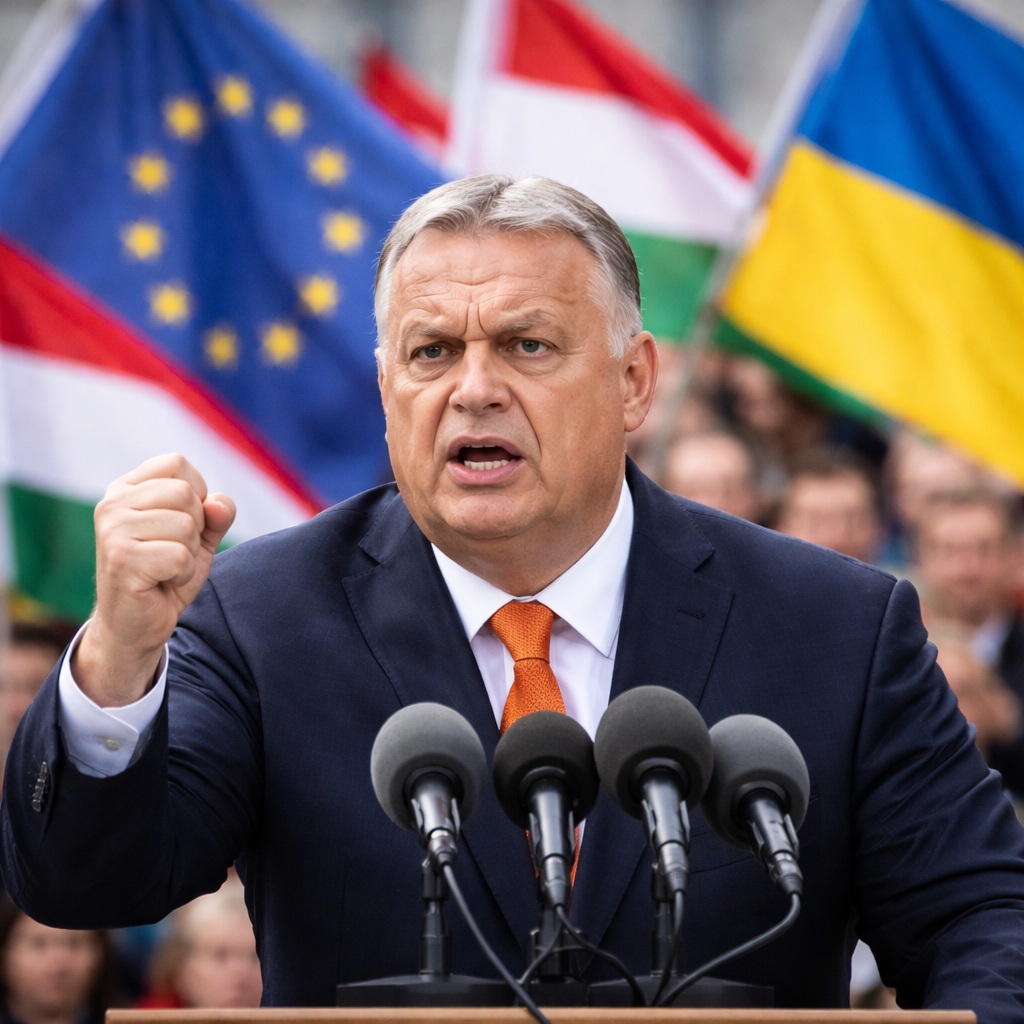
By early winter, Hungary’s political landscape has hardened into familiar lines of confrontation. Prime Minister Viktor Orban, facing a decisive parliamentary election in the spring, has intensified a campaign that places opposition to European Union support for Ukraine at the center of domestic politics. The move underscores Orban’s long-running strategy of framing Brussels as an external force threatening Hungarian sovereignty, while recasting the war next door as a burden imposed on ordinary citizens.
At the heart of the new push is a nationwide petition launched by the government, urging voters to reject continued EU assistance to Ukraine. Presented as a “national consultation,” the initiative asks Hungarians to weigh in on whether the bloc should keep financing Kyiv’s defense and reconstruction efforts. While officially non-binding, such consultations have become a hallmark of Orban’s rule—tools to legitimize policy positions already embraced by his ruling Fidesz party.
Government billboards, talk shows, and social media channels have amplified the message, warning that EU aid to Ukraine risks dragging Hungary into a prolonged conflict, raising energy prices, and undermining national interests. Officials argue that Hungary should remain neutral and prioritize economic stability at home. The campaign’s language echoes themes Orban has refined over more than a decade in power: skepticism toward liberal Western policies, resistance to what he calls “war psychosis” in Brussels, and a promise to shield Hungarian families from external shocks.
Critics see a different calculation. With the opposition fragmented and struggling to find a unifying message, the Ukraine issue offers Orban a clear mobilizing wedge. “This is not about consultation; it’s about turnout,” said a Budapest-based political analyst. “The government wants to activate its core voters by presenting the election as a choice between peace and war, sovereignty and submission.”
Hungary’s stance has repeatedly put it at odds with EU partners. Since Russia’s full-scale invasion of Ukraine, Budapest has slowed or diluted several EU measures aimed at supporting Kyiv, from sanctions packages to financial assistance. While Hungary has allowed humanitarian aid to transit its territory, Orban has refused to send weapons and has criticized what he describes as an open-ended commitment by the bloc. Diplomats in Brussels privately express frustration, noting that unanimity rules give Budapest outsized leverage at critical moments.
The petition campaign taps into genuine public anxieties. Hungary remains heavily dependent on Russian energy supplies, and inflation has left many households wary of further economic strain. Government messaging links EU aid to Ukraine with higher costs at home, even as independent economists argue that the relationship is far more complex. Still, the narrative resonates in a country where state-aligned media dominates much of the information space.
Opposition parties have denounced the initiative as misleading and cynical. They accuse the government of exploiting the war for electoral gain while isolating Hungary within the EU. Some have attempted to counter with their own outreach, emphasizing solidarity with Ukraine and the long-term security benefits of a united European response. But their voices struggle to match the scale and resources of the state-backed campaign.
The stakes extend beyond Hungary’s borders. As one of the EU’s most vocal dissenters on Ukraine policy, Orban’s electoral fortunes are closely watched in European capitals. A renewed mandate could embolden Budapest to continue blocking or reshaping common positions, complicating efforts to maintain cohesion as the war grinds on. Conversely, any significant erosion of Fidesz’s support would be read as a signal that the strategy carries political risks.
For now, the prime minister shows no sign of retreat. In speeches and interviews, Orban portrays himself as a lone defender of national interest against a pro-war consensus, insisting that history will vindicate Hungary’s caution. Whether voters accept that framing will become clear when they head to the polls. Until then, the anti-Ukraine campaign is set to remain a dominant—and divisive—feature of Hungary’s political debate.



 The Tower Post