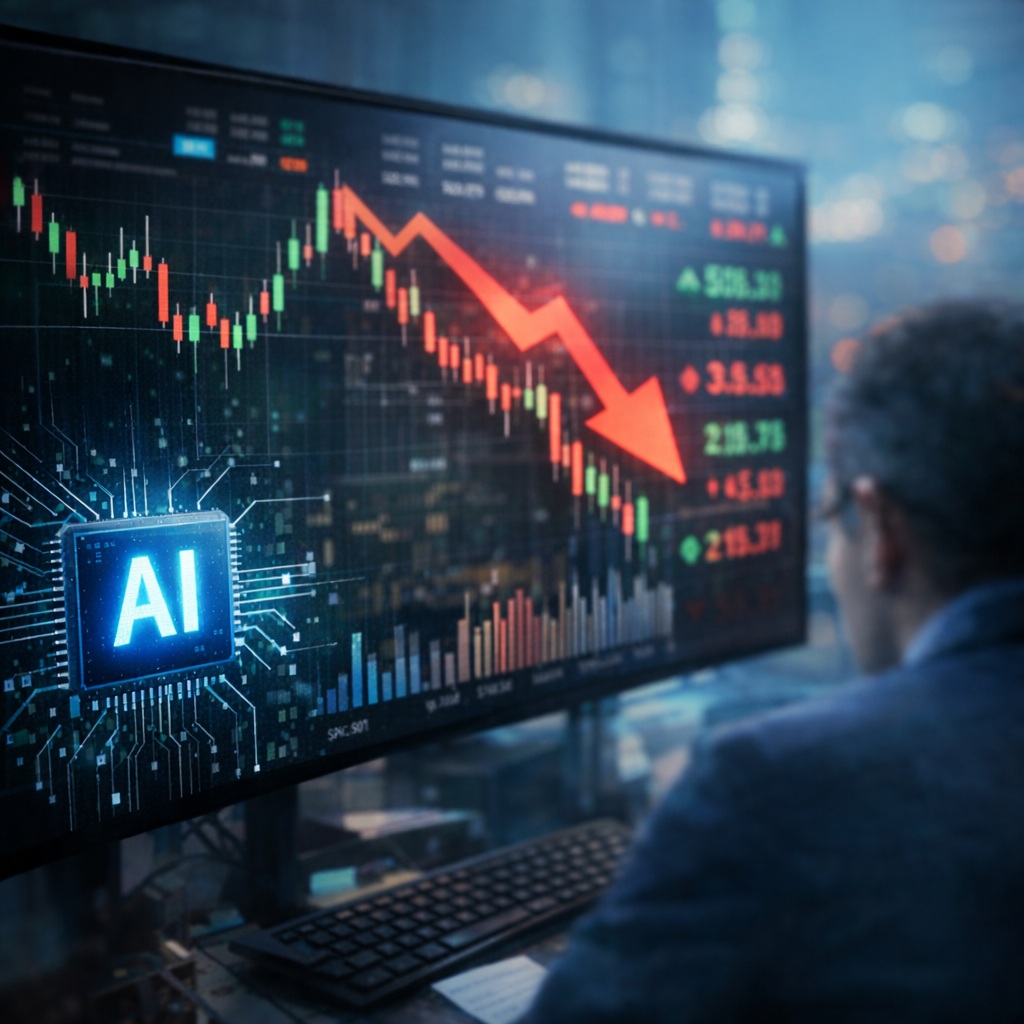
Economists warn of a bifurcated market where artificial intelligence leaders pull ahead while much of the broader tech sector faces flat or declining prospects.
As global markets move through the early weeks of 2026, technology stocks are entering the year under a cloud of uncertainty. After more than a decade in which digital companies largely set the pace for equity markets, analysts now describe a more fragile and uneven landscape. Artificial intelligence remains a powerful growth engine, but outside that narrow segment, confidence is eroding.
Surveys of economists and market strategists indicate that around 58% expect non-AI technology stocks to post flat or falling performance this year. Their outlook reflects a convergence of pressures: slowing global growth, restrictive financial conditions in several major economies, and rising skepticism over whether long-standing valuations can still be justified.
A Divided Technology Sector
The defining feature of the current market is divergence. On one side stand a relatively small group of companies tied closely to artificial intelligence infrastructure and applications. These firms continue to attract capital on expectations that AI will reshape productivity across industries, from manufacturing and logistics to healthcare and finance.
On the other side lies the broader technology sector: hardware manufacturers, legacy software providers, consumer electronics firms, and digital platforms whose growth rates have cooled. For many of these companies, revenues are stable but no longer accelerating, while costs remain elevated due to labor pressures, energy prices, and sustained investment requirements.
“This is no longer a story of technology moving as one,” said a senior portfolio strategist at a European investment firm. “Investors are making sharp distinctions between companies clearly leveraged to AI adoption and those that are not.”
A Cautious Global Outlook
Across regions, the tone is notably restrained. In North America, higher borrowing costs have slowed corporate spending on IT upgrades, particularly among small and mid-sized businesses. In Europe, regulatory scrutiny and subdued economic growth continue to weigh on sentiment, especially for platform companies facing tighter rules on data use and competition.
Asia presents a mixed picture. Some markets benefit from continued demand for advanced semiconductors and AI-related hardware, while others struggle with softer consumer electronics sales and geopolitical uncertainty. Supply chains are more resilient than in previous years, but they are also more expensive, compressing margins for manufacturers.
Taken together, these conditions explain why economists are reluctant to forecast a broad technology rebound. Instead, many expect selective gains concentrated in AI-linked niches, offset by stagnation or declines elsewhere.
Valuations Under Pressure
Valuation concerns sit at the center of investor unease. Even after periods of correction, many technology stocks still trade at levels that assume strong long-term growth. With global demand cooling and competition intensifying, those assumptions are increasingly under scrutiny.
Investors are also less willing to overlook weak cash flow or delayed profitability. In earlier cycles, abundant liquidity allowed companies to prioritize expansion over earnings. That tolerance has diminished. Firms unable to demonstrate a clear path to sustainable profits are facing higher capital costs and diminishing investor patience.
This shift is particularly visible in non-AI software and digital services, where subscription growth has slowed and customer churn has increased. In the current environment, even modest earnings disappointments can trigger outsized market reactions.
AI: Promise and Volatility
Artificial intelligence remains the bright spot, but it is not without risk. Expectations are exceptionally high, and competition is intensifying as both new entrants and established players race to scale models, secure data, and expand energy-intensive infrastructure.
There are also broader economic questions. While AI promises productivity gains, those benefits may take time to materialize across the wider economy. In the near term, heavy capital expenditure on data centers and chips could strain balance sheets, particularly if demand projections prove overly optimistic.
Some economists warn that enthusiasm for AI itself could become a source of volatility. When a large share of expected growth is concentrated in a small number of stocks, markets become more sensitive to sudden shifts in sentiment.
What Markets Are Watching
As the year progresses, investors are expected to focus on a handful of indicators: corporate technology spending trends, earnings guidance from major firms, and policy signals from governments and central banks. Any easing in financial conditions or renewed fiscal support could improve sentiment, while additional tightening or regulatory shocks would reinforce caution.
For now, the prevailing mood is one of guarded realism. Technology remains central to long-term economic transformation, but the era of broad, sector-wide gains appears to be over. In 2026, success in tech investing is increasingly about selectivity and risk management rather than momentum.
Uncertainty, once a temporary feature of the market, has become its defining characteristic. As artificial intelligence lights the path forward for a select group of companies, much of the broader technology sector faces a more challenging and uncertain year.




 The Tower Post