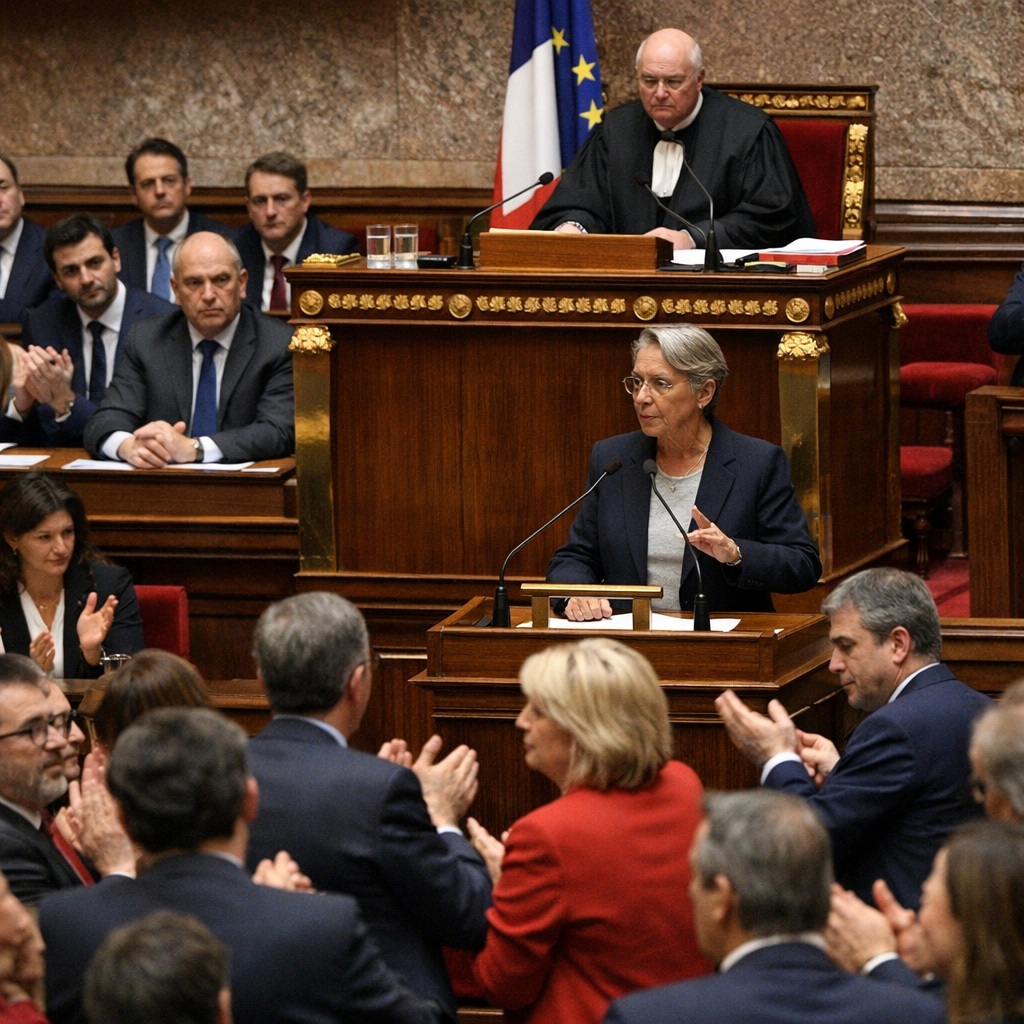
Budget tensions and political fragmentation push the executive into a defining parliamentary moment
France’s government is facing one of its most delicate moments of the current parliamentary cycle as two no-confidence motions converge in the National Assembly, exposing deep political fractures and sharpening debates over economic direction, social priorities, and the limits of executive authority.
The motions, initiated by opposition forces from different ends of the political spectrum, reflect mounting frustration with the government’s handling of fiscal policy and its broader reform agenda. While no-confidence votes are a familiar feature of France’s constitutional architecture, the coincidence of two such challenges has intensified pressure on the executive and raised questions about the stability of governance in Paris.
At the heart of the confrontation lies the state budget, traditionally one of the most contentious moments in the legislative calendar. Opposition parties argue that the government has relied excessively on procedural tools to push through budgetary measures, sidelining parliamentary debate at a time of economic uncertainty. Rising living costs, strained public services, and concerns over debt reduction strategies have all fed into a narrative of executive overreach.
Critics from the left have framed the budget as socially unbalanced, accusing the government of protecting higher-income households and corporations while asking ordinary citizens to absorb austerity through reduced public spending. Trade unions and civic groups have echoed these concerns, warning that cuts to welfare, healthcare, and local government funding risk widening social inequalities and undermining cohesion.
From the right, the criticism has taken a different tone but no less forceful. Conservative and nationalist lawmakers have denounced what they see as fiscal irresponsibility and a lack of structural reform. They argue that the government has failed to control public expenditure or articulate a credible long-term economic strategy, leaving France vulnerable in an increasingly competitive global environment.
These parallel critiques have converged in the form of two no-confidence motions, each grounded in distinct political visions but united by a shared objective: to challenge the government’s legitimacy and constrain its room for maneuver. Although the executive has survived similar tests in the past, the current configuration of the Assembly makes the outcome less predictable.
France’s fragmented парламент has complicated governance since the loss of an outright majority by the ruling coalition. Without a stable majority, the government has been forced to negotiate issue by issue, often relying on constitutional mechanisms designed to prevent legislative deadlock. While legal, these tactics have fueled resentment among lawmakers who feel marginalized from the decision-making process.
The Prime Minister has defended the government’s approach, insisting that the budget reflects a necessary balance between fiscal discipline and social protection. Officials argue that difficult choices are unavoidable given international economic pressures, inflationary risks, and commitments to European partners. They also stress that rejecting the budget without a viable alternative would create uncertainty and damage France’s credibility.
Behind the procedural battle lies a deeper political struggle over the country’s direction. The no-confidence motions have become a vehicle for broader discontent, allowing opposition parties to signal resistance to reforms ranging from public sector restructuring to taxation and energy policy. In this sense, the votes are less about a single budget than about competing visions of the state’s role in society.
Public opinion adds another layer of complexity. Surveys and street-level sentiment suggest widespread fatigue with political confrontation, coupled with anxiety about purchasing power and economic security. While few voters expect an immediate change of government, many see the parliamentary showdown as symptomatic of a system struggling to reconcile strong executive power with pluralistic representation.
If either motion were to succeed, the consequences would be significant. The government would be forced to resign, opening the door to a new cabinet, a reconfigured majority, or potentially early elections. Even if the motions fail, the episode is likely to leave lasting marks on the legislative agenda, compelling the executive to seek broader compromises or scale back ambitions.
For now, attention in Paris remains fixed on the Assembly, where the votes will serve as a test not only of parliamentary arithmetic but of political endurance. As lawmakers prepare to cast their ballots, the broader question looms: whether France’s institutions can absorb rising polarization without drifting into paralysis.
Whatever the immediate outcome, the twin no-confidence motions underscore a central reality of contemporary French politics: governing without a clear majority demands constant negotiation, and each budgetary battle carries the potential to redefine power relations at the heart of the Republic.




 The Tower Post