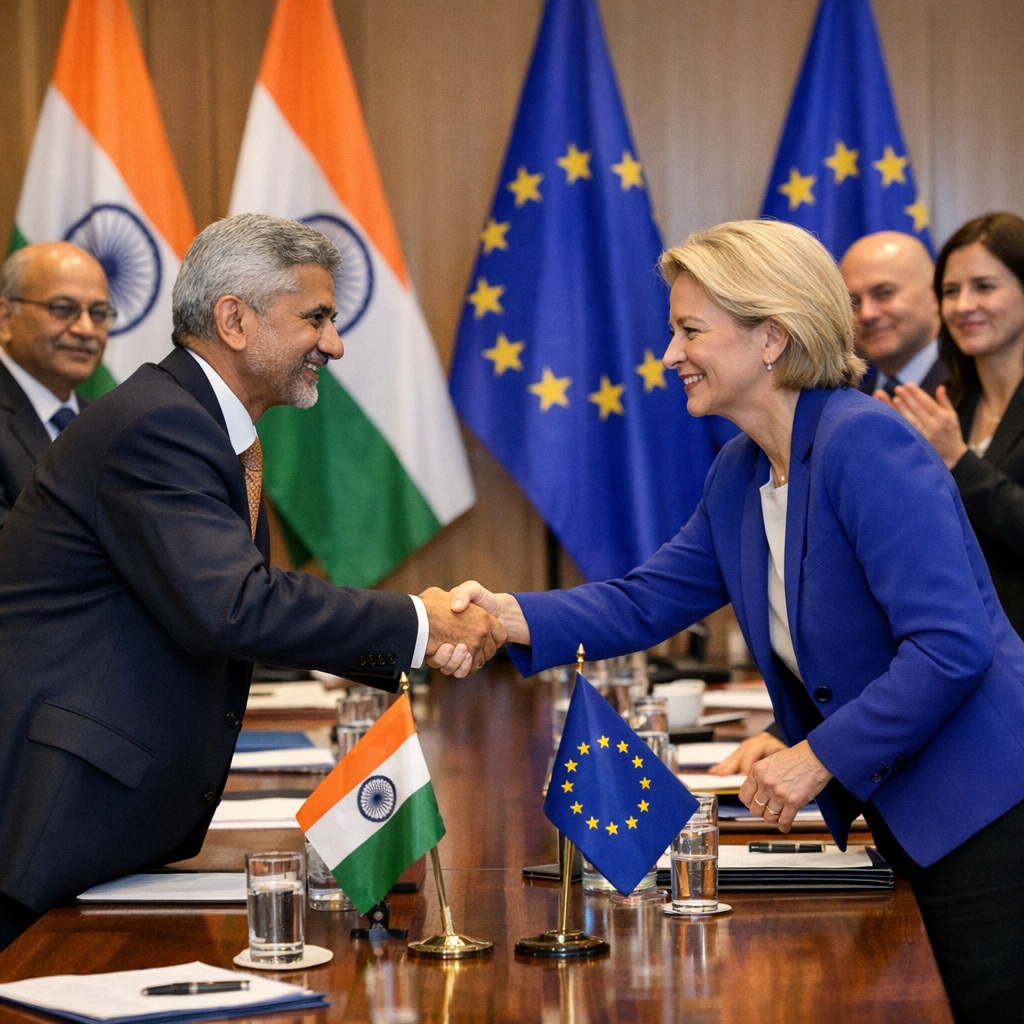
After decades of talks, New Delhi and Brussels signal that a comprehensive agreement is within reach, promising to reshape Asia–Europe commerce amid global uncertainty.
India and the European Union are edging closer to what could become one of the most consequential trade agreements of the decade. After years of intermittent negotiations, missed deadlines, and political hesitation on both sides, officials now say that a long-awaited deal is entering its final stretch, with key chapters nearing closure and remaining differences narrowing.
The renewed momentum comes at a time of heightened global trade tensions. Supply chains remain under pressure, geopolitical rivalries are reshaping commercial alliances, and governments across continents are reassessing their dependence on single markets. Against this backdrop, a comprehensive India–EU trade agreement would not only deepen bilateral ties but also send a broader signal about the future of open, rules-based commerce.
Talks between India and the EU have spanned decades, often advancing in fits and starts. Early ambitions were slowed by disagreements over market access, regulatory standards, labor and environmental provisions, and intellectual property rules. In recent months, however, negotiators from both sides have adopted a more pragmatic tone. Senior officials describe a shared recognition that strategic and economic realities now favor compromise over delay.
For India, closer trade integration with Europe aligns with its broader effort to position itself as a global manufacturing and investment hub. European companies already count among the country’s largest investors, with strong footprints in automotive manufacturing, renewable energy, pharmaceuticals, and digital services. A finalized agreement could lower tariffs, streamline customs procedures, and provide clearer rules for investors, potentially accelerating capital flows and technology transfers.
European policymakers, for their part, view India as a critical partner in diversifying supply chains and reducing overreliance on a limited number of global manufacturing centers. With a large domestic market, a growing middle class, and an expanding industrial base, India represents both an export destination and a production partner for European firms seeking resilience and scale.
Officials familiar with the negotiations say that progress has been particularly notable in areas such as goods trade, services, and investment protection. Discussions on sustainable development and regulatory cooperation have also reportedly moved forward, reflecting the EU’s emphasis on environmental and social standards and India’s interest in preserving policy flexibility while expanding market access.
Agriculture and sensitive industrial sectors remain among the most complex chapters. European producers are keen on greater access to India’s vast consumer market, while New Delhi remains cautious about protecting small farmers and domestic manufacturers from sudden competition. Negotiators say that solutions are being crafted through phased liberalization, safeguard mechanisms, and tailored quotas designed to balance openness with economic stability.
Beyond tariffs and trade flows, the potential agreement carries geopolitical weight. As Asia and Europe recalibrate their economic relationships, a strong India–EU pact could reinforce economic corridors linking the two regions. It would also underline a shared commitment to multilateral principles at a time when unilateral measures and trade disputes are increasingly common.
Business groups on both sides have welcomed the recent signals of progress. European chambers of commerce have highlighted the benefits of clearer regulatory frameworks and dispute-resolution mechanisms, while Indian industry associations emphasize opportunities for exports, skill development, and integration into advanced manufacturing value chains.
Still, officials caution that final hurdles remain. Trade agreements of this scale require political endorsement at the highest levels, as well as careful legal scrutiny before they can be concluded and implemented. Domestic debates within EU member states and in India could yet influence the final shape of the pact.
Despite these uncertainties, the current tone marks a departure from past cycles of optimism followed by stalemate. The sense among negotiators is that the strategic cost of failure has risen, while the economic incentives for success have grown clearer.
If concluded, the India–EU trade agreement would rank among the largest of its kind, linking two major economic blocs across continents. More than a technical trade document, it would reflect a shared bet on cooperation in an era defined by fragmentation. For New Delhi and Brussels alike, the coming weeks may determine whether decades of negotiation finally give way to a new chapter in Asia–Europe economic relations.




 The Tower Post