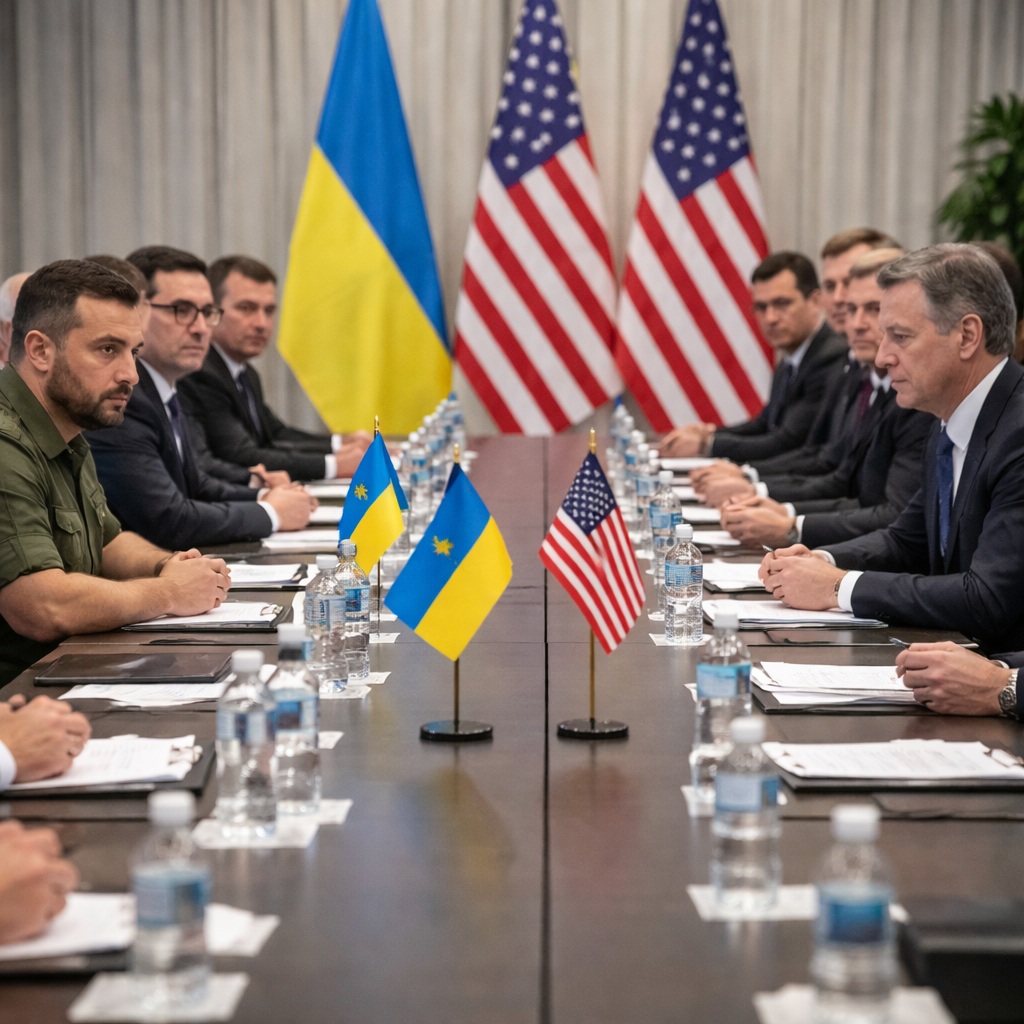
A senior Ukrainian delegation travels to Miami to press for long-term defense guarantees and recovery financing, arguing that continued Russian strikes on energy infrastructure undermine any claim of genuine peace intent.
Ukraine is taking its case directly to the United States again, dispatching a high-level delegation to Miami for a fresh round of security and recovery talks with American officials and policy leaders. The visit comes at a delicate moment in the war, as Kyiv seeks firmer assurances about its future defenses and the financial architecture that would underpin post-war reconstruction, even while the fighting grinds on.
Led by senior figures from the presidential administration, the foreign ministry, and the defense sector, the Ukrainian team is expected to engage with U.S. government representatives, lawmakers, defense experts, and financial institutions. According to Ukrainian officials, the discussions are designed to move beyond short-term military aid and toward binding security guarantees that would deter future aggression once the current phase of the war ends.
For Kyiv, the timing is strategic. The meetings are intended to help shape transatlantic positions ahead of major international gatherings, including the World Economic Forum in Davos, where Ukraine plans to press allies and investors on long-term commitments. Ukrainian diplomats say the Miami talks will focus on aligning political support with concrete financing mechanisms for rebuilding cities, energy systems, and industrial capacity damaged by years of conflict.
At the heart of Ukraine’s message is a warning: despite periodic rhetoric about negotiations, Moscow’s actions on the ground tell a different story. Ukrainian officials point to continued Russian attacks on energy infrastructure as evidence that the Kremlin is not seriously preparing for peace. Power plants, substations, and heating facilities have remained frequent targets, particularly during periods of heightened diplomatic speculation.
“Every strike on our energy system is a signal,” a senior Ukrainian official said ahead of the trip. “It shows that Russia still believes pressure on civilians can deliver political results. That is not the behavior of a party ready for a durable peace.”
The United States remains Ukraine’s most important partner, both militarily and politically. While Washington has provided substantial support since the early days of the invasion, Ukrainian leaders have increasingly emphasized the need for predictability. They argue that clear, long-term security arrangements — whether through bilateral agreements or multilateral frameworks — are essential to stabilize the country and reassure investors that post-war Ukraine will not be left exposed.
American officials, for their part, have signaled continued support but remain cautious about the form and scope of future guarantees. The Miami meetings are expected to explore a range of options, from expanded defense cooperation and training to long-term weapons production partnerships and intelligence sharing. Financing will also be high on the agenda, with Ukrainian representatives seeking U.S. backing to unlock private capital and international lending for reconstruction.
Energy security is likely to be a central theme. Ukraine’s power grid has survived repeated waves of attacks, but officials warn that resilience has limits. Rebuilding the energy sector is not only a humanitarian necessity but also a strategic priority, as stable electricity supplies are critical for economic recovery and social cohesion. Kyiv is pushing for investment in decentralized and renewable energy systems that would be harder to disrupt in any future conflict.
Beyond the technical details, the delegation’s visit carries symbolic weight. By choosing Miami, a hub for international finance and political networking, Ukraine is signaling that its recovery is not a distant, abstract project but an urgent, investable reality. Officials hope to convince U.S. partners that planning for post-war Ukraine must proceed even before the guns fall silent.
The trip also reflects a broader Ukrainian diplomatic push to keep the war high on the international agenda. As global attention is pulled in multiple directions, Kyiv fears fatigue among allies. Senior officials argue that sustained engagement now is cheaper — politically and financially — than confronting renewed instability in Eastern Europe later.
In conversations with U.S. counterparts, Ukrainian delegates are expected to stress that security guarantees and reconstruction funding are two sides of the same coin. Without credible defenses, rebuilding efforts could stall; without economic recovery, long-term security would remain fragile. The message is one of interdependence: peace, when it comes, must be backed by institutions, money, and commitments that endure.
As the delegation prepares to carry its arguments onward to other international forums, Ukrainian leaders remain blunt about the stakes. They insist that Russia’s continued pressure on civilian infrastructure leaves little room for complacency. Until attacks stop and binding assurances are in place, they argue, Ukraine must plan for both war and peace at the same time — and ask its partners to do the same.




 The Tower Post