First dedicated security and defence deal targets SMEs and mid-caps, aiming to unlock €200M in strategic investment and strengthen Europe’s industrial resilience
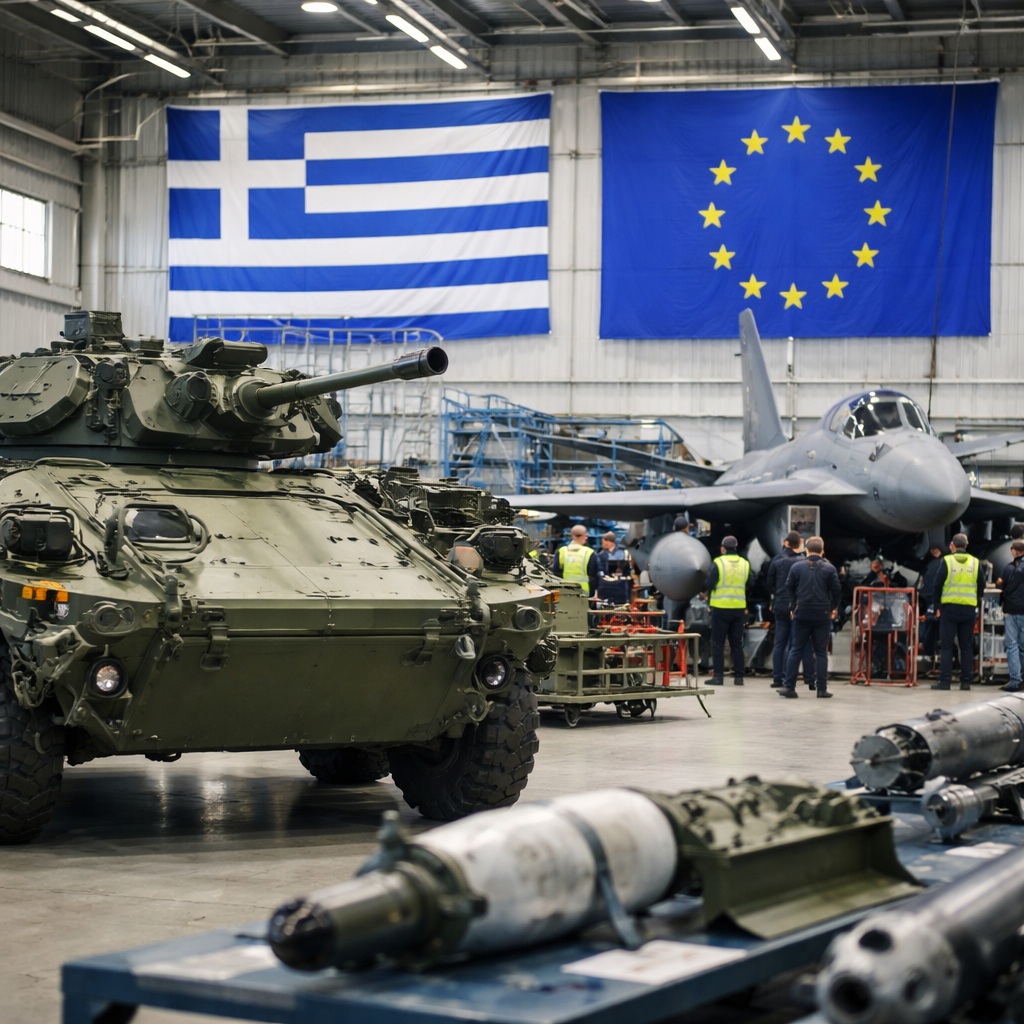
In a move that underscores Europe’s accelerating push to reinforce its strategic autonomy, the European Investment Bank (EIB) has agreed to channel €100 million into Greece’s defence and security sector, marking the institution’s first financing operation in the country dedicated specifically to defence-oriented small and medium-sized enterprises and mid-cap companies.
The initiative, announced in mid-January, is designed to catalyse up to €200 million in total investment by combining EIB financing with private capital. It comes at a moment when European governments are reassessing defence readiness, supply-chain resilience and industrial depth, amid heightened geopolitical uncertainty and sustained pressure to increase security spending within the European Union.
At the centre of the agreement is a structured financing framework that will provide long-term funding to Greek companies active across the defence and security value chain. These include firms involved in advanced manufacturing, electronics, cyber security, dual-use technologies and critical components used in both civilian and military applications. By targeting SMEs and mid-caps, the EIB aims to support the segment of the market often regarded as the backbone of innovation but traditionally underserved by large-scale institutional finance.
EIB officials describe the deal as a strategic milestone. While the bank has gradually expanded its eligibility criteria for security and defence projects in recent years, the Greek agreement represents a concrete shift from policy to implementation at national level. It also signals confidence in Greece’s industrial base, which has undergone significant restructuring and consolidation since the country’s sovereign debt crisis more than a decade ago.
For Greece, the funding arrives at a critical juncture. The country sits at the EU’s south-eastern frontier and has long maintained one of the highest defence spending levels in the bloc relative to GDP. Yet much of this expenditure has historically flowed abroad through major procurement contracts. Policymakers in Athens have increasingly sought to rebalance that equation by strengthening domestic production capacity, fostering export-oriented defence technologies and integrating local firms into European supply chains.
Government officials welcomed the EIB’s involvement as both a financial and symbolic endorsement. By leveraging the EIB’s balance sheet and due-diligence standards, the programme is expected to crowd in private lenders and institutional investors who might otherwise remain cautious about the sector. The ultimate objective is not only to finance individual projects, but to build a more sustainable ecosystem capable of scaling innovation and competing at European level.
From the EIB’s perspective, the operation aligns closely with broader EU policy priorities. Brussels has repeatedly called for deeper coordination of defence investment, warning that fragmented national approaches risk inefficiency and strategic vulnerability. By supporting cross-cutting technologies and industrial capabilities, the bank aims to contribute to a more integrated European defence market while remaining within its mandate to finance projects with clear economic and societal value.
The structure of the financing emphasises long-term investment over short-term procurement. Eligible projects are expected to focus on research and development, production upgrades, digitalisation and energy efficiency within industrial facilities. Particular attention is being paid to dual-use technologies, which can serve both civilian and defence markets, thereby enhancing commercial viability and reducing reliance on volatile government orders.
Industry representatives have cautiously welcomed the announcement. Executives from Greek defence SMEs note that access to patient capital has been one of the main obstacles to growth, especially for companies seeking to move from prototype development to full-scale production. The availability of EIB-backed financing could help bridge that gap, enabling firms to invest in skilled labour, certification processes and export readiness.
However, challenges remain. The Greek defence sector is highly heterogeneous, ranging from state-owned legacy enterprises to agile start-ups. Ensuring that funds are allocated efficiently, transparently and in line with EU competition rules will be critical to the programme’s credibility. There is also the question of timing: transforming industrial capacity is a multi-year process, and tangible results may take time to materialise.
Analysts nevertheless see the agreement as part of a broader trend. Across Europe, public financial institutions are increasingly being called upon to support sectors once considered politically sensitive or commercially marginal. The recalibration reflects a changing security environment and a growing consensus that economic strength and defence capability are deeply intertwined.
In this context, Greece’s deal with the EIB could serve as a template for similar initiatives in other member states with undercapitalised defence industries. By blending public and private finance and focusing on SMEs and mid-caps, the model seeks to balance strategic objectives with market discipline.
As Europe enters a year defined by strategic recalibration, the EIB’s €100 million commitment to Greece’s defence sector stands as a tangible expression of that shift. Beyond the headline figures, its significance lies in the signal it sends: that strengthening Europe’s security increasingly means investing at home, in the industrial and technological foundations that underpin long-term resilience.



 The Tower Post