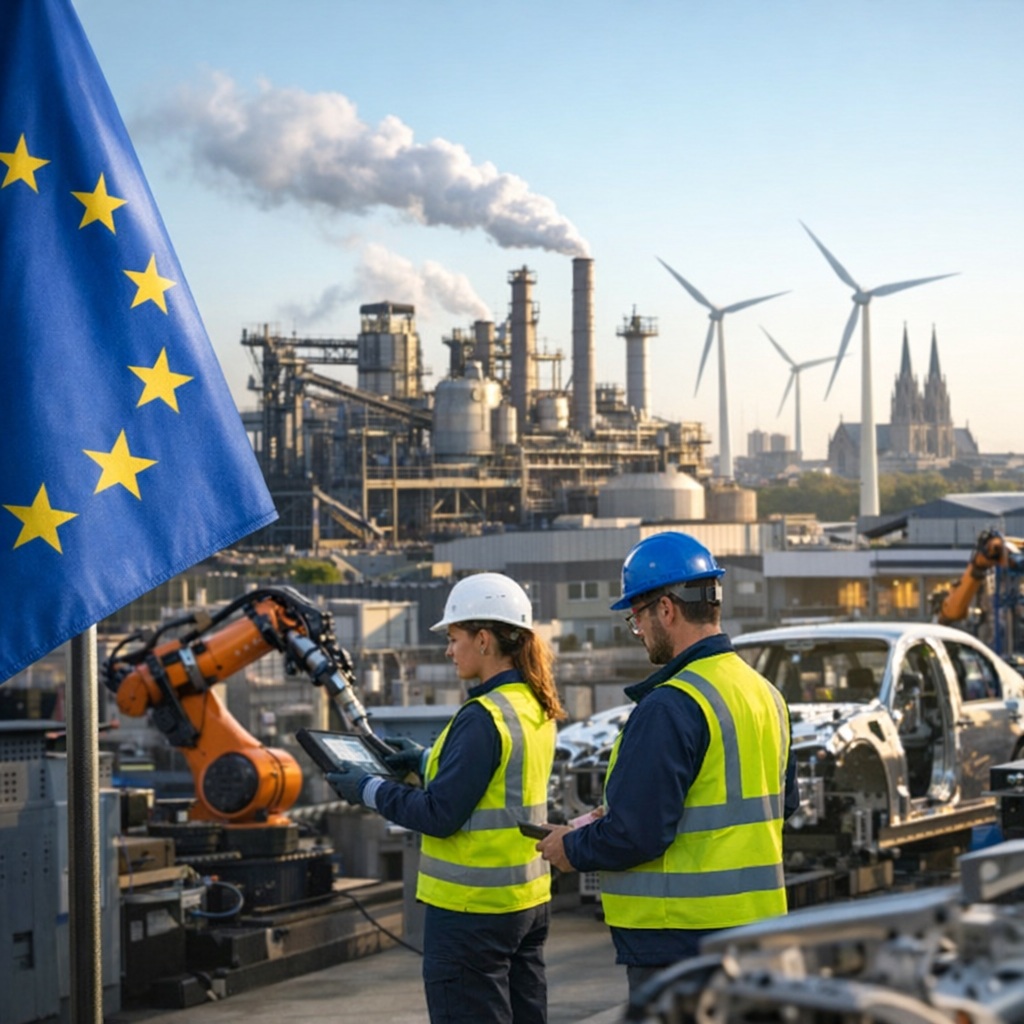
Brussels drafts an Industrial Accelerator Act aimed at shoring up supply chains and competitiveness, tying major foreign investments to technology sharing and local partnerships.
By early January 2026, the European Union finds itself at a crossroads. Years of factory closures, fragile supply chains, and intensifying competition from the United States and China have sharpened a long-running debate in Brussels: how to keep industrial production, innovation, and strategic technologies rooted in Europe without sliding into outright protectionism.
The European Commission’s answer is now taking shape in the form of a proposed “Made in Europe” framework, anchored by a draft Industrial Accelerator Act. The initiative, still under internal discussion, is designed to reverse industrial decline by strengthening European supply chains and ensuring that large-scale foreign investments contribute directly to the bloc’s long-term technological and economic resilience.
At the heart of the draft is a clear political message: Europe remains open to global investment, but access to its vast single market should come with commitments that go beyond capital alone.
A Response to Structural Weakness
European officials acknowledge that the bloc’s industrial base has been under pressure for more than a decade. High energy costs, fragmented capital markets, and slower scaling of new technologies have left many European manufacturers struggling to compete with rivals that benefit from heavier state support elsewhere.
Recent disruptions have exposed the risks of overreliance on external suppliers for critical components, from advanced semiconductors to clean energy technologies. In Brussels, this vulnerability is increasingly framed not just as an economic issue, but as a strategic one.
The Industrial Accelerator Act is intended to address these weaknesses by using the EU’s regulatory and market power to encourage deeper integration of foreign investors into Europe’s industrial ecosystem.
Conditions for Big Investments
According to officials familiar with the draft, the proposed law would apply to large foreign investments exceeding €100 million in sectors deemed strategic. These include advanced manufacturing, digital infrastructure, energy technologies, and other industries critical to Europe’s competitiveness and security.
Rather than imposing blanket restrictions, the Commission is exploring a conditional approach. Foreign companies seeking to make major investments would be expected to enter into partnerships with European firms, research centers, or suppliers. In certain cases, they could also be required to share specific technologies or know-how, particularly where public funding, regulatory support, or fast-track approvals are involved.
The aim, Commission officials say, is to ensure that such investments generate lasting value within Europe, rather than operating as isolated enclaves that can be relocated when conditions change.
“Europe has learned the hard way that simply hosting production is not enough,” said one senior EU official involved in the drafting process. “We need ecosystems, skills, and innovation to stay here.”
Learning from Global Rivals
The proposed approach reflects a broader shift in European industrial policy, influenced by developments abroad. In the United States, massive subsidies tied to domestic production have reshaped investment decisions in sectors such as electric vehicles and semiconductors. China, meanwhile, continues to leverage market access and joint venture requirements to accelerate domestic technological capabilities.
While Brussels has long criticized such practices, there is growing recognition that Europe must adapt or risk falling further behind. The Industrial Accelerator Act stops short of copying foreign models outright, but it borrows the underlying logic: public and market advantages should translate into domestic industrial strength.
Supporters argue that Europe’s rules-based system and emphasis on partnerships can achieve similar results without undermining competition or international commitments.
Balancing Openness and Sovereignty
The draft law is not without controversy. Business groups have warned that additional conditions on foreign investment could deter much-needed capital at a time when Europe is already struggling to finance its industrial transition.
Some member states, particularly those that rely heavily on foreign direct investment, fear that the measures could disproportionately affect their economies. Others, led by larger industrial countries, see the initiative as overdue and necessary.
The Commission is attempting to strike a careful balance. Officials stress that the Act would be targeted, proportionate, and compatible with existing trade rules. Smaller investments would remain unaffected, and companies that demonstrate clear benefits for European supply chains could face lighter requirements.
Still, the political sensitivity is evident. Any perception that Europe is closing its doors could trigger retaliation or complicate relations with key partners.
A Broader Industrial Push
The Industrial Accelerator Act is expected to complement existing EU initiatives, including funding programs for clean technologies, digital infrastructure, and defense-related industries. Together, they form part of a broader effort to move from crisis-driven interventions toward a more permanent industrial strategy.
In internal discussions, Commission President and senior officials have framed the moment as decisive. Europe’s green and digital transitions are accelerating, but without a stronger industrial base, the benefits risk flowing elsewhere.
By tying large investments to technology transfer and local partnerships, Brussels hopes to anchor innovation, jobs, and production within the Union, while maintaining its reputation as a predictable and open market.
What Comes Next
The draft proposal is still being refined and will need the backing of member states and the European Parliament. Negotiations are expected to be intense, with amendments likely as political lines are drawn.
Yet the direction of travel appears clear. As Europe enters the new year, the “Made in Europe” concept is moving from slogan to policy, reflecting a growing consensus that industrial decline is not inevitable, but reversing it will require firmer rules and bolder choices.
Whether the Industrial Accelerator Act can deliver on that promise will depend on its final shape — and on Europe’s ability to act collectively in a far more competitive global landscape.


 The Tower Post