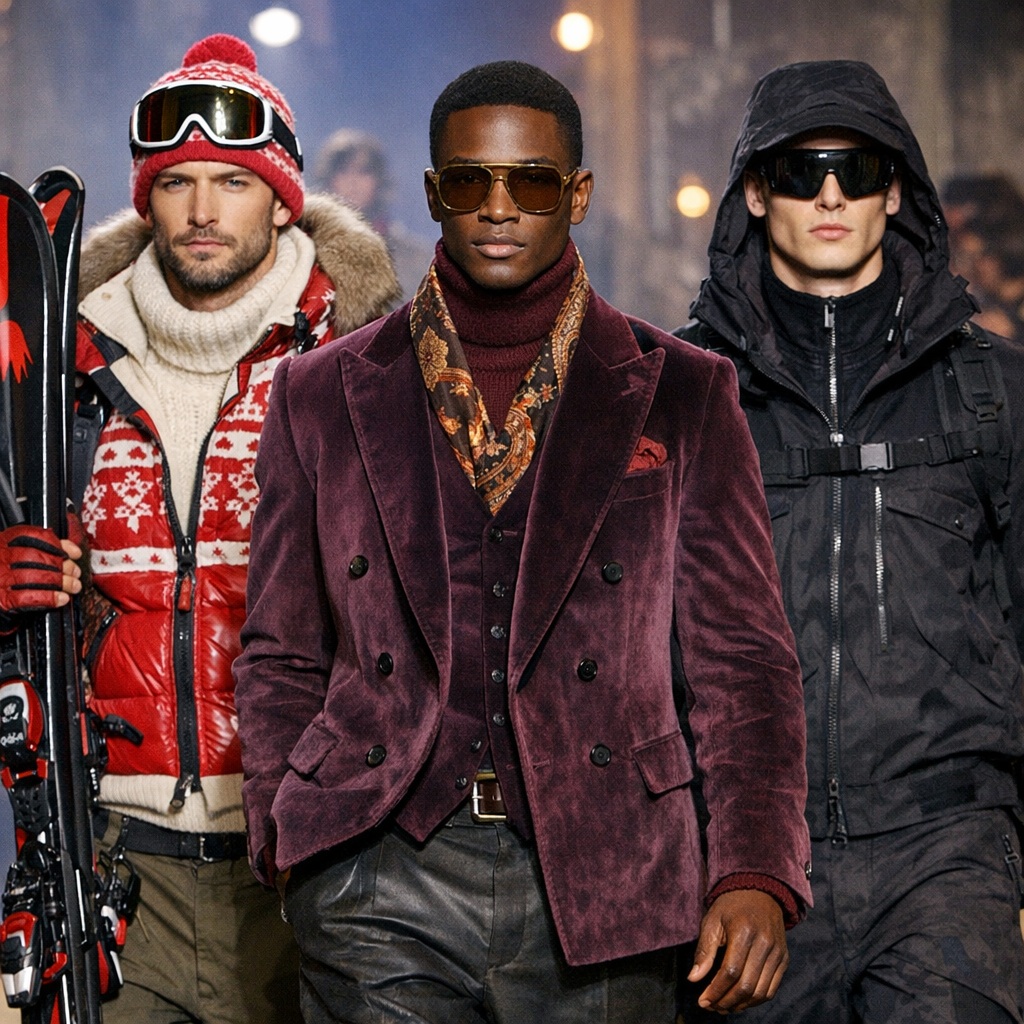
From Dsquared2’s alpine bravado to Paul Smith’s archival intelligence, Milano Moda Uomo signals a confident, forward-looking wardrobe.
Milan woke up this season to a menswear conversation that felt both grounded and quietly ambitious. As buyers, editors, and designers moved between show venues, the prevailing mood at Milano Moda Uomo was not about shock value, but about refinement, resilience, and relevance. Collections presented a wardrobe built for real lives—urban, mobile, and increasingly hybrid—where heritage codes met technical curiosity.
At Dsquared2, the runway leaned into alpine chic with a knowing wink. The brand’s signature bravado was reframed through cold-weather pragmatism: shearling-lined outerwear, heavy knits layered under sharply cut jackets, and boots that suggested both mountain terrain and city asphalt. The collection spoke to escape without fantasy, proposing a rugged masculinity that remains rooted in style rather than costume. Technical nylons appeared alongside traditional wools, reinforcing a dialogue between performance and polish that has become central to contemporary menswear.
The Canadian duo’s show was emblematic of a broader Milanese theme: clothes that acknowledge climate, movement, and utility, without abandoning personality. Outerwear dominated many runways, not as an afterthought but as the foundation of the look. Parkas, duffels, and elongated coats were cut with architectural precision, signaling that protection and elegance are no longer opposing ideas.
Paul Smith offered a different but complementary perspective, turning inward to move forward. His collection mined the brand’s rich archives, reviving color combinations, tailoring tricks, and graphic details from past decades. Yet the result felt anything but nostalgic. Relaxed suits came with softened shoulders and generous trousers, styled with knit polos or fine-gauge sweaters. Color appeared in thoughtful bursts—rust, olive, deep violet—suggesting optimism tempered by experience.
Smith’s strength lay in his ability to make memory feel modern. Prints were reworked digitally, proportions subtly adjusted, and fabrics upgraded with contemporary blends that improve comfort and durability. It was a reminder that innovation does not always announce itself loudly; sometimes it arrives through quiet mastery.
Across the city, other houses echoed this balance between legacy and evolution. Italian tailoring stalwarts continued to refine the suit, loosening silhouettes while preserving craft. Jackets were lighter, often unlined, and trousers sat lower on the waist with fluid movement. The suit, Milan seemed to say, is not disappearing—it is adapting.
Technology played a supporting but increasingly visible role. Smart textiles, weather-resistant treatments, and modular design elements appeared throughout the week. Zippers, snaps, and detachable layers allowed garments to shift function, aligning with a lifestyle that moves between work, travel, and leisure with little pause. The influence of outdoor wear was unmistakable, yet filtered through Milan’s instinct for elegance.
Footwear and accessories reinforced this narrative. Chunky boots, refined sneakers, and hybrid shoes designed for both walking and statement-making grounded the looks. Bags were practical and structured, often worn crossbody or slung over one shoulder, underscoring a hands-free approach to modern dressing.
Color palettes remained largely restrained, favoring earth tones, charcoal, navy, and winter white. When brights appeared, they were strategic—a flash of red lining, a patterned scarf, a vibrant knit under a muted coat. This restraint suggested confidence, an understanding that impact can be achieved through proportion and texture as much as hue.
What emerged most clearly from Milan was a renewed sense of purpose. Designers are responding to a man who values quality, adaptability, and authenticity. The collections acknowledged uncertainty without succumbing to it, offering clothes designed to last beyond a single season, both physically and emotionally.
Milano Moda Uomo did not shout its intentions; it articulated them with clarity. Alpine influences, archival intelligence, and technological nuance came together to form a wardrobe that feels ready—ready for weather, for movement, and for a world that demands both resilience and style. In doing so, Milan once again asserted its role as a compass for menswear, setting a tone that feels measured, modern, and unmistakably confident.

 The Tower Post