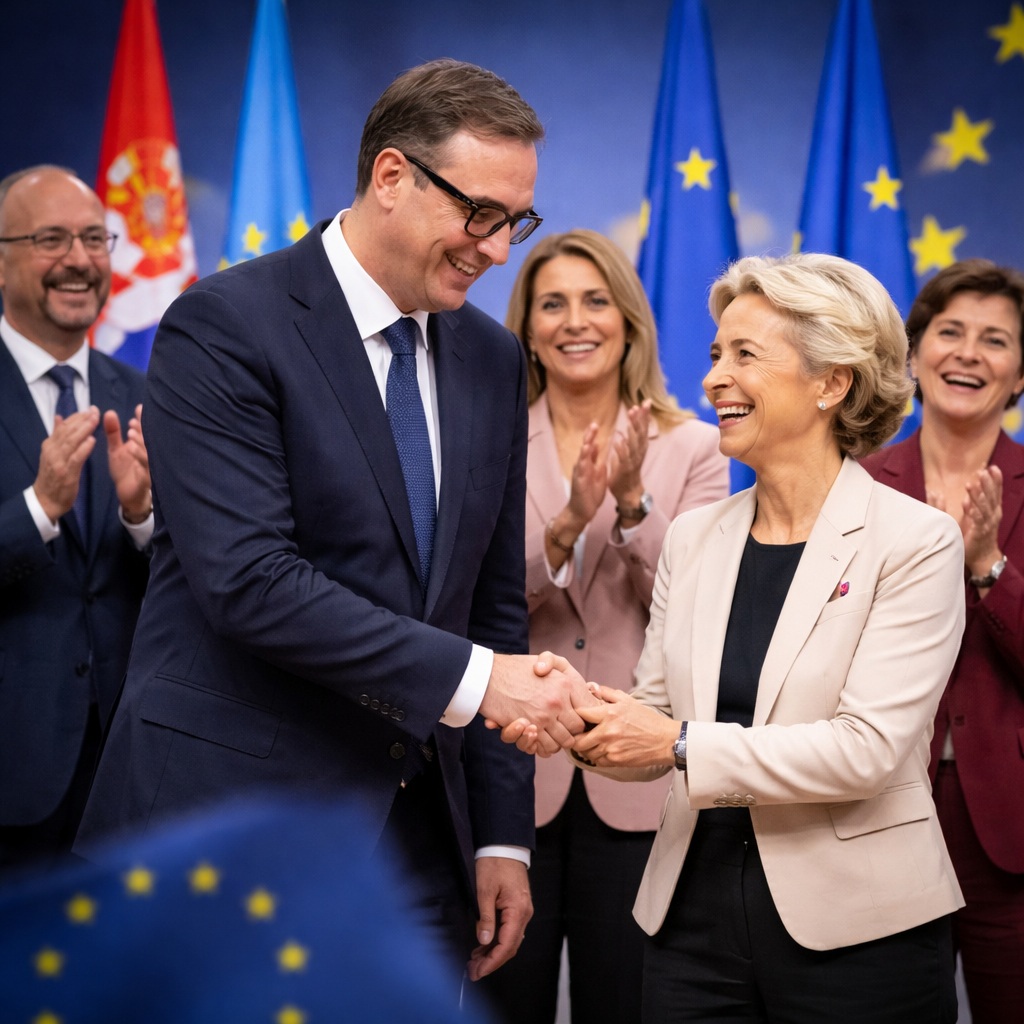
A political roadmap agreed in Brussels signals the end of a long journey, reshaping Balkan integration and the EU’s strategic horizon
Serbia and the European Union have agreed on a political roadmap designed to bring Belgrade’s long-running accession process to a close by the end of the year, marking what leaders on both sides describe as a turning point for Southeast Europe. After months of intensified negotiations in Brussels, the framework lays out the final steps Serbia must complete to become the EU’s newest member, with a sharp focus on judicial reforms and rule-of-law benchmarks.
The agreement reflects a renewed momentum in EU enlargement policy, a process that has often stalled amid political fatigue and competing priorities within the bloc. For Serbia, which formally applied for membership more than a decade ago, the roadmap represents both a culmination and a test: a chance to anchor its future firmly within the European project, while confronting reforms that strike at the heart of state institutions and political culture.
At the center of the deal are commitments to strengthen judicial independence, enhance transparency in public administration, and ensure consistent enforcement of anti-corruption measures. EU officials have long argued that progress in these areas is essential not only for Serbia’s membership credentials, but also for the credibility of the Union’s enlargement policy as a whole. The roadmap translates these principles into concrete milestones, coupled with monitoring mechanisms intended to reassure skeptical member states.
European leaders welcomed the announcement as a historic step toward Balkan integration and long-term regional stability. Several heads of government emphasized that Serbia’s accession would send a powerful signal to neighboring countries that the door to the EU remains open to those willing to meet its standards. In a region marked by unresolved disputes and fragile trust, they argued, full membership could help normalize relations, deepen economic ties, and reduce the space for external geopolitical influence.
For Brussels, Serbia’s progress carries strategic weight beyond the Western Balkans. As the EU seeks to bolster its influence in a rapidly shifting global landscape, enlargement has re-emerged as a tool of geopolitical relevance. Integrating Serbia would extend the Union’s reach in Southeast Europe, strengthening transport corridors, energy connectivity, and security cooperation along one of the continent’s most sensitive fault lines.
Serbian officials, for their part, framed the roadmap as recognition of reforms already undertaken, while acknowledging the scale of work that remains. Government representatives stressed that aligning with EU legal standards is not merely a technical exercise, but a transformation intended to deliver tangible benefits to citizens—more predictable courts, stronger protections for rights, and a business environment better suited to investment and growth.
Public opinion in Serbia remains complex. While support for EU membership has fluctuated over the years, the prospect of a clear endgame has injected new energy into the debate. Business groups and younger voters, in particular, view accession as a pathway to greater mobility, economic opportunity, and institutional stability. Critics, however, warn that reforms must be implemented genuinely rather than symbolically, cautioning against a rushed process driven by political timetables.
Within the EU, the agreement has also revived internal discussions about how enlargement should be managed. Some member states have pushed for stricter conditionality, wary of past experiences where reforms slowed after accession. The roadmap’s emphasis on measurable benchmarks reflects these concerns, aiming to balance political momentum with safeguards that protect the Union’s legal and democratic foundations.
As negotiations enter their final phase, both sides are keenly aware that success will depend on sustained political will. For Serbia, closing the accession process would mark a definitive shift in its post-Yugoslav trajectory, embedding the country within the EU’s legal, economic, and political structures. For the Union, it would reaffirm the transformative promise of enlargement at a time when its future role on the global stage is under intense scrutiny.
If the roadmap is implemented as planned, Serbia’s entry would stand as one of the most consequential enlargements in recent years. More than a symbolic milestone, it would represent a recalibration of Europe’s southeastern frontier—one grounded in the belief that integration, anchored in the rule of law, remains a cornerstone of lasting stability on the continent.


 The Tower Post