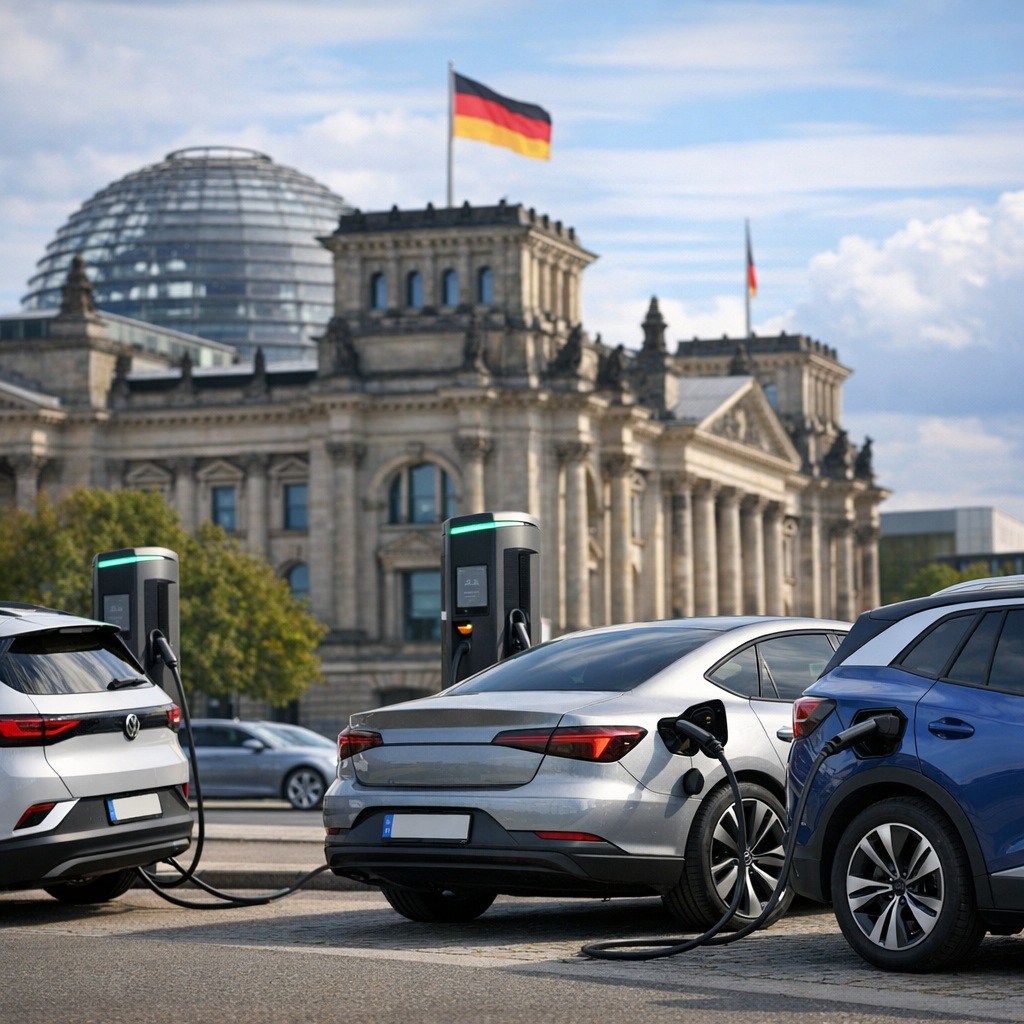
Berlin unveils a multi-year subsidy scheme aimed at restoring competitiveness, accelerating electrification, and anchoring battery production across Europe’s largest economy.

Germany’s government has unveiled a sweeping electric-vehicle support scheme worth €3bn, marking one of the most ambitious industrial policy moves of the current decade. The program, presented as a cornerstone of the country’s economic strategy, is designed to strengthen the competitiveness of German automakers as global competition in electric mobility intensifies.
The initiative comes at a critical moment for Europe’s largest economy. Germany’s traditional automotive sector—long the backbone of its industrial model—is navigating a difficult transition from combustion engines to electric drivetrains. Rising competition from China, shifting consumer demand, and higher energy and production costs have put pressure on manufacturers that once dominated global markets with ease.
Under the new scheme, the federal government aims to provide targeted support across the electric-vehicle value chain. Officials describe the plan as a mix of consumer incentives, production subsidies, and infrastructure investment, all intended to speed up the adoption of electric vehicles while ensuring that manufacturing and innovation remain anchored in Germany.
At the heart of the program is a renewed focus on industrial competitiveness. Policymakers argue that the transition to electric mobility is not only an environmental imperative, but also an economic one. Without decisive intervention, they warn, Germany risks losing market share, technological leadership, and high-quality industrial jobs to faster-moving rivals abroad.
The support package is structured to run through the end of the decade, offering companies greater planning certainty than earlier, short-lived subsidy programs. Government officials stress that long-term visibility is essential for automakers and suppliers making multi-billion-euro investment decisions in new platforms, battery technology, and software-driven vehicle architectures.
A significant portion of the funding is expected to be directed toward domestic production. This includes incentives for the expansion of electric-vehicle assembly lines, support for battery cell manufacturing, and assistance for suppliers adapting their operations to electric drivetrains. By reinforcing local supply chains, Berlin hopes to reduce dependence on imports and shield the sector from geopolitical shocks.
Consumer incentives also play a central role. After previous purchase subsidies were scaled back, electric-vehicle demand in Germany showed signs of slowing. The new scheme seeks to restore confidence among buyers by lowering upfront costs and improving the overall value proposition of electric cars, particularly in the mass-market segment where adoption has lagged.
Beyond vehicles themselves, the program places renewed emphasis on charging infrastructure. Officials acknowledge that concerns over charging availability remain a key barrier to adoption. Funding will therefore support the expansion of fast-charging networks along highways, in urban centers, and in rural areas, aiming to make electric mobility a practical option nationwide.
The announcement reflects a broader shift in Germany’s economic thinking. Long known for its market-oriented approach, Berlin has increasingly embraced a more interventionist industrial policy, mirroring moves by other major economies. Supporters argue that strategic subsidies are necessary to compete in a world where governments elsewhere actively back their own industries.
Industry reaction has been cautiously optimistic. Automakers and suppliers have welcomed the clearer policy direction, while emphasizing that execution will be crucial. Several executives have stressed that subsidies alone cannot solve structural challenges such as high energy prices, regulatory complexity, and labor shortages, which continue to weigh on investment decisions.
Economists are divided on the long-term impact. Some see the scheme as a necessary bridge that gives the automotive sector time to adapt and innovate. Others warn that public funds must be carefully targeted to avoid distorting competition or propping up uncompetitive business models. Much, they argue, will depend on how strictly performance and innovation criteria are applied.
From a political perspective, the program allows the government to signal both economic resolve and climate ambition. Electric mobility remains central to Germany’s emissions-reduction strategy, and officials frame the support scheme as aligning industrial strength with environmental responsibility.
As the plan moves from announcement to implementation, attention will turn to its practical effects. The coming years will reveal whether the €3bn support scheme can help Germany reclaim momentum in electric mobility—or whether deeper structural reforms will still be required to secure the future of its most important industry.




 The Tower Post