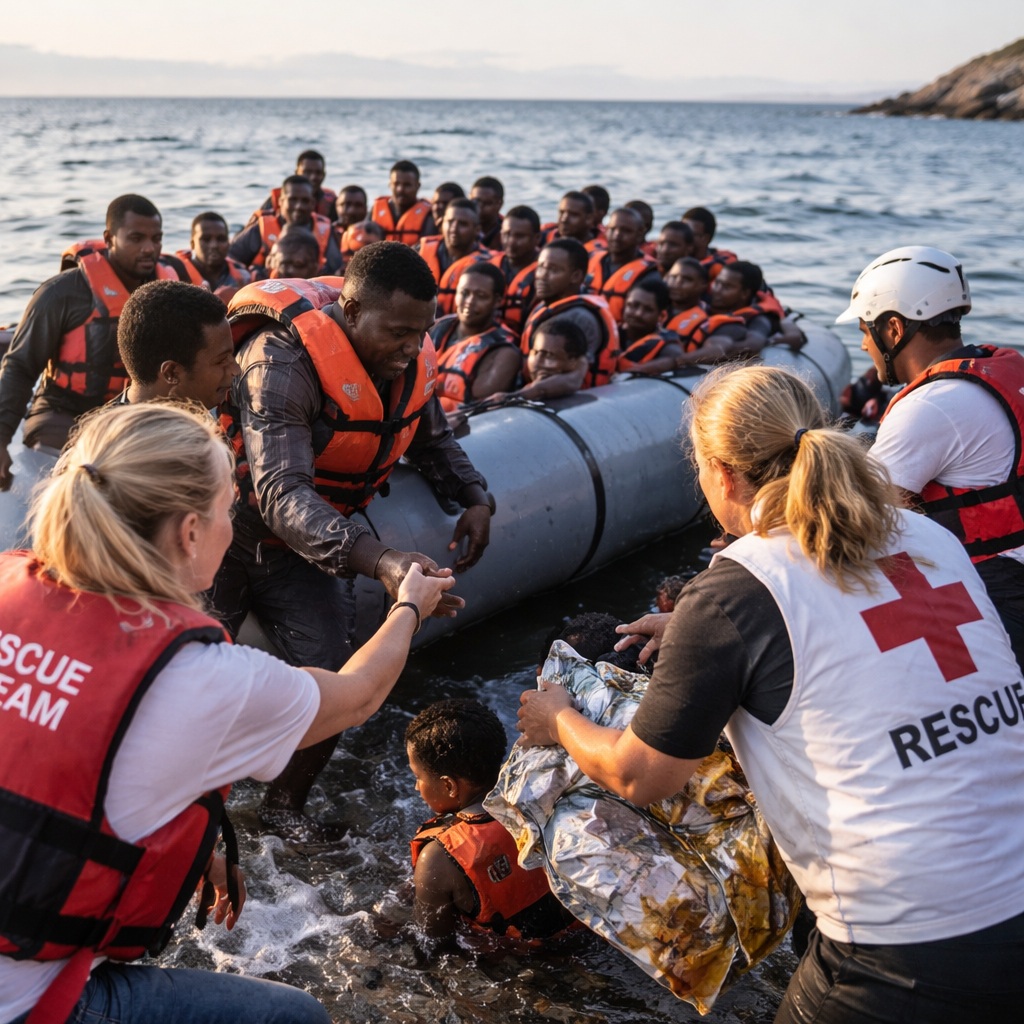
A landmark acquittal closes a long legal chapter and reignites Europe’s debate over migration, borders, and humanitarian action.
In a decision closely watched across Europe, a Greek court has cleared a group of humanitarian workers who had been accused of involvement in migrant smuggling, bringing an end to years of legal uncertainty for the defendants and for aid organizations operating in the Mediterranean.
The ruling concerns 24 defendants, many of them foreign volunteers and aid workers, who were charged in a high-profile case that became emblematic of the tension between border enforcement and humanitarian action. Prosecutors had alleged that the group’s involvement in search-and-rescue operations amounted to facilitation of irregular migration. The court rejected these claims, finding insufficient evidence that the defendants acted with criminal intent.
For those acquitted, the decision closes a prolonged and emotionally draining chapter. Several of the defendants had faced restrictions on their movement and the constant prospect of lengthy prison sentences. Human rights organizations argue that the drawn-out proceedings had a chilling effect well beyond the individuals involved, discouraging volunteers from participating in life-saving operations at sea.
Humanitarian groups welcomed the acquittal as a reaffirmation of the principle that saving lives should not be criminalized. Advocacy organizations noted that the Mediterranean remains one of the world’s deadliest migration routes, and that non-governmental rescue missions often fill gaps left by state authorities. According to these groups, years of legal pressure have undermined trust and cooperation, making it harder to respond effectively to distress calls.
Greek authorities, for their part, have consistently maintained that they must enforce national and European laws designed to combat human trafficking and organized crime. Officials argue that distinguishing between genuine humanitarian assistance and smuggling networks is essential to maintaining the integrity of border controls. The case has highlighted how blurred that distinction can become in practice, particularly in a region where volunteers, coast guards, and migrants often converge in emergency situations.
The court’s decision comes at a sensitive moment for European migration policy. Several governments continue to push for tougher border measures, while civil society organizations warn that restrictive approaches risk violating international obligations toward refugees and asylum seekers. The acquittal is likely to be cited by campaigners as evidence that current legal frameworks are ill-equipped to deal with the realities of migration by sea.
Legal experts say the ruling could influence similar cases across Europe, where aid workers and volunteers have faced investigation or prosecution for their involvement with migrants. While the judgment does not automatically change legislation, it sends a strong signal about the limits of criminal law when applied to humanitarian contexts.
Beyond the courtroom, the case has fueled a broader public debate in Greece. The country has long been on the frontline of migration into Europe, balancing the demands of border management with the humanitarian consequences of conflict and poverty beyond its borders. The acquittal may prompt renewed discussion about how to support rescue efforts while addressing legitimate security concerns.
As winter seas continue to pose dangers for those attempting the crossing, aid organizations say the need for clarity is urgent. They are calling for policies that protect both borders and basic human rights, arguing that the two should not be mutually exclusive.
For now, the court’s decision offers a measure of relief to those who stood accused and to the organizations that supported them. It also underscores a central question facing Europe: how to reconcile the enforcement of migration laws with the moral and legal imperative to save lives.




 The Tower Post